News groups seek to protect journalists in Afghanistan
Advertisement
Read this article for free:
or
Already have an account? Log in here »
To continue reading, please subscribe:

Digital Subscription
One year of digital access for only $205*
- Enjoy unlimited reading on winnipegfreepress.com
- Read the E-Edition, our digital replica newspaper
- Access News Break, our award-winning app
- Play interactive puzzles
*First annual payment billed as $205.00 + GST for one year. This annual subscription will automatically renew at $233.00 + GST every 52 weeks (10% off the regular annual price of $259.35). Offer available to new and qualified returning subscribers only. Cancel any time.
To continue reading, please subscribe:
Add Free Press access to your Brandon Sun subscription for only an additional
$1 for the first 4 weeks*
- Enjoy unlimited reading on winnipegfreepress.com
- Read the E-Edition, our digital replica newspaper
- Access News Break, our award-winning app
- Play interactive puzzles
*Your next Brandon Sun subscription payment will increase by $1.00 and you will be charged $17.95 plus GST for four weeks. After four weeks, your payment will increase to $24.95 plus GST every four weeks.
Read unlimited articles for free today:
or
Already have an account? Log in here »
Hey there, time traveller!
This article was published 16/08/2021 (1880 days ago), so information in it may no longer be current.
NEW YORK (AP) — The swift Taliban takeover of Afghanistan has news organizations simultaneously trying to cover the story, protect their journalists and families and help people who have done work for them over the past two decades.
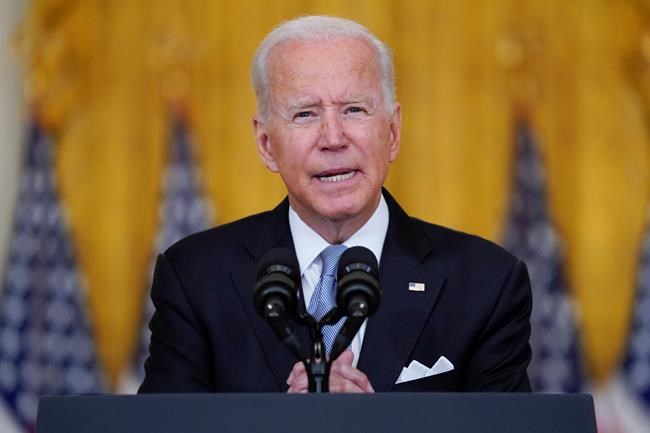
Video of chaotic scenes from the Kabul airport were frequently repeated during news reports of the fast-developing story Monday, which President Joe Biden addressed in a speech to the nation.
CNN reporter Clarissa Ward, in an interview from Afghanistan, said even some Taliban fighters she had spoken to were surprised at the speed with which the country fell.
“I don’t think they ever doubted they would win,” she told The Associated Press. “But I don’t think they anticipated it would happen this quickly.”
Ward’s own reporting from Kabul streets illustrated uncertainties about the country’s future. At one point, she noted that the Taliban had given her permission for CNN to film a report, but she was asked to stand to the side “because I’m a woman.” She adjusted her attire to reflect the takeover by the more culturally conservative forces, wearing a tighter head covering that obscured her hair.
News organizations were continually assessing security needs: At one point NBC News’ Richard Engel said the network had moved out of its office to a safer location. CBS News’ Roxana Saberi reported from her hotel room on “CBS This Morning” on Monday because the facility was on lockdown.
On Monday, Washington Post Publisher and CEO Fred Ryan sent an urgent request for help to the Biden administration on behalf of more than 200 journalists, support staff and families of people who worked for the Post, The New York Times and Wall Street Journal. For safety reasons, they wanted to be transported from the civilian to the military side of the Kabul airport.
In a memo, A.G. Sulzberger, chairman and publisher of The New York Times, said the developments had created a precarious and rapidly changing situation.
“I want to assure you that we are doing everything we can to try to get our staff, former staff, and their families out of harm’s way as soon as humanly possible,” Sulzberger said in a company-wide memo.
The Committee to Protect Journalists said it had fielded requests from 475 journalists in Afghanistan — who work for both local and international news organizations — for help leaving the country, said Maria Salazar-Ferro, the organization’s emergencies director.
CPJ is working with the U.S. military, along with governments in Canada, France, Germany and Britain, to seek landing places for some of these journalists and their families, she said. But for much of Monday, no planes were leaving Kabul.
She said she heard two reports of Taliban soldiers going to homes looking for a specific Afghan journalist. She’s advising journalists to leave the country, but with flights halted, “right now the best advice is to stay in place and wait to see how the situation is developing,” she said.
News organizations, many of them working together, are making day-to-day decisions on where journalists should be deployed for safety reasons. The Associated Press, for example, has two staff members who have left with their families and are reporting remotely from Turkey, but others that are staying in the country.
“The most important thing on any assignment is the security of our team and we take that incredibly seriously,” CNN’s Ward said. “We’re always assessing and evaluating, but for now we feel this is a really important story and we want to keep telling it.”
Ward, working in the country along with another CNN reporter, Nick Paton Walsh, said her biggest concern now is for Afghan journalists.
Safety is always a concern for journalists in unstable countries. The added element in Afghanistan now, as it was previously in Iraq, is the safety of people — not just journalists but drivers, translators and others — who helped news organizations at different points in the 20 years the United States has fought in the country. The AP is seeking visas for what may amount to hundreds of people, including current and former staff, freelancers and their families.
“It’s a moral duty,” said Ian Phillips, AP’s vice president for international news. “They may not work for us now, but they worked for us in difficult years.”
The AP also asked the Biden administration on Monday for help in allowing more commercial flights to land in Kabul, and to allow access on the military side of the airport for charter flights carrying journalists, support staff and their families leaving the country.
Many of the former employees are concerned about their safety, and some are also worried about what the future means economically for their country with the Taliban in control, said Kathy Gannon, AP’s news director for Pakistan and Afghanistan.

“I think people don’t realize how many difficult decisions there are — really, really hard decisions,” Gannon said.
CPJ’s Salazar-Ferro said she’s concerned about a “black hole for news” in Afghanistan with so many journalists looking to leave. But partly with the help of social media, there are other ways of getting news out that didn’t necessarily exist when the war started.
An Indian journalist, Sudhir Chaudhary, posted video that was used frequently showing people trying to hold on to a cargo plane as it taxis down the runway.
The Fuller Project, a nonprofit newsroom dedicated to reporting on women, kept up a steady stream of social media posts. They included a picture of men in Kabul painting over portraits of women on the side of a building, and contributor Zahra Yusufi, who tweeted that “my sister and friends in Kabul say as they were rushing home today, people shouted at them, ‘the Taliban are coming because of you! The Taliban are here to discipline you!’”
“It’s simply not safe for journalists to stay there right now,” Salazar-Ferro said, “especially women journalists.”
Related Articles
Taliban announce 'amnesty,' urge women to join government

Advertisement Advertise With Us
Advertisement Advertise With Us