Legacy of battle
SiR’s production of An Iliad explores war, in Troy and beyond

Advertisement
Read this article for free:
or
Already have an account? Log in here »
To continue reading, please subscribe:

Digital Subscription
One year of digital access for only $205*
- Enjoy unlimited reading on winnipegfreepress.com
- Read the E-Edition, our digital replica newspaper
- Access News Break, our award-winning app
- Play interactive puzzles
*First annual payment billed as $205.00 + GST for one year. This annual subscription will automatically renew at $233.00 + GST every 52 weeks (10% off the regular annual price of $259.35). Offer available to new and qualified returning subscribers only. Cancel any time.
To continue reading, please subscribe:
Add Free Press access to your Brandon Sun subscription for only an additional
$1 for the first 4 weeks*
- Enjoy unlimited reading on winnipegfreepress.com
- Read the E-Edition, our digital replica newspaper
- Access News Break, our award-winning app
- Play interactive puzzles
*Your next Brandon Sun subscription payment will increase by $1.00 and you will be charged $17.95 plus GST for four weeks. After four weeks, your payment will increase to $24.95 plus GST every four weeks.
Read unlimited articles for free today:
or
Already have an account? Log in here »
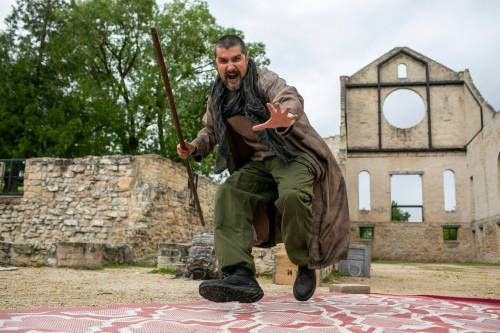
The Trappist Monastery Ruins are enlisted as the stand-in for a bedraggled Trojan battleground in An Iliad, the second production of Shakespeare in the Ruins’ 2026 season.
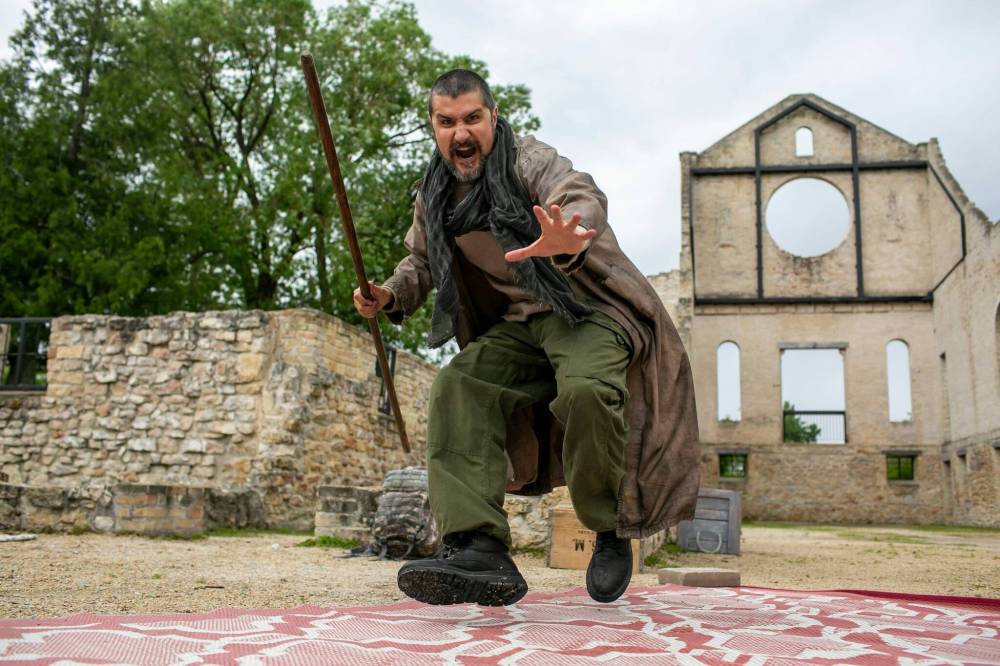
Director Christopher Brauer calls the St. Norbert heritage site — dusty, rugged and incomplete, a reflection of a majestic past fallen into disrepair — the perfect setting for the production’s lone survivor, a road-weary poet played by SiR artistic director Rodrigo Beilfuss, to grapple with tours of duty he might prefer to forget.
“He is not just a person who experienced the war in Troy, but he seems to somehow have been put on earth to travel from battle to battle and from war to war,” says Brauer, who directed Beilfuss in the 2022 Royal Manitoba Theatre Centre production of The Three Musketeers.
BROOK JONES / FREE PRESS
Rodrigo Beilfuss as Homer in An Iliad
The director calls that literary adaptation of a sweeping, romantic epic a romp, where the “heroes are heroes and the villains are villainous.”
But whereas the Dumas classic has captured imaginations for mere centuries, The Iliad has done so for millennia, owing to its honest, brutal and timeless interrogation of “this terrible compulsion we have towards war,” Brauer says.
Written by Lisa Peterson and Tony-winning actor Denis O’Hare amid the American invasion of Iraq in the early 2000s, An Iliad — on to July 5 at the Ruins — draws directly from its source material but makes modernistic digressions: the poet begins his remembrance in the original Greek, but quickly shifts to a contemporary, reflective English.
That diversion from a pure “classical” retelling is key in the playwrights’ outright mission to recontextualize ancient epics to fit the vernacular of modern warfare, says Brauer. “They were interested in writing a play about war that wasn’t a polemic,” he says. “It’s a play that aims to ask questions about the cost.
“It feels very much like a thriller when you’re in it,” he adds.
And any thriller worth its salt needs a commanding, exacting score.
BROOK JONES / FREE PRESS
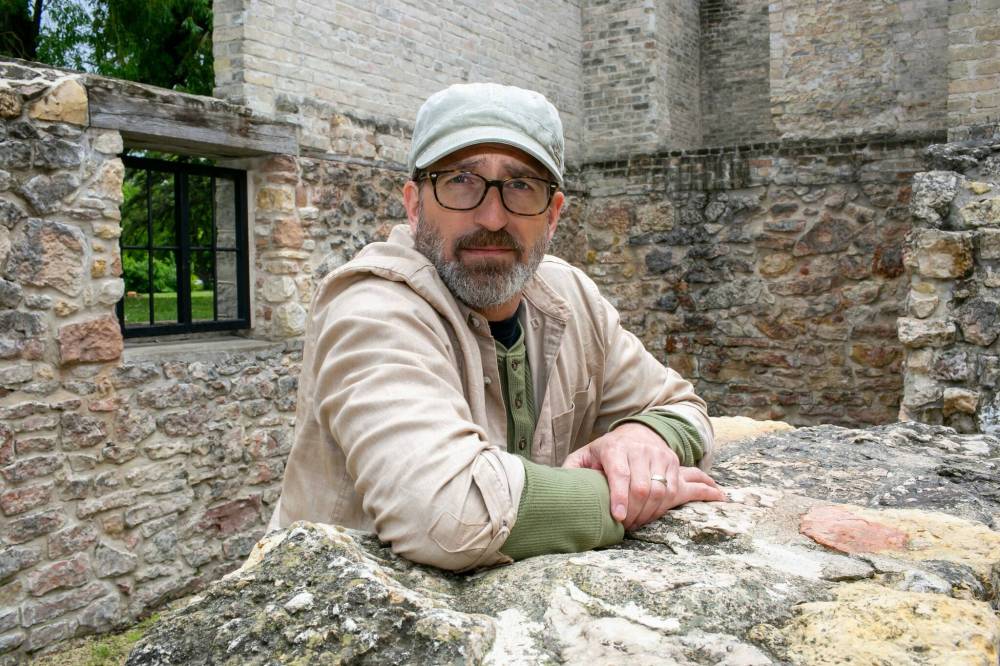
An Iliad director Christopher Brauer
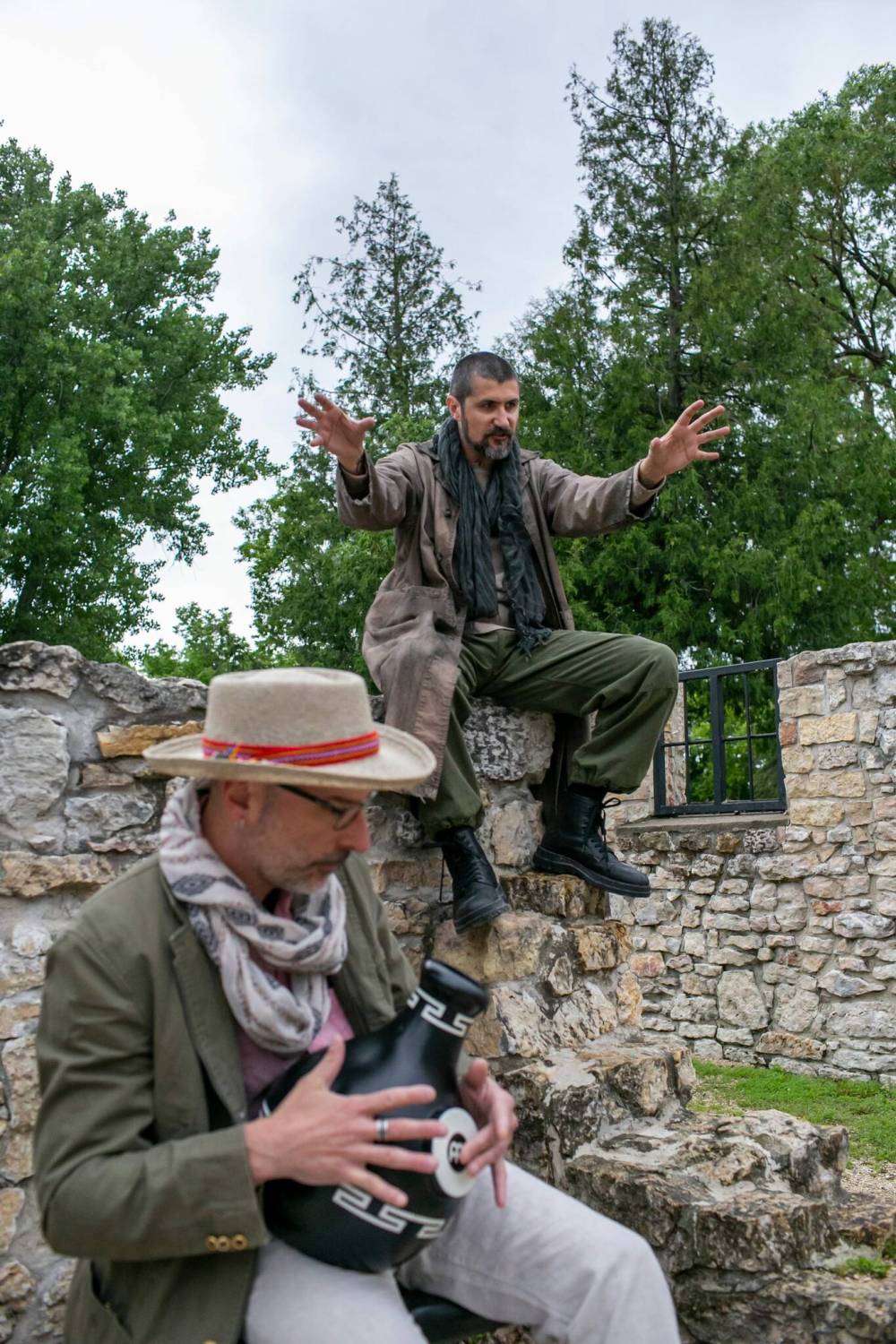
To that end, the production has drafted multi-instrumentalist Daniel Roy, whose onstage muse wanders into the ruined city just as did the poet. “We’ve treated both the poet and the muse very much as if they’re street performers,” says Brauer.
“The poet doesn’t want to do this alone,” says Brauer of the character’s task of martial memory. “So he keeps imploring the muses. Daniel arrives on the scene as the poet’s partner in the telling. Unlike in movie music, which can sometimes feel sentimental, in our case, the music creates the world and interior experience of the story.”
Roy has an elaborate setup that includes percussion, acoustic guitar, bass and pre-recorded sequences. “It has an intensity to it,” the director says.
As does the entire 108-minute performance, a solo endeavour that Brauer says exceeds the typical “talking-head” style in favour of a more gymnastic, mobile storytelling style.
“(Beilfuss) is Homer, the original writer of this poem, this recorder of the history of warfare, and his whole mission is to make this story feel real and immediate,” Brauer says. “He wants to make it feel like it’s really happening.”
BROOK JONES / FREE PRESS
Daniel Roy (left) plays an udu as SiR artistic director Rodrigo Beilfuss plays a poet.
When the poet recalls the dust of a settled battlefield, Beilfuss can kick at the actual stuff, and when the script refers to the ramparts and the walls, the production crew could utilize the actual built environment as a literal jumping-off point.
“There are lots of places to leap and do battle,” says Brauer.
A solo show’s battle scenes look a little bit different than Ben Hur or director Christopher Nolan’s upcoming treatment of The Odyssey.

Brauer, along with fight director Shannon Guile, collaborated with classics scholars, including the University of Winnipeg’s Conor Whately, to bring a sense of realism to the depiction of armed conflict and spear-wielding.
“The style of fighting that normally happens is one person versus another — Petrocles versus everybody or Achilles versus Hector,” says Brauer. With An Iliad, the battle happens inside the vacuum of memory. This character is telling the story not just of the Trojan War, but war in general.
“But there is a struggle to remember because it’s been 3,000 years, and because in the last 100 years or so we’ve wanted to forget. There hasn’t been an urge to invite him to tell us for a while.

BROOK JONES / FREE PRESS
Rodrigo Beilfuss (left) and musician Daniel Roy perform in An Iliad, Shakespeare in the Ruins’ second summer production, which opens today.
“We haven’t focused on that PTSD angle, but it’s printed on the poet throughout the show,” Brauer adds. “It’s more about the human habit of forgetting, because to remember is to ask why we keep doing this.”
winnipegfreepress.com/benwaldman
Ben Waldman covers a little bit of everything for the Free Press.
Our newsroom depends on a growing audience of readers to power our journalism. If you are not a paid reader, please consider becoming a subscriber.
Our newsroom depends on its audience of readers to power our journalism. Thank you for your support.
Theatre preview
An Iliad
Shakespeare in the Ruins
● Trappist Monastery Provincial Heritage Park, St. Norbert
● Opens tonight, runs to July 5
Tickets: $42, or $21.25 for theatre workers, under-30s, or those living on a fixed income.
Ben Waldman covers a little bit of everything for the Free Press.
Our newsroom depends on a growing audience of readers to power our journalism. If you are not a paid reader, please consider becoming a subscriber.
Our newsroom depends on its audience of readers to power our journalism. Thank you for your support.
Advertisement Advertise With Us
Advertisement Advertise With Us