Pelkey’s plugged in
Gallery’s new executive director happy to be leading ‘amazing institution’

Advertisement
Read this article for free:
or
Already have an account? Log in here »
To continue reading, please subscribe:

Digital Subscription
One year of digital access for only $205*
- Enjoy unlimited reading on winnipegfreepress.com
- Read the E-Edition, our digital replica newspaper
- Access News Break, our award-winning app
- Play interactive puzzles
*First annual payment billed as $205.00 + GST for one year. This annual subscription will automatically renew at $233.00 + GST every 52 weeks (10% off the regular annual price of $259.35). Offer available to new and qualified returning subscribers only. Cancel any time.
To continue reading, please subscribe:
Add Free Press access to your Brandon Sun subscription for only an additional
$1 for the first 4 weeks*
- Enjoy unlimited reading on winnipegfreepress.com
- Read the E-Edition, our digital replica newspaper
- Access News Break, our award-winning app
- Play interactive puzzles
*Your next Brandon Sun subscription payment will increase by $1.00 and you will be charged $17.95 plus GST for four weeks. After four weeks, your payment will increase to $24.95 plus GST every four weeks.
Read unlimited articles for free today:
or
Already have an account? Log in here »
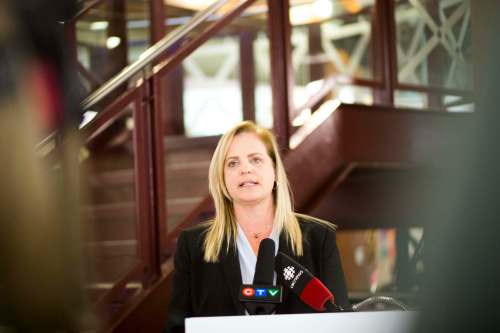
It’s been a busy week for Nadja Pelkey, the newest executive director of the Plug In Institute of Contemporary Art.
After landing in Winnipeg on Saturday, marking her arrival with an at-home banquet of Mexican cuisine and champagne, Pelkey was immediately thrust into the centre of civic conversation Tuesday, attending the Mayor’s Luncheon for the Arts on her second day on the job.
“It’s funny. I was talking to a couple friends of friends of mine at other organizations, and typically, when you come into a new organization, a new institution, there’s a sort of lull in which you can gain your footing and learn before getting very involved,” says Pelkey, who last worked as a programmer and curator with Art Windsor-Essex in Ontario.

Supplied
Plug In ICA executive director Nadja Pelkey couldn’t be happier to make her way to Winnipeg.
Not only was Pelkey in mingle-mode within hours of starting on the Plug In payroll, but the organization’s 11th executive director’s first week also coincided with a “blockbuster” exhibition, Sarah Anne Johnson’s House on Fire, opening tonight at 460 Portage Ave.
Pelkey — the Saskatoon-raised daughter of photographer Brenda Frances Pelkey and the late writer Chester Pelkey — couldn’t be happier to have found her way to Winnipeg, a city whose artistic community she holds up as an axiomatic icon of national excellence.
“I visited Winnipeg as a child; we used to take the train. And then later as an arts student (at the University of Windsor) I remember coming and actually sitting in the audience of a Plug In program, thinking what an amazing institution it was, how great it would be to work somewhere like this some day.
“On Day 2, it seems a bit surreal to actually be here,” she adds. “Especially coming from another Prairie arts community, Winnipeg is held in such high regard. It’s kind of a magical city. The quality of artists here is unmatched by any Canadian city. I would challenge anyone to say that the quality of artists in their city is better than the quality of artists in Winnipeg. I don’t think that there’s any comparison.”
Artists like Sarah Anne Johnson, Lori Blondeau and Shawna Dempsey, “who could work from anywhere in the world, make Winnipeg their home, and I think that says so much not only for the arts community in Winnipeg but the broader community in Winnipeg.”
Pelkey, who received her MFA at the University of Guelph, has a background in studio teaching, photography and digital media. She takes over as executive director from Gilles Hébert, who returned to the directorship in July 2024, taking over for outgoing director Allison Yearwood on an interim basis.

“I’m happy not so much because I’m losing a job — I didn’t really want a job to begin with, so I don’t feel the loss — but I am thrilled that this one has taken this job,” says Hébert, who was previously the executive director from 1989 to 1991.
“During the hiring process, the hiring committee, which I was on as well, (made) the determination that all committee members should reach out and look for people they thought would be appropriate for the job,” he says, returning to the gallery after supping on chicken at the mayor’s luncheon. “I only came up with one, and it was her.”
“I just went to the lunch with her, and she’s working the room, making connections with people, and she knows their histories,” Hébert adds. “It’s amazing — she’s amazing, and we’re really lucky to have her. I like this job, but I’m a little long in the tooth for it, and it’s time for me to move on.”
Founded in 1972, Plug In will release 50/10, featuring 10 chapters authored by the organization’s executive directors over its first 50 years, in August through its publishing arm, Plug In Editions. Each chapter has its own distinct graphic designer and editor.
winnipegfreepress.com/benwaldman
If you value coverage of Manitoba’s arts scene, help us do more.
Your contribution of $10, $25 or more will allow the Free Press to deepen our reporting on theatre, dance, music and galleries while also ensuring the broadest possible audience can access our arts journalism.
BECOME AN ARTS JOURNALISM SUPPORTER
Click here to learn more about the project.
Ben Waldman covers a little bit of everything for the Free Press.
Our newsroom depends on a growing audience of readers to power our journalism. If you are not a paid reader, please consider becoming a subscriber.
Our newsroom depends on its audience of readers to power our journalism. Thank you for your support.
If you value coverage of Manitoba’s arts scene, help us do more.
Your contribution of $10, $25 or more will allow the Free Press to deepen our reporting on theatre, dance, music and galleries while also ensuring the broadest possible audience can access our arts journalism.
BECOME AN ARTS JOURNALISM SUPPORTER
Click here to learn more about the project.
Ben Waldman covers a little bit of everything for the Free Press.
Our newsroom depends on a growing audience of readers to power our journalism. If you are not a paid reader, please consider becoming a subscriber.
Our newsroom depends on its audience of readers to power our journalism. Thank you for your support.
Advertisement Advertise With Us
Advertisement Advertise With Us