Collaboration across languages
Award-nominated picture book details displacement, relocation of Chemawawin Cree Nation in both English and Cree

Advertisement
Read this article for free:
or
Already have an account? Log in here »
To continue reading, please subscribe:

Digital Subscription
One year of digital access for only $205*
- Enjoy unlimited reading on winnipegfreepress.com
- Read the E-Edition, our digital replica newspaper
- Access News Break, our award-winning app
- Play interactive puzzles
*First annual payment billed as $205.00 + GST for one year. This annual subscription will automatically renew at $233.00 + GST every 52 weeks (10% off the regular annual price of $259.35). Offer available to new and qualified returning subscribers only. Cancel any time.
To continue reading, please subscribe:
Add Free Press access to your Brandon Sun subscription for only an additional
$1 for the first 4 weeks*
- Enjoy unlimited reading on winnipegfreepress.com
- Read the E-Edition, our digital replica newspaper
- Access News Break, our award-winning app
- Play interactive puzzles
*Your next Brandon Sun subscription payment will increase by $1.00 and you will be charged $17.95 plus GST for four weeks. After four weeks, your payment will increase to $24.95 plus GST every four weeks.
Read unlimited articles for free today:
or
Already have an account? Log in here »
Hey there, time traveller!
This article was published 14/11/2022 (1370 days ago), so information in it may no longer be current.
Doris George and Don K. Philpot believe telling stories is important.
For them, stories are a link to the past, a way for present and future generations to learn about fast-disappearing traditions that are swiftly being swallowed up by modern developments.
But most crucially, stories are key to keep a language alive.
SUPPLIED Author and Cree educator Doris George is the principal of Chemawawin School in Easterville, Manitoba.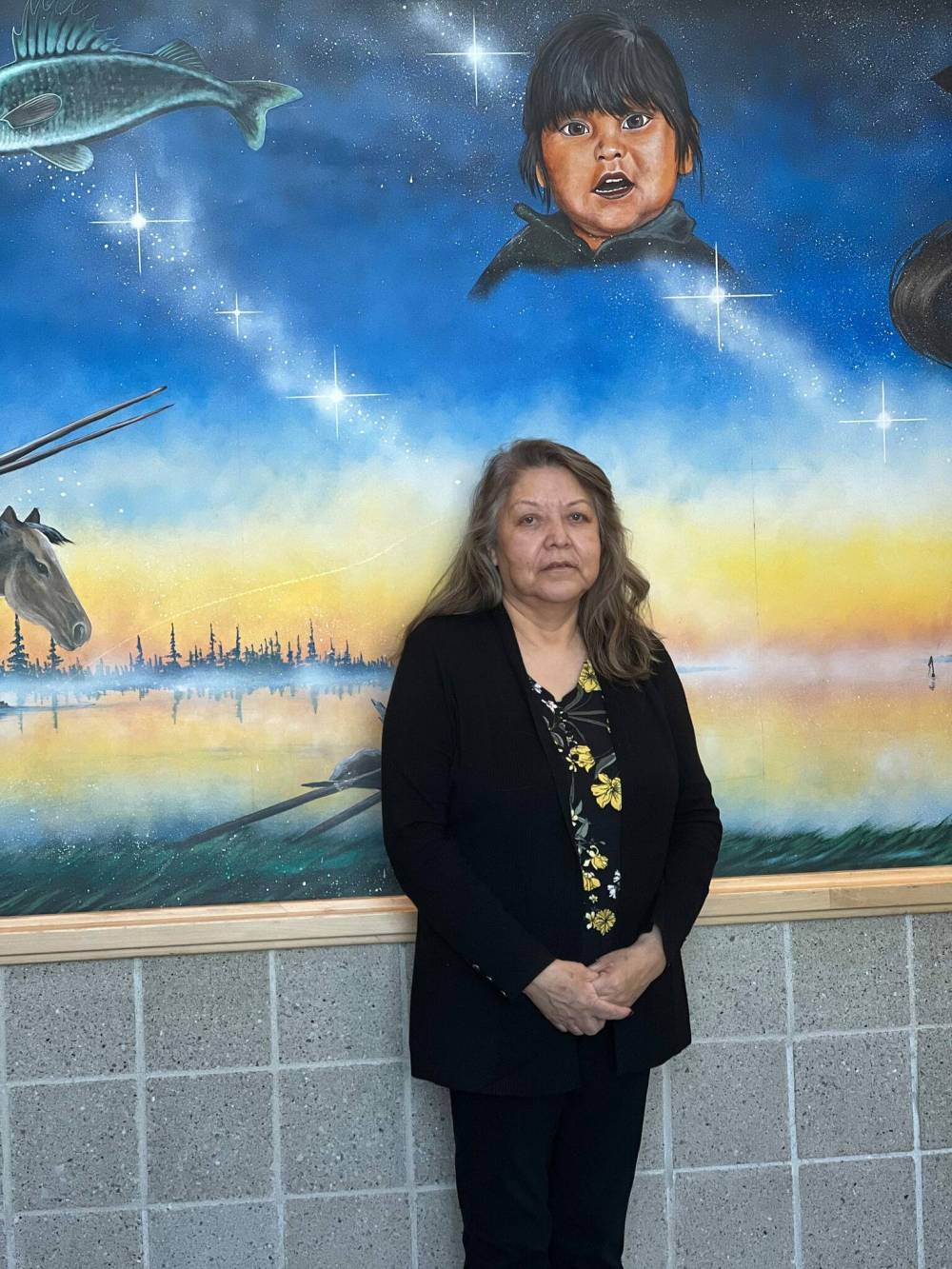
“Your language is very, very important. I think it defines you as a person. It is your identity. Being able to speak your language is powerful,” says George, a Cree educator and principal of Chemawawin Schools in Easterville, Man.
George and Philpot, whose friendship dates back to the late 1970s, co-authored the Cree and English book kā-āciwīkicik/The Move, which has been nominated for the 2022 Governor General’s Literary Awards.
They had been bandying about the idea of writing something together for some time. During an annual family barbecue, the conversations coalesced and the book was born.
Philpot, a professor at Shippensburg University, in Pennsylvania, worked on the English section of the book and sent off the first draft to the publishers in 2017.
“I have been working with translating Cree for many years and I’ve never been involved in a project like this; a literary text that comes into being through the interplay of two languages,” he shares.
Book shortlisted
kā-āciwīkicik/The Move, published in spring 2022 by Heritage House, is shortlisted for the 2022 Governor General’s Literary Awards Young People’s Literature – Illustrated Books category. The 2022 winners will be announced on Wednesday; winners will receive a $25,000 prize, and publishers receive $3,000 to promote the winning book.
“I am trying not to use the word ‘translate.’ There’s an exchange that is going on in this story between me and Doris that’s very unique.”
Cree is a descriptive language. If there is no word in the lexicon for an English one, Cree speakers will instead describe what they’re trying to convey.
There were times during the writing process when George says “things didn’t sound right” or sentences didn’t make sense, forcing them both to keep refining the text, going back and forth to change the Cree or alter the English.
And whilst they are both happy with the end result — “overall it’s OK,” George says, before admitting with a laugh that, “Yes, it’s good, it’s good” — they consider the work ever-evolving.
“I am satisfied,” George says, “but I did go back and look at it again and there are certain words I think need to change still. It’s a book that’s written at the same time in two languages, and the way it sounds in Cree has to correspond in English. So you’re running with two languages in your mind… I think it’s an ongoing thing. Now when I read it, I think, ‘Oh, I would have said that different…’”
Supplied by Heritage House Publishing) Written in Cree and English, kā-āciwīkicik / The Move has been nominated for a Governor General’s Literary Award.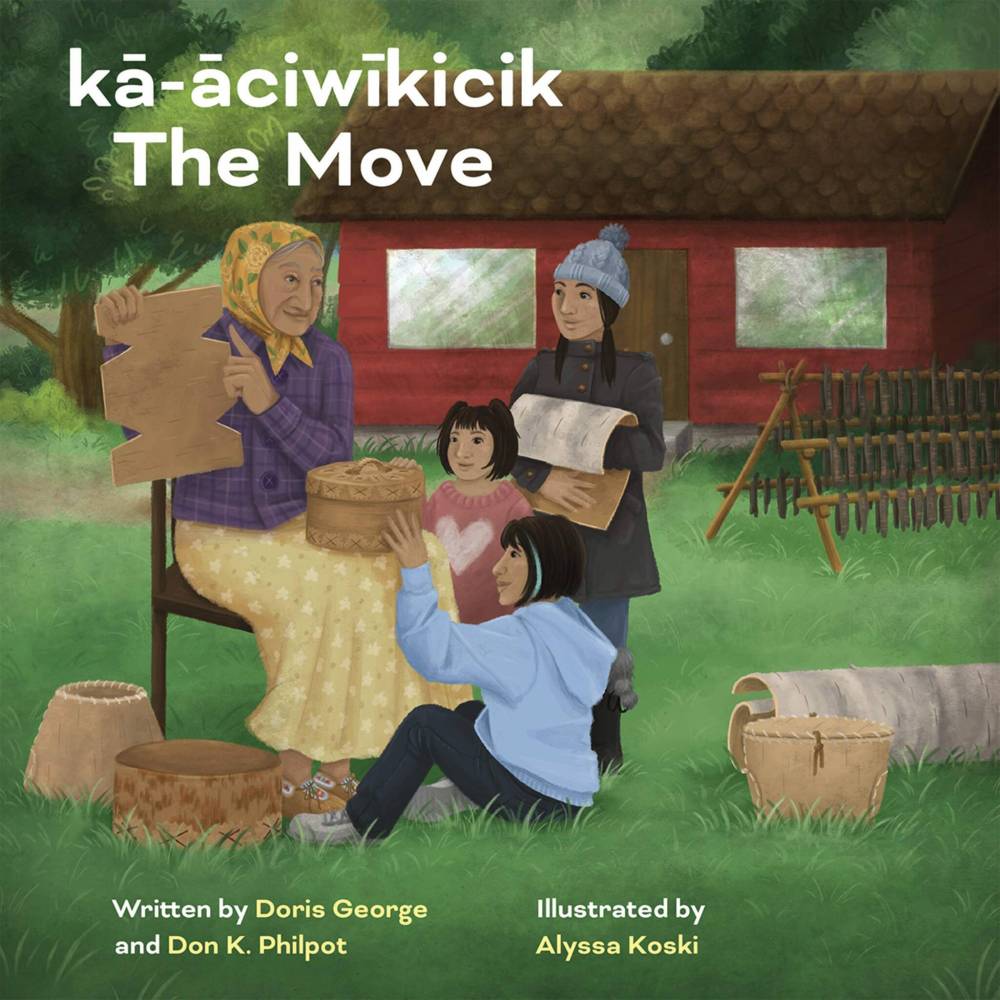
It’s an observation which fills Philpot with joy. “It’s wonderful Doris feels this way, because this is what oral storytelling in the tradition of Cree is all about. It’s never about a set text; you don’t perfect the text. Each storyteller will tell a version of the text and prioritize what they think is important, use the words that they think are the most fitting for a situation.
“I am really happy to hear her say that; I feel the same way. The story is not fixed, and I hope that the kind of tentativeness of the text will continue to shape with the illustration.”
Artist Alyssa Koski, a member of the Kainai Nation, Alta., worked very closely with Philpot to create the illustrations for the book. Working over Zoom, Philpot shared photographs and exchanged ideas about page composition with the illustrator.
“We had very intimate and lengthy conversations and I provided Alyssa — she’s Blackfoot and my background is Cree — images of the cultural artifacts from Swampy Cree (another name for members of Chemawawin Cree Nation) culture and Doris’s community in particular,” she says.
“Alyssa was so open to learning about Cree culture, objects and artifacts. For someone who is not Cree to have that degree of openness is extraordinary to me.”
kā-āciwīkicik/The Move is about an old couple forced to relocate from their ancestral lands to a barren area.
The story is rooted in the historical displacement and relocation of the members of the Chemawawin Cree Nation — including George’s mother, grandparents, and other relatives — who were moved to Easterville in the early 1960s to accommodate the building of a dam by the Manitoba government in the nearby community of Grand Rapids.
“These stories matter to the people who are gone. Doris and I know the people that are gone, and we have a responsibility to those people to make sure they are represented accurately,” Philpot says.
SUPPLIED Author Don K Philpot is currently a Professor at Shippensburg University, Pennsylvania.
“There is a lot of stuff in the story that reminds us of how we used to live,” George explains. “I used to see elders tanning hides, they would use the bones from the moose to clean the hides, instead of using an axe. I used to see my mom and dad cleaning their nets after fishing and fixing them with twine. My grandmother would pluck ducks and we would help as kids, hauling water from the well, chopping wood.”
Writing the story, with its constant revisions and rewrites, threw up some challenges, but nothing fazed Philpot and George. They quickly came to an understanding that things could not be rigid — that in order for the book to be a success, the two languages needed to “speak to each other.”
“The languages needed to find a common space, and I feel like this is representative of Canadian mosaic culture — that as Canadians we want to find that shared space where we can know each other,” says Philpot. “I live in the States, and I feel like people aren’t really interested in my Canadian experience, they just want me to be American like them. In Canada I always feel like Canadians are open to learning about other people so they will find that common space to learn, and I feel like this is what the languages were doing — they found a common space.”
For George, the book is a way to preserve a vital part of the Cree culture. “We as Indigenous Cree people, most of our stories were verbal. Now that a lot of our elders are passing away. Not many people are carrying on that tradition of telling stories. It is better to be putting it in a book form, so it will stay, so that our future generations will be able to see the stories that the elders used to talk about,” she says.
av.kitching@freepress.mb.ca
Our newsroom depends on a growing audience of readers to power our journalism. If you are not a paid reader, please consider becoming a subscriber.
Our newsroom depends on its audience of readers to power our journalism. Thank you for your support.
Our newsroom depends on a growing audience of readers to power our journalism. If you are not a paid reader, please consider becoming a subscriber.
Our newsroom depends on its audience of readers to power our journalism. Thank you for your support.
Advertisement Advertise With Us
Advertisement Advertise With Us