‘Life is hard. We just have to keep going’

Winnipeg man skates to remember victims

Advertisement

Advertise with us

On the most famous street in Winnipeg, Alan Young stickhandles past invisible defenders. He dekes left, he dekes right, accelerating like the semi-trucks that speed past him before stopping gracefully at Portage Avenue and Sherbrook Street.

Read this article for free:


By clicking the button above, an account will be created and you will begin to receive some of our recommended newsletters. You may opt out of any newsletter by visiting your Email and Communication Preferences page or by clicking "unsubscribe" at the bottom of any email.

or

Already have an account? Log in here »

To continue reading, please subscribe:

Digital Subscription

One year of digital access for only $1.44 a week*

  • Enjoy unlimited reading on winnipegfreepress.com
  • Read the E-Edition, our digital replica newspaper
  • Access News Break, our award-winning app
  • Play interactive puzzles

*Billed as $5.77 plus GST every four weeks. After 52 weeks, price increases to the regular rate of $19.95 plus GST every four weeks. Offer available to new and qualified returning subscribers only. Cancel any time.

To continue reading, please subscribe:

Add Free Press access to your Brandon Sun subscription for only an additional

$1 for the first 4 weeks*

  • Enjoy unlimited reading on winnipegfreepress.com
  • Read the E-Edition, our digital replica newspaper
  • Access News Break, our award-winning app
  • Play interactive puzzles
Start now

*Your next Brandon Sun subscription payment will increase by $1.00 and you will be charged $17.95 plus GST for four weeks. After four weeks, your payment will increase to $24.95 plus GST every four weeks.

Hey there, time traveller!
This article was published 29/09/2022 (1517 days ago), so information in it may no longer be current.

On the most famous street in Winnipeg, Alan Young stickhandles past invisible defenders. He dekes left, he dekes right, accelerating like the semi-trucks that speed past him before stopping gracefully at Portage Avenue and Sherbrook Street.

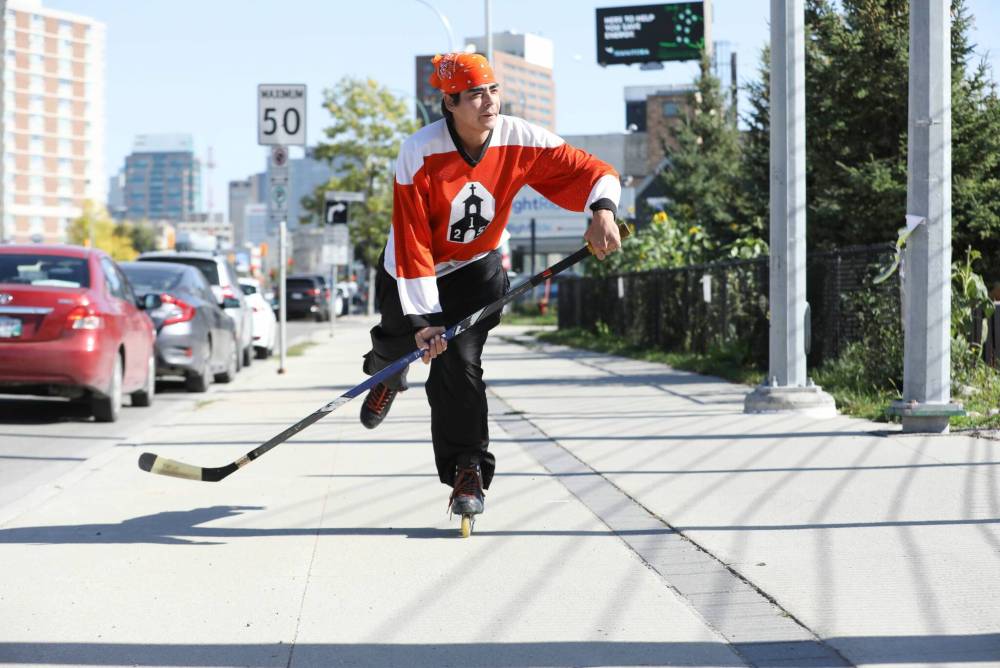
He stands out, not just because he’s six-feet tall, wearing Rollerblades, holding a beat-up hockey stick, and moving around effortlessly.

Young is impossible to miss because of his orange, black and white attire.
RUTH BONNEVILLE / WINNIPEG FREE PRESS
                                Alan Young is the son of residential school survivors, and growing up in Cross Lake and Bloodvein, the horror stories written at those institutions were both quiet and loud, known and unknown, unspoken yet heard.

RUTH BONNEVILLE / WINNIPEG FREE PRESS

Alan Young is the son of residential school survivors, and growing up in Cross Lake and Bloodvein, the horror stories written at those institutions were both quiet and loud, known and unknown, unspoken yet heard.

From far away, it looks like a Philadelphia Flyers jersey is clinging to Young’s frame, but that’s not it. There’s a much more serious logo on the front, and a much more solemn message on the back.

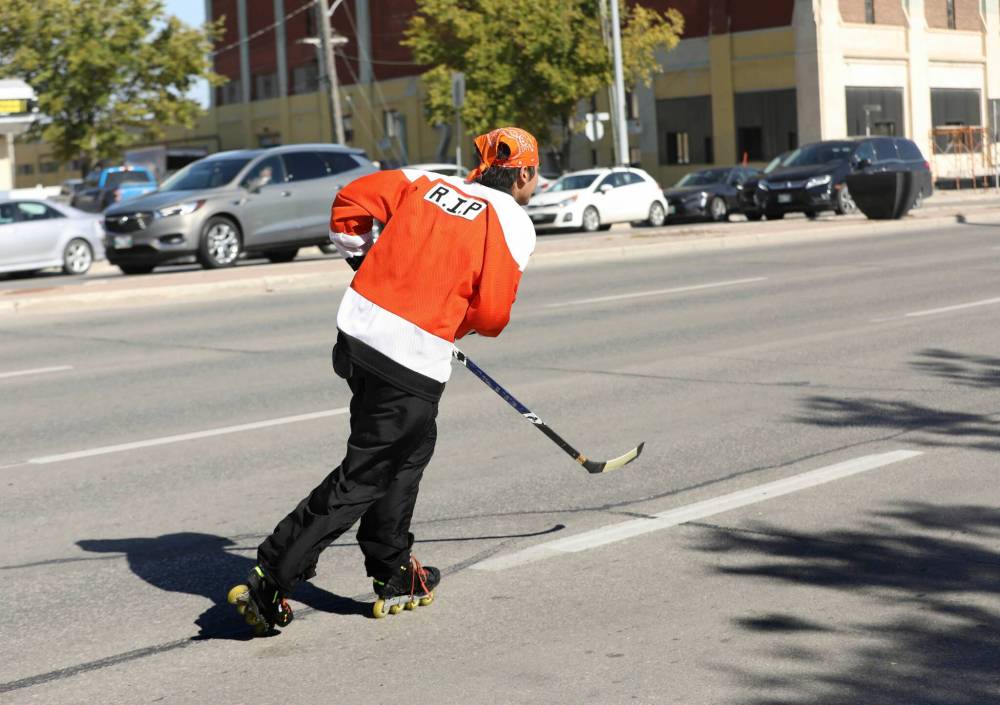
Across his chest is the black facade familiar to anybody who’s seen a photograph of the residential school in Cross Lake. Across the black facade are three digits: 215. On the back, where a player’s name is normally stitched, are three capital letters: R.I.P.

Young, 42, is the son of residential school survivors, and growing up in Cross Lake and Bloodvein, the horror stories written at those institutions were both quiet and loud, known and unknown, unspoken yet heard. So when the potential unmarked graves of 215 children were uncovered in Kamloops, B.C., last year, Young was not surprised. Records revealed last year that 84 children had died at Cross Lake Residential School, confirming what had long been known by many Indigenous people.

“I’d known about that since I was in my 20s,” Young says. He’d heard terrible stories about what happened to the children.

As public awareness grows, Young wanted to pay his respects to those who survived, those who didn’t, and those who still feel the effect of residential schools by wearing orange, while simultaneously crafting another narrative.

His father was a good hockey player. His grandmother once carried hundreds of pounds of flour on her back in a local competition. The NHLer Brady Keeper comes from Cross Lake, too. On the ice, Young faced racism from opponents, but persevered.

“Our people are strong,” Young says. “Our people are athletes.”
RUTH BONNEVILLE / WINNIPEG FREE PRESS
                                As public awareness grows, Alan Young wanted to pay his respects to those who survived, those who didn’t, and those who still feel the effect of residential schools by wearing orange, while simultaneously crafting another narrative.

RUTH BONNEVILLE / WINNIPEG FREE PRESS

As public awareness grows, Alan Young wanted to pay his respects to those who survived, those who didn’t, and those who still feel the effect of residential schools by wearing orange, while simultaneously crafting another narrative.

So at 9:15 a.m., Thursday, Young left his house in Windsor Park and tied the orange laces on his Bauer Rollerblades. He grabbed a well-loved stick, stepped onto the road, and in his thrifted jersey, emblazoned with a hand-drawn logo and nameplate, went off.

He zoomed around in traffic as he made his way through the city. At his former workplace, he grabbed an orange bandana. From a bush by a bridge, he snatched an orange blossom, tucking the flower into his hair. By 10:30 a.m., he was twirling at Portage and Sherbrook.

Blink, and Young was gone. He dashed between Corvettes and Nissans, past pedestrians and cyclists — a whir of orange on a concrete speedway. He hardly took a moment to breathe.

Outside Polo Park, he passed a city bus. “WOOOOOOO,” one rider screamed through an open window. Young flashed a thumbs-up.

Near Sargent Sundae, at around 11, he tossed his stick playfully around a telephone pole, catching it with his left.

Cutting across lanes and using the blade of his stick as a turn signal, Young disappeared into traffic.

Around noon he made it to the Perimeter Highway, before turning around to go back, saying hello to “brothers and sisters” downtown, where the intergenerational trauma caused by residential schools is on clear display.
RUTH BONNEVILLE / WINNIPEG FREE PRESS
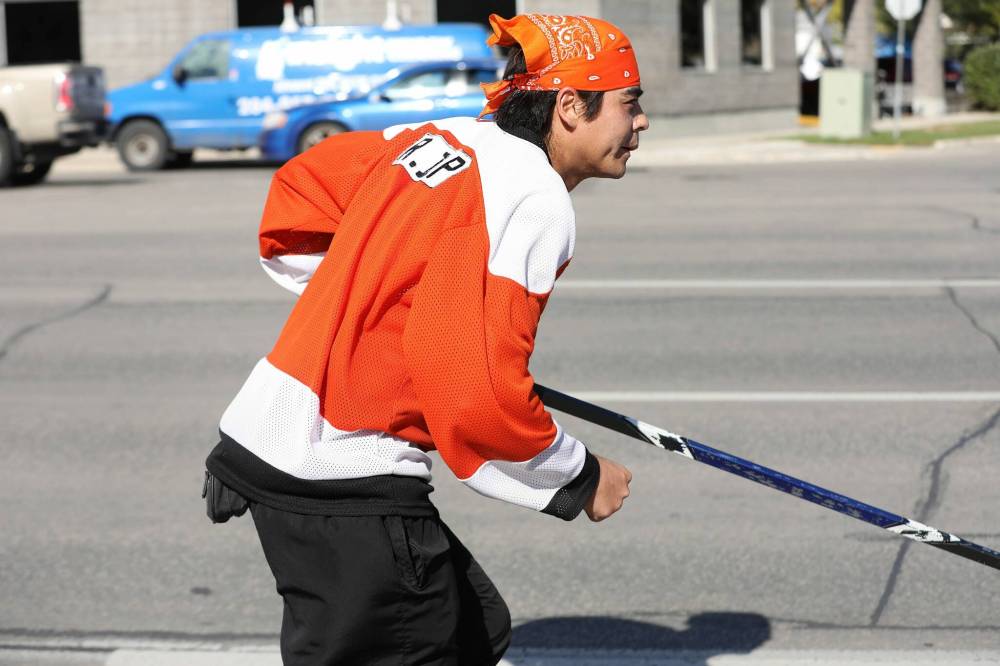
                                Alan Young roller blades along Portage Ave. wearing a orange jersey and carrying a hockey stick Thursday.

RUTH BONNEVILLE / WINNIPEG FREE PRESS

Alan Young roller blades along Portage Ave. wearing a orange jersey and carrying a hockey stick Thursday.

By the time he made it home, Young was exhausted, having skated for almost five hours and still having to walk to school to pick up his son, AJ.

“Life is hard,” Young says of the message behind his rolling journey. “We just have to keep going.”

ben.waldman@winnipegfreepress.com

Ben Waldman

Ben Waldman
Reporter

Ben Waldman covers a little bit of everything for the Free Press.

Our newsroom depends on a growing audience of readers to power our journalism. If you are not a paid reader, please consider becoming a subscriber.

Our newsroom depends on its audience of readers to power our journalism. Thank you for your support.

Report Error Submit a Tip

More Stories

China cracks down on recyclables; city, residents to feel impact

Aldo Santin 4 minute read Preview

China cracks down on recyclables; city, residents to feel impact

Aldo Santin 4 minute read Tuesday, Apr. 17, 2018

Questions over city hall’s plan to award a 10-year, $112-million contract to a Toronto firm to process and market curbside recyclable materials have drawn attention to dramatic changes in recycling.

Randy Park, the city’s acting manager of solid waste, said Winnipeggers need to be more discerning when it comes to what they place in their blue carts or there could be huge financial implications for city hall and property taxpayers.

Park said in the past city hall was focused on helping Winnipeggers adapt to recycling, but now the focus is on recycling appropriate and clean materials.

“Residents really need to educate themselves on what is acceptable for the recycling program,” Park told the Free Press. “In the past, when someone was unsure if it was acceptable, they just tossed it in the bin. Now on a go-forward basis if you’re not sure, find out because that’s really important.”

Read
Tuesday, Apr. 17, 2018

Doubling down: New Flyer buys U.K. double-decker bus maker in $545M deal

Martin Cash 7 minute read Preview

Doubling down: New Flyer buys U.K. double-decker bus maker in $545M deal

Martin Cash 7 minute read Tuesday, May. 28, 2019

NFI Group (formerly New Flyer Industries) has bought the U.K. double-decker bus maker, Alexander Dennis Ltd.. for $545 million making the Winnipeg company the leading independent bus maker in the world.

Scotland-based ADL is the largest manufacturer of double-deck buses in the world and has a commanding share of the U.K. market and also has double digit market share in Hong Kong and Singapore, as well as sales in a handful of European countries, New Zealand, Mexico, Canada and the U.S. The company also makes single deck transit buses as well as a motor coach under the brand Plaxton.

In the last couple of years it has won significant contracts in Poland, Switzerland and Germany, where it is just starting to build for a contract for 430 buses.

Officials from the Winnipeg bus company said the acquisition of ADL will add to its bottom line almost immediately and will not impact the dividends it pays shareholders.

Read
Tuesday, May. 28, 2019

Luke Gannon

0 minute read Preview

Luke Gannon

0 minute read Thursday, Aug. 6, 2026

Read
Thursday, Aug. 6, 2026

U.S. military on the back foot

Kyle Volpi Hiebert 5 minute read 2:00 AM EST

America’s global hegemony has for decades rested upon its vast war machine. Yet technology changes and Washington’s strategic blunders are challenging U.S. hard power like never before. And it’s now buckling under the pressure.

Indeed, military historian Phillips Payson O’Brien recently wrote that the American era was always destined to end. Rather, “what’s shocking is how suddenly that moment arrived.”

How the U.S. regains military supremacy — or whether that’s even possible — is uncertain.

After the Soviet Union collapsed in 1991, America stood alone atop the international hierarchy. Operation Desert Storm during the first Gulf War then broadcast the devastating prowess of new U.S. precision-guided bombs and co-ordinated joint force operations.

Reviews of this week's CD releases

8 minute read Preview

Reviews of this week's CD releases

8 minute read Thursday, Nov. 29, 2018

POP / ROCKChristine FellowsRoses on the Vine (Vivat Virtute/Outside Music)

This album from Winnipeg singer-songwriter Christine Fellows’ is aptly titled, since she says many of its 13 songs have been around for a while, written while she was working on other projects and then lovingly nurtured and carefully tended and finally coming to bloom on her seventh full-length studio recording.

Fellows makes baroque art-pop, she’s always been an adventurous artistic spirit and Roses... is certainly a musical expression of that trait, as she brings a rich melange of instruments to bear on the arrangements — everything from a traditional guitar-bass-drums rock configuration to pedal steel guitar, toy synthesizers, cello, gongs and exotic keyboards such as celeste and spinet. You’ll also hear a flock of geese, an old cassette snippet of her grandfather’s voice and even a duet with her life-partner, John K. Samson, on beautifully spare album closer The Swimmer.

Many of the songs started life as simple ukulele melodies and, as a result, this album is probably Fellows’ most accessible; even when stripped to their barest essence — as on Sunrise or Passage — these are hummable tunes.

Read
Thursday, Nov. 29, 2018

Report slams Omnitrax in fatal derailment

Kevin Rollason 5 minute read Preview

Report slams Omnitrax in fatal derailment

Kevin Rollason 5 minute read Thursday, Apr. 23, 2020

A Hudson Bay Railway derailment south of Thompson which resulted in the death of a conductor occurred after the track was washed out because of high water levels due to heavy rain.

But the 44-page report released by the Transportation Safety Board of Canada on Thursday also condemned the railroad's former owner, Omnitrax, saying that in the months before the derailment, while the company still owned it, "because the rail line was for sale, much of the other infrastructure maintenance was being deferred.

"In general, HBR, under Omnitrax, performed only a minimum amount of maintenance to keep the remaining portion of the rail line open while remaining in regulatory compliance. With a reduced engineering force, the track infrastructure began to deteriorate."

The TSB also found Omnitrax's reduction of its beaver control program also left the track vulnerable to a washout, its emergency response plan didn't include anything about responding to a train derailment, and the plan had never been reviewed by the regulator.

Read
Thursday, Apr. 23, 2020