Queen’s image an iconic symbol with myriad meanings

Advertisement
Read this article for free:
or
Already have an account? Log in here »
To continue reading, please subscribe:

Digital Subscription
One year of digital access for only $205*
- Enjoy unlimited reading on winnipegfreepress.com
- Read the E-Edition, our digital replica newspaper
- Access News Break, our award-winning app
- Play interactive puzzles
*First annual payment billed as $205.00 + GST for one year. This annual subscription will automatically renew at $233.00 + GST every 52 weeks (10% off the regular annual price of $259.35). Offer available to new and qualified returning subscribers only. Cancel any time.
To continue reading, please subscribe:
Add Free Press access to your Brandon Sun subscription for only an additional
$1 for the first 4 weeks*
- Enjoy unlimited reading on winnipegfreepress.com
- Read the E-Edition, our digital replica newspaper
- Access News Break, our award-winning app
- Play interactive puzzles
*Your next Brandon Sun subscription payment will increase by $1.00 and you will be charged $17.95 plus GST for four weeks. After four weeks, your payment will increase to $24.95 plus GST every four weeks.
Read unlimited articles for free today:
or
Already have an account? Log in here »
Hey there, time traveller!
This article was published 14/09/2022 (1485 days ago), so information in it may no longer be current.
In 1964, a British sculptor by the name of Arnold Machin was chosen to design a new effigy for Queen Elizabeth II, which was to be used on coinage and stamps in the U.K. and in other Commonwealth countries. The iconic Machin effigy — with the Queen cutting a striking profile — is now believed to be the most reproduced artwork in history.
That’s how many of us knew Queen Elizabeth II, who died last week at the age of 96, with 70 of those years on the throne: as a static icon of history, art and pop culture.
Even if you aren’t a royal watcher, the queen’s image is inescapable — for the simple fact her face is almost always in your wallet. For a long time, she cast a watchful eye over Winnipeg Jets games at the old arena; her official portraits and statues can be found in and around all manner of government buildings.
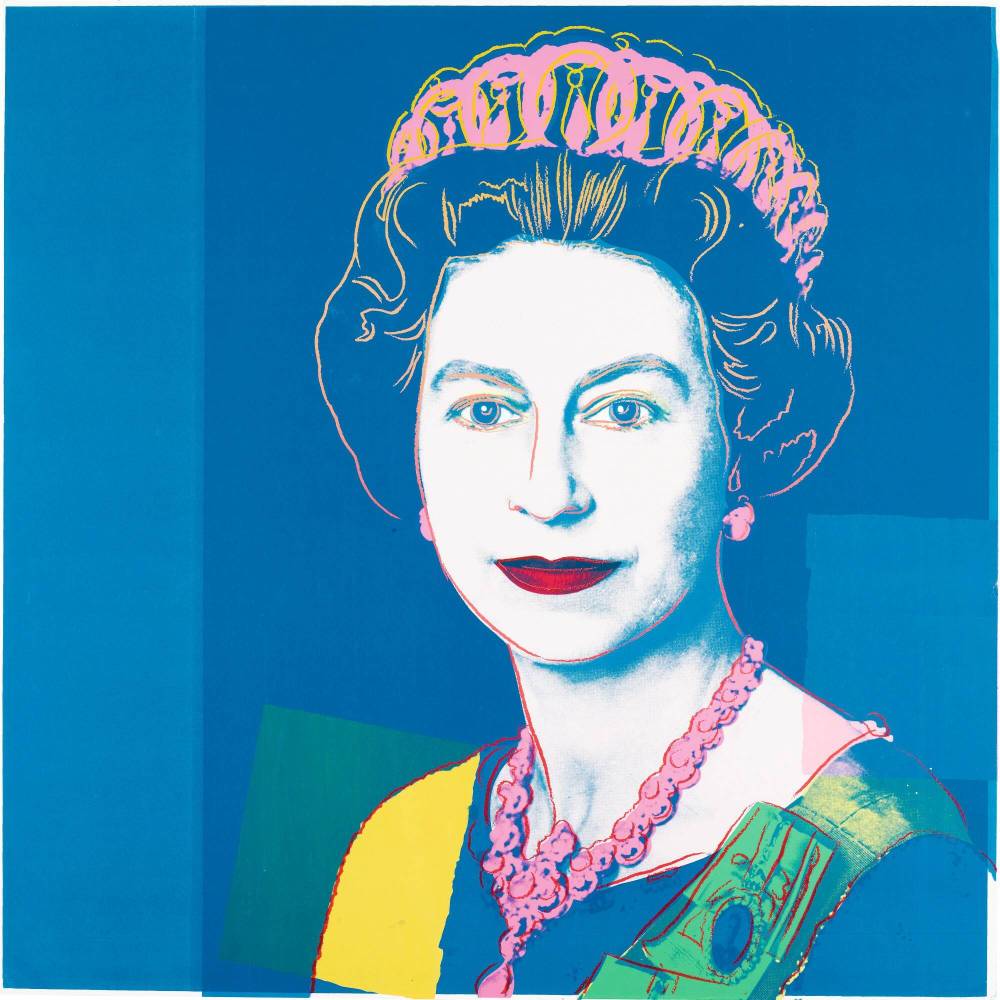
Andy Warhol’s Reigning Queen plays on the already much-repeated image of the late British monarch.
Like that famous 2000s study that showed that kids as young as two recognize brand logos, Commonwealth kids likely have the same sensation with the queen.
But Elizabeth II was an artistic muse far beyond the official effigies and portraits.
Comedian Scott Thompson, a member of the influential Canadian sketch comedy troupe Kids in the Hall, often played the queen with great affection on its TV show, which ran on CBC from 1989 to 1995.
“In Canada, and like anywhere in the Commonwealth, the queen’s more than a person; she’s a symbol,” Thompson said in a recent interview with Vulture. “So when I played her, it wasn’t like I was doing a celebrity impersonation; it was portraying an idea.”
Less affectionate, but just as iconic as any official portrait, is British punk artist Jamie Reid’s controversial artwork for the Sex Pistols single God Save the Queen, which features a defaced 1977 Silver Jubilee portrait of the monarch.
One version has a safety pin hooked through her mouth; the other, more recognizable design, has her mouth and eyes torn away to reveal the “God Save The Queen” and “Sex Pistols” in a magazine-collage font most closely associated with ransom notes.
In addition to reliably topping lists of defining U.K. punk rock images, Reid’s Sex Pistols cover artwork has been exhibited in art galleries. The Museum of Modern Art in New York City has a lithograph.
In American pop art-pioneer Andy Warhol’s hands, that same 1977 Silver Jubilee portrait is rendered in a riot of colours — her eyes, especially, a piercing blue — as part of his 1985 series of silkscreen portraits entitled Reigning Queens. Warhol frequently used repetition in his work; here, it adds another level — images of royalty, more so than the other celebrities whose likenesses he turned into pop art, tend to be copies of copies of copies.
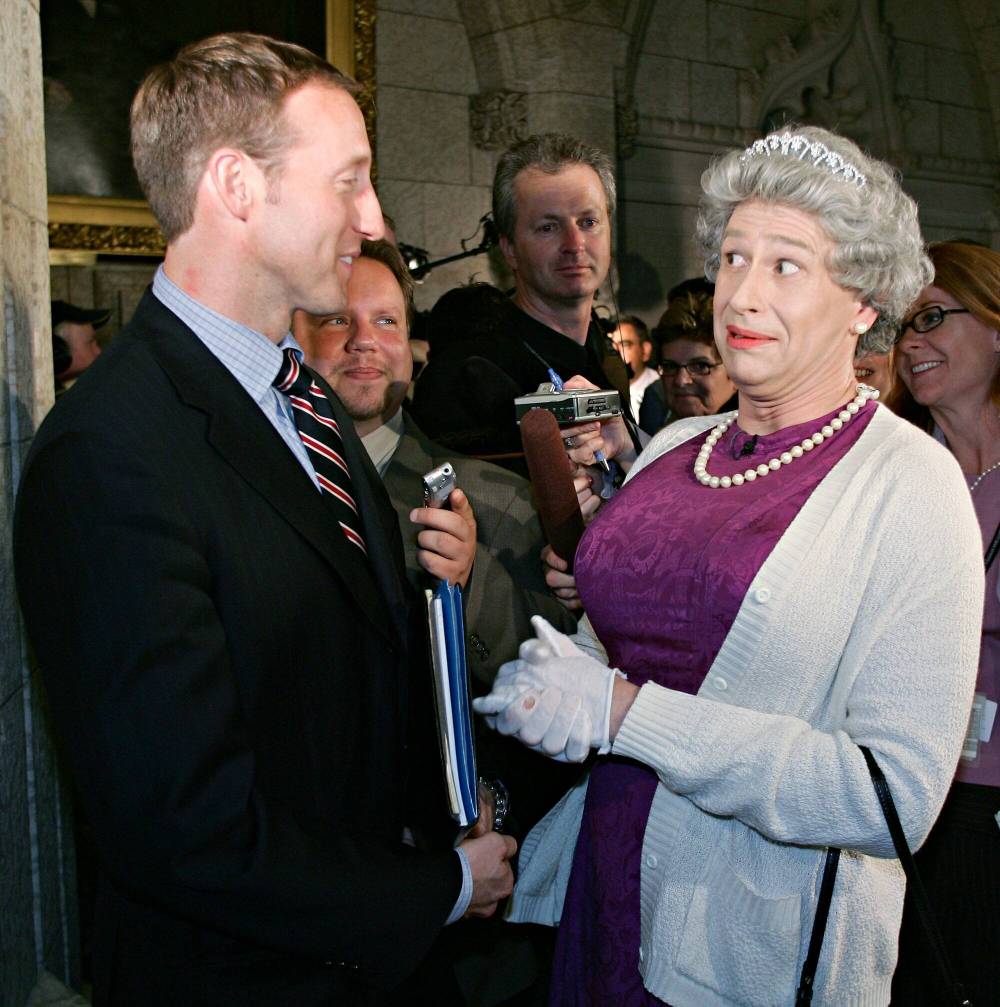
JONATHAN HAYWARD / CANADIAN PRESS FILES
Former Conservative MP Peter MacKay (left) speaks with actor Scott Thompson, dressed as Queen Elizabeth II in 2005.

And she’s still inspiring art. Earlier this year, more than 50 contemporary artists created portraits of the queen for a London exhibition called Art Save the Queen, in celebration of the queen’s Platinum Jubilee. While some portraits skew traditional, others go playful (and a little caustic): the queen in aviator sunglasses. The queen covered in tattoos. The queen in full KISS makeup, with LIZZ written in the rock band’s signature font. Some even riff on the Machin effigy.
That artistic expression, of course, lends to this notion of the queen as idea — or symbol, or avatar, or relic or cipher. Depending on the lens, she is a symbol of colonialism and imperialism, or she’s a symbol of duty and discipline. She’s cool and unknowable, or she’s the grandmotherly figure with a fondness for loud hats, dry martinis and corgis.
There is so much we don’t know about Elizabeth II, the human person, so devout was her commitment to the crown — also an idea and a symbol — to the point that the crown and the woman wearing it became one and the same. It may be her likeness, but it’s our projections and perceptions that continue to shape and reshape it.
jen.zoratti@winnipegfreepress.com
Twitter: @JenZoratti
Jen Zoratti is a Winnipeg Free Press columnist and author of the newsletter, NEXT, a weekly look towards a post-pandemic future.
Our newsroom depends on a growing audience of readers to power our journalism. If you are not a paid reader, please consider becoming a subscriber.
Our newsroom depends on its audience of readers to power our journalism. Thank you for your support.
Jen Zoratti is a Winnipeg Free Press columnist and author of the newsletter, NEXT, a weekly look towards a post-pandemic future.
Our newsroom depends on a growing audience of readers to power our journalism. If you are not a paid reader, please consider becoming a subscriber.
Our newsroom depends on its audience of readers to power our journalism. Thank you for your support.
Related Articles
Premier League to pay tribute to queen at weekend games



Advertisement Advertise With Us
Advertisement Advertise With Us