New play explores meaning of theatre

Advertisement

Advertise with us

Since fringe festivals have been rife with one-man Hamlet productions over the past few years, it may be necessary to clarify that The Player King, a new play by Ron Pederson, is not that.

Read this article for free:


or

Already have an account? Log in here »

To continue reading, please subscribe:

Subscribe and receive a limited-edition Free Press branded hat or tote.

Digital Subscription

One year of digital access for only $205*

  • Enjoy unlimited reading on winnipegfreepress.com
  • Read the E-Edition, our digital replica newspaper
  • Access News Break, our award-winning app
  • Play interactive puzzles

*First annual payment billed as $205.00 + GST for one year. This annual subscription will automatically renew at $233.00 + GST every 52 weeks (10% off the regular annual price of $259.35). Offer available to new and qualified returning subscribers only. Cancel any time.

To continue reading, please subscribe:

Add Free Press access to your Brandon Sun subscription for only an additional

$1 for the first 4 weeks*

  • Enjoy unlimited reading on winnipegfreepress.com
  • Read the E-Edition, our digital replica newspaper
  • Access News Break, our award-winning app
  • Play interactive puzzles
Start now

*Your next Brandon Sun subscription payment will increase by $1.00 and you will be charged $17.95 plus GST for four weeks. After four weeks, your payment will increase to $24.95 plus GST every four weeks.

Hey there, time traveller!
This article was published 11/06/2022 (1548 days ago), so information in it may no longer be current.

Since fringe festivals have been rife with one-man Hamlet productions over the past few years, it may be necessary to clarify that The Player King, a new play by Ron Pederson, is not that.

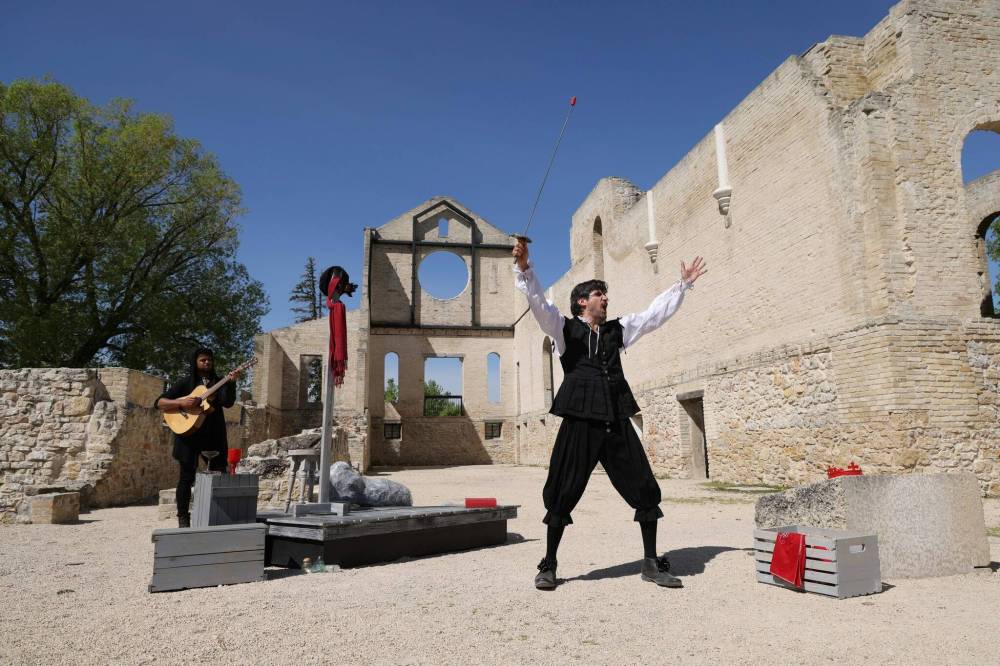
Mind you, the premise lends itself to it. A panicked actor (Rodrigo Beilfuss), searching for his absent castmates, comes upon an audience and tries to work through how he got there. His only stagemate is an ominously spectral musician (Cuinn Joseph) who limits himself to a running musical commentary to the nameless actor’s story.

A show must go on, if not the intended Hamlet show. So the actor tells his own story, interlaced with lines from the Bard to illustrate when appropriate, that is: frequently.
LEIF NORMAN PHOTO
The Player King, written by Ron Pederson, runs until July 2.
LEIF NORMAN PHOTO The Player King, written by Ron Pederson, runs until July 2.

It emerges that the actor comes from a background that may not be rogue but certainly qualifies as peasant slave, a young 19th century farm worker electrified by witnessing a performance by a ragtag itinerant troupe. He quickly becomes obsessed, even after finding that the author of these works is long gone. (“The same week I learn about Shakespeare, I learn he’s dead,” he laments.) Nevertheless, he finds his own way to the stage courtesy of a failed actor named Roger, found in a pub doing recitations for drinks.

They join forces, and then expand their troupe with the addition of Izzy, a nun who secretly worships at the shrine of Shakespeare. (Both Roger and Izzy are represented by a pair of makeshift mannequins.) After toiling in obscurity, he finally convinces his cohorts to let him play Hamlet.

Between the memories and flashes of agony (brought on by the shaking of a metal “thunder sheet” offstage), the actor slowly comes to the truth of his situation.

With a running time of a little more than an hour (without intermission), the show deviates from the usual SiR show in that it foregoes the promenade format to seat the audiences in a single location in the easternmost courtyard of the Trappist Monastery’s ruins in St. Norbert. And of course, Pederson is a very-much-alive scribe whose own influences, one infers, encompass non-Bard properties such as The Twilight Zone.

Directed by Pederson, the tone is fanciful and often humourous. But it’s not entirely a comedy. At its heart, it is a serious exploration of the meaning of theatre, and a timely treatise it is, given that live theatre is effectively rising from the dead after two and a half years in a pandemic-induced coma.

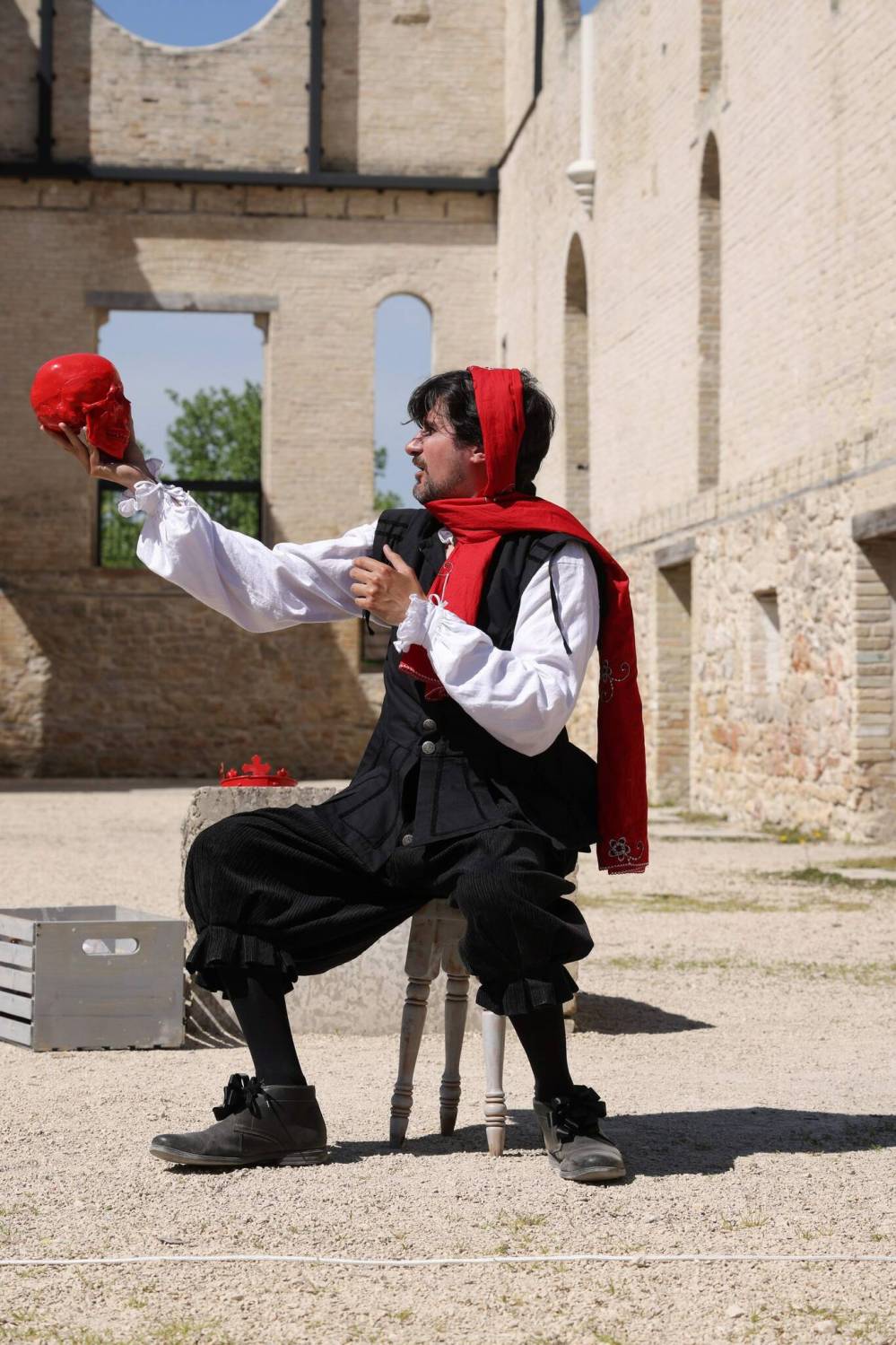
The casting is key. Rodrigo Beilfuss, the Brazilian-born artistic director of SiR was himself electrified by Shakespeare when studying English in a Winnipeg high school. So who better to aptly mirror the character’s passion for the playwright? Beilfuss does this with his characteristic ebullience.
LEIF NORMAN PHOTO
Rodrigo Beilfuss, the Brazilian-born artistic director of SiR was himself electrified by Shakespeare when studying English in a Winnipeg high school.
LEIF NORMAN PHOTO Rodrigo Beilfuss, the Brazilian-born artistic director of SiR was himself electrified by Shakespeare when studying English in a Winnipeg high school.

The play is ultimately a celebration of stumbling through misery and darkness and finding light and joy in the unlikeliest of places.

randall.king.arts@gmail.com

Twitter: @FreepKing

Randall King

Randall King
Reporter

In a way, Randall King was born into the entertainment beat.

Our newsroom depends on a growing audience of readers to power our journalism. If you are not a paid reader, please consider becoming a subscriber.

Our newsroom depends on its audience of readers to power our journalism. Thank you for your support.

Report Error Submit a Tip

More Stories

Remembering when, where we were when Putin invaded Ukraine

Melissa Martin 7 minute read Preview

Remembering when, where we were when Putin invaded Ukraine

Melissa Martin 7 minute read Thursday, Feb. 24, 2022

As a child, I learned history through books and movies but lived it vicariously through the eyes of my father, gathering up all his where-were-you-whens with an insatiable hunger. Every time I learned about an event that had shaped the course of the world, my young mind did a hasty calculation and, having verified he’d been alive at the time, I’d ask him the question.

Where was he on May 8, 1945, when news broke that Germany had made an unconditional surrender? He was young, almost too young to remember, except in fragmented pictures: the kitchen of his little house in small-town Michigan, the hem of his mother’s dress, newscasters declaring victory on the radio, people running down the street in jubilation.

Where was he on Nov. 22, 1963, when John F. Kennedy was assassinated? In a classroom at the American university where he was teaching, finishing up a lecture. He went home through stunned streets and yelled at the dog; my mother, seeing this, snapped back that the dog didn’t do it, so he sat and wept and felt the world he knew fall apart.

By the time I was eight years old, I had committed most of these stories to memory. None were dramatic. None of them had my father at the heart of what was the most violent or important or transforming. He was, like many folks in North America and all of those who are lucky, only a second-hand witness to the greatest machinations of geopolitical trauma.

Read
Thursday, Feb. 24, 2022

Another new year starts with hope

Niigaan Sinclair 5 minute read Preview

Another new year starts with hope

Niigaan Sinclair 5 minute read Tuesday, Dec. 29, 2020

The year began with hope that many long-standing challenges for Indigenous communities could be overcome.

For example, on Jan. 1, Bill C-92 came into effect, enabling Indigenous communities to take control of child and family services, making them “free to develop policies and laws based on their particular histories, cultures, and circumstances.”

This followed the 2019 passing of Bill C-91 and the creation of a federal Indigenous languages office — committing the government to support and fund “Indigenous-led language reclamation, revitalization, maintenance and strengthening activities.”

January also marked the opening of the Indian day school settlement process, offering more than 200,000 survivors compensation for harms perpetuated at 699 schools, and a $200-million education, healing and commemoration fund.

Read
Tuesday, Dec. 29, 2020

Smith’s pretzel logic confuses

Editorial 4 minute read Preview

Smith’s pretzel logic confuses

Editorial 4 minute read Yesterday at 2:02 AM CDT

Alberta Premier Danielle Smith had both sides of her mouth working overtime on Aug. 30, when she spoke at an event in Calgary to commemorate Alberta Day, the annual celebration of the province’s entry into Confederation in 1905 (officially Sept. 1, it was celebrated on the weekend).

Smith’s comments — and the things she did not say — revealed a lot about the political tightrope the premier is trying to walk over the challenges currently faced by her province. At the top of that list of challenges is a persistent campaign to separate Alberta from the aforementioned Confederation. A campaign that Smith appears to both support and oppose, depending on which day of the week it is.

Her Alberta Day remarks were an excellent case in point.

Smith has decided that on Oct. 19, Albertans will vote on a series of non-binding propositions in a province referendum. One of those questions will ask Albertans whether they want to hold a referendum on separation, thus making this fall’s vote a “referendum on whether to hold a referendum,” as some observers have dubbed it.

Read
Yesterday at 2:02 AM CDT

Virus testing the new normal as China sticks to 'zero-COVID'

Ken Moritsugu, The Associated Press 5 minute read Preview

Virus testing the new normal as China sticks to 'zero-COVID'

Ken Moritsugu, The Associated Press 5 minute read Thursday, Jun. 9, 2022

BEIJING (AP) — Thousands of coronavirus testing sites have popped up on sidewalks across Beijing and other Chinese cities in the latest development in the country's “zero-COVID” strategy.

Lines form every day, rain or shine, even where the spread of the virus has largely stopped. Some people need to go to work. Others want to shop. All are effectively compelled to get tested by a requirement to show a negative test result to enter office buildings, malls and other public places.

Liu Lele, who works for a live-streaming company, has no problem getting tested regularly but said the daytime operating hours don't always fit his schedule.

“Sometimes I get held up at work," he said after finishing a test Thursday near Beijing's historic Bell and Drum towers. "I wish there were sites open 24 hours or not closing until 7 or 8 p.m.”

Read
Thursday, Jun. 9, 2022

Billboard evangelism may look outdated but group says it’s effective

John Longhurst 5 minute read Preview

Billboard evangelism may look outdated but group says it’s effective

John Longhurst 5 minute read Yesterday at 2:02 AM CDT

Maybe you’ve seen them in Winnipeg — billboards that say things like: “Jesus is alive!” “Are you prepared to meet Jesus?” “After you die, you will meet God.” They include a phone number to call: 844-FIND-TRUTH.

There are two billboards in Winnipeg. One is on Henderson Highway in Elmwood. The other is on Balmoral Street, by Cumberland.

Have you ever wondered who is behind them, and why they do it?

You might be surprised to learn they are created and sponsored by an Amish/Mennonite organization called Christian Aid Ministries (CAM). Based in rural Ontario, the group is funded by Amish and some conservative Mennonite denominations and individuals.

Read
Yesterday at 2:02 AM CDT

Pandemic has seen a record number of adults taking music lessons

Alan Small 6 minute read Preview

Pandemic has seen a record number of adults taking music lessons

Alan Small 6 minute read Tuesday, Oct. 13, 2020

For some people, it’s called six-string therapy. For others, it has become 88 keys to coping with 2020.

It seems learning to play a musical instrument has struck a chord for adults during the COVID-19 pandemic.

“Since the whole COVID outbreak, a lot of people are starting to turn toward in-home lessons or online lessons,” says Mike Fondse, operations manager at Quest Musique’s Portage Avenue location. “As far as music lessons, home recording, anything regarding playing music at home has skyrocketed recently.”

It’s no surprise, really. In the spring, when lockdown protocols to prevent the spread of the novel coronavirus kept people at home, they took up baking, tried learning a new language, or planted their first gardens, among other activities.

Read
Tuesday, Oct. 13, 2020