WEATHER ALERT

Indigenous performer was a musical trailblazer

Local singer, producer a tireless promoter of Aboriginal acts

Advertisement

Advertise with us

Shingoose, a Indigenous musician from Winnipeg who was part of the 1960s folk movement in New York and would later become a producer and mentor to others in entertainment in Winnipeg, died Tuesday morning of COVID-19 complications. He was 74.

Read this article for free:

or

Already have an account? Log in here »

To continue reading, please subscribe:

Subscribe and receive a limited-edition Free Press branded hat or tote.

Digital Subscription

One year of digital access for only $205*

  • Enjoy unlimited reading on winnipegfreepress.com
  • Read the E-Edition, our digital replica newspaper
  • Access News Break, our award-winning app
  • Play interactive puzzles

*First annual payment billed as $205.00 + GST for one year. This annual subscription will automatically renew at $233.00 + GST every 52 weeks (10% off the regular annual price of $259.35). Offer available to new and qualified returning subscribers only. Cancel any time.

To continue reading, please subscribe:

Add Free Press access to your Brandon Sun subscription for only an additional

$1 for the first 4 weeks*

  • Enjoy unlimited reading on winnipegfreepress.com
  • Read the E-Edition, our digital replica newspaper
  • Access News Break, our award-winning app
  • Play interactive puzzles
Start now

*Your next Brandon Sun subscription payment will increase by $1.00 and you will be charged $17.95 plus GST for four weeks. After four weeks, your payment will increase to $24.95 plus GST every four weeks.

Hey there, time traveller!
This article was published 13/01/2021 (2007 days ago), so information in it may no longer be current.

Shingoose, a Indigenous musician from Winnipeg who was part of the 1960s folk movement in New York and would later become a producer and mentor to others in entertainment in Winnipeg, died Tuesday morning of COVID-19 complications. He was 74.

He had contracted COVID-19 at the Southeast Personal Care Home, said his daughter, Nahanni Shingoose, but he told her in a phone conversation Jan. 7 that he thought he was getting over it.

“He was supposed to be getting better. He had a fever for three days, he said, and he called and said he had COVID and was feeling better,” Nahanni Shingoose said from Toronto. “On Saturday, he didn’t answer his phone.”
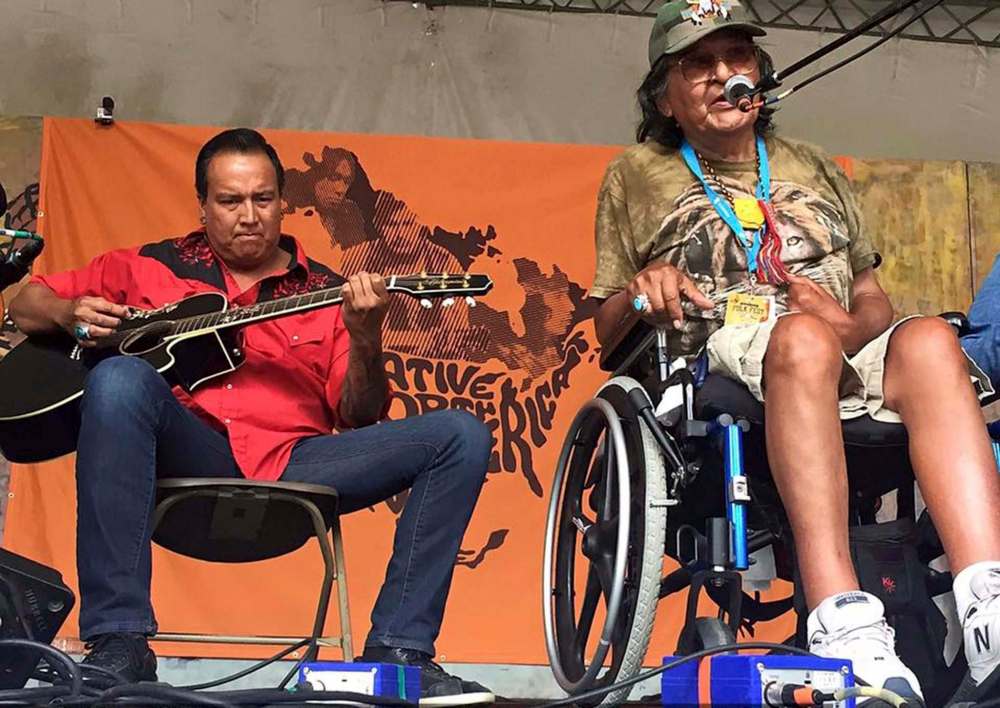
David McLeod photo
Shingoose performs with Jesse Green on guitar at the Winnipeg Folk Festival in 2016.
David McLeod photo Shingoose performs with Jesse Green on guitar at the Winnipeg Folk Festival in 2016.

The performer was born Curtis Jonnie in 1946 at Roseau River First Nation. By 1965 he’d made his way to Washington, D.C., where he joined a band called Puzzle that landed a deal with ABC Records. It was during this time, when the band moved to New York, when he would brush shoulders with rock legends such as Jimi Hendrix and John Lennon during recording sessions and gatherings of friends and fellow musicians.

Puzzle broke up and eventually Jonnie made his way to Toronto, where he began performing as a solo act at coffee houses. It was there he took on the name Shingoose, his grandfather’s name before Indian agents changed their family members’ names, Nahanni Shingoose said.

In 1973 he met Duke Redbird, an Aboriginal artist from Ontario, and in 1976 they recorded the EP Native Country, accompanied by a young Bruce Cockburn.

Shingoose returned to Winnipeg in 1981 and began focusing on promoting Aboriginal performers. That would lead to Indian Time, a series of variety television specials he produced and starred in that highlighted Indigenous acts and won a Gemini Award.

In 1994, he would join with Canadian folksinger Buffy Sainte-Marie and songwriter Elaine Bomberry to create the Juno Awards’ Aboriginal Music Committee in 1994, which led to the creation of the Junos’ Indigenous Album of the Year category.

His music with Redbird returned to prominence in 2016 after one of their songs, Silver River, was included in Native North America Vol. 1Aboriginal Folk, Rock, and Country 1966-1985, a Grammy Award-nominated anthology of songs by Indigenous artists. That same year, he performed the song at the Winnipeg Folk Festival, an event he loved, his family says, as part of a workshop that showcased songs from the record.

Shingoose suffered a stroke in 2012 that paralyzed the left side of his body, but that didn’t stop him from coming up with ideas to promote Indigenous artists, said David McLeod, general manager of NCI and a vice-chair of APTN.

Clay Hage, Shingoose’s half-brother, who grew up in North Dakota, crossed paths with Shingoose countless times when the singer was on tour. He remembered how determined Shingoose was to have a musical career, and later to promote other entertainment ideas.

“What a great talent Curt was, to have done so many things with that talent, travelling to the United States and Europe, but never getting that one big break,” he said in a telephone call from Moreno Valley, Calif. “He was always pursuing that one big break. He was the eternal optimist, always.”

alan.small@freepress.mb.ca

Twitter:@AlanDSmall

Alan Small

Alan Small
Reporter

Alan Small has been a journalist at the Free Press for more than 22 years in a variety of roles, the latest being a reporter in the Arts and Life section.

Our newsroom depends on a growing audience of readers to power our journalism. If you are not a paid reader, please consider becoming a subscriber.

Our newsroom depends on its audience of readers to power our journalism. Thank you for your support.

Report Error Submit a Tip

More Stories

Throne speech offers glimpse of PCs’ priorities

Shannon Sampert 5 minute read Preview

Throne speech offers glimpse of PCs’ priorities

Shannon Sampert 5 minute read Thursday, Nov. 22, 2018

Throne speeches are more than just pomp and circumstance and the opportunity for selfies between political rivals on the beautiful marble floors of the Manitoba legislature building on Broadway. They set the agenda for the legislative session and set the tone for the government as it moves into its new session. Looked at carefully, they also reveal the priorities of the government by what is said, and also what is not said.

But they are also highly symbolic. They are delivered by the lieutenant-governor of the province, who acts as the symbol of the head of state, the Queen, but they are written by speechwriters for the government of the day.

Political scientists have studied the throne speeches delivered at the federal level to understand the thematic commonalities and what they say about nationalism over the past 30 years. Janine Brodie of the University of Alberta, for example, determined that Canadian throne speeches delivered before the 2000s embraced a more neo-liberal tone that was tied to the global economy.

After 2000, an analysis by Tim Nieguth (Laurentian University) and Tracey Raney (Ryerson University) found that Conservative throne speeches tended to focus on neo-conservative themes — emphasizing the family, the military and threats to security — while Liberals’ speeches talked about health care and Indigenous issues.

Read
Thursday, Nov. 22, 2018

COVID cases spike even as US hits 200M vaccine milestone

Sophia Tareen And Jennifer Mcdermott, The Associated Press 6 minute read Preview

COVID cases spike even as US hits 200M vaccine milestone

Sophia Tareen And Jennifer Mcdermott, The Associated Press 6 minute read Wednesday, Dec. 8, 2021

A collection of breaking news briefs filed on December 13, 2021

• Province seeks help from Ottawa to staff intensive care units

• Bombers hosting Grey Cup celebration at IG Field Wednesday

• Snowmobiler killed in crash with pedestrian in Pimicikamak Cree Nation

• Missing man last seen in Elmwood neighbourhood

• Small passenger plane crashes after engine failure

• Latest round of Teachers' Idea Fund projects announced

• Eight dead as COVID-19 climbs in Southern Health

• Extent of Wheeler's injury still unknown, Moose dealing with COVID-19 situation

• Teenage boy arrested after Charleswood stabbing

• Teen girl arrested in bus shelter stabbing

• Man with ties to Winnipeg wanted by Saskatoon police in sex assault investigation

• Woman slain on College Avenue

• Jets shuffle lines at practice without injured Wheeler

• Pionk returns to practice with Jets

• Province extends paid sick leave

Read
Wednesday, Dec. 8, 2021

Lifelong friends will now be facing off in WHL

Mike Sawatzky 5 minute read Preview

Lifelong friends will now be facing off in WHL

Mike Sawatzky 5 minute read Thursday, Mar. 4, 2021

Trent Crane and William Irvine have been friends since before they can remember.

Through good times and bad, a tight bond was forged during their formative years in Morden. The boys went to school together, fought like siblings and were frequent hockey teammates.

They also played dozens of golf rounds together and were teammates on Manitoba's gold-medal winning baseball team at the 2016 Western Canadian peewee championship. They hung out constantly.

Their connection — Trent and William were born 29 days apart in the spring of 2003 — endures to this day.

Read
Thursday, Mar. 4, 2021

If it works in Ontario, why not in Manitoba?

James Wilt 5 minute read Preview

If it works in Ontario, why not in Manitoba?

James Wilt 5 minute read 2:00 AM CDT

Grid-scale battery storage has fundamentally changed the global energy landscape — and Manitoba needs to get on board.

Battery systems store large amounts of excess electricity for when it’s most needed. While they can be charged from any generation source, they are especially beneficial for integrating wind and solar power, which vary with weather and time of day. Batteries allow electrical grids to meet the need for firm, dispatchable and affordable capacity using renewable energy, rather than relying on coal, nuclear and fossil gas. They also provide numerous other benefits, including reducing overloading of transmission infrastructure and helping to regulate the grid’s frequency and voltage.

Average costs for grid-scale batteries plummeted by more than half between 2023 and 2025 and installations have skyrocketed in China, the U.S., Australia and Europe. Texas now has 16,500 megawatts (MW) of battery storage, while California has 15,200 MW. Closer to home, Ontario recently awarded 640 MW of contracts to three battery storage projects in a competitive auction, with batteries beating out fossil gas-fired power plants on cost every time. One of these projects will be built near Dryden, only four hours east of Winnipeg.

Each battery system will provide eight hours of capacity but will cost considerably less than Ontario’s previous battery procurements, which provide only four hours of capacity. With this latest auction, Ontario has now secured 3,600 MW of battery storage capacity, including the operational Oneida (250 MW), Hagersville (300 MW) and Napanee (250 MW) projects. Almost all have significant Indigenous participation, with the latest procurements boasting 50 per cent First Nations ownership.

Read
2:00 AM CDT

CFL greats open up about full effects of concussions

By Paul Wiecek 7 minute read Preview

CFL greats open up about full effects of concussions

By Paul Wiecek 7 minute read Monday, Dec. 14, 2015

He remembers the four Grey Cup wins. He remembers his Hall of Fame teammates. He even remembers single plays he authored that changed the history of the Winnipeg Blue Bombers franchise and which fans still talk about more than 50 years later.

But what Canadian Football Hall of Fame quarterback Ken Ploen no longer remembers is what he did yesterday. The greatest Bombers player who ever lived has been diagnosed — like an alarming number of his aging CFL teammates — with dementia.

“He’s still in great health otherwise. We just had our checkups and the doctors say he has the heart of a 16-year-old,” says Janet Ploen, his wife of 55 years.

“He’s still able to get out and he’s still able to do things. It’s just that he doesn’t remember the experience the next day.”

Read
Monday, Dec. 14, 2015

It’s time to start a healthier new life chapter

Maureen Scurfield 4 minute read 2:00 AM CDT

DEAR MISS LONELYHEARTS: I want my wife back! I ran into her at a wedding recently, and she was as brilliant and charming as ever. She has also lost the extra weight she put on while married to me. I loved her cooking and baking!

She now looks like she did when I first met her and was actually quite pleasant with me — but she’s always been quite the charmer. But at the end of the night when I tried to kiss her, she withdrew and said quietly, “I’m sorry. Not in this lifetime! That chapter is over for us.” I was hurt and felt embarrassed.

I realize I lost her because of all my bad habits, not just drinking. Now she’s letting me know she wouldn’t come back to me even if I cleaned them all up. I know she used to love me a lot because she’d say it all the time. That’s part of why I married her! True love never dies, I hear. Was she lying?

— Suspicious, St. James