Concert something to remember

Emotional sold-out classical collaboration marks 100 years since end of Great War

Advertisement

Advertise with us

One hundred years ago, a battered and bruised world held its breath as the Allies and Germany signed the armistice to end the “war of all wars,” First World War on Nov. 11th, 1918.

Read this article for free:

or

Already have an account? Log in here »

To continue reading, please subscribe:

Subscribe and receive a limited-edition Free Press branded hat or tote.

Digital Subscription

One year of digital access for only $205*

  • Enjoy unlimited reading on winnipegfreepress.com
  • Read the E-Edition, our digital replica newspaper
  • Access News Break, our award-winning app
  • Play interactive puzzles

*First annual payment billed as $205.00 + GST for one year. This annual subscription will automatically renew at $233.00 + GST every 52 weeks (10% off the regular annual price of $259.35). Offer available to new and qualified returning subscribers only. Cancel any time.

To continue reading, please subscribe:

Add Free Press access to your Brandon Sun subscription for only an additional

$1 for the first 4 weeks*

  • Enjoy unlimited reading on winnipegfreepress.com
  • Read the E-Edition, our digital replica newspaper
  • Access News Break, our award-winning app
  • Play interactive puzzles
Start now

*Your next Brandon Sun subscription payment will increase by $1.00 and you will be charged $17.95 plus GST for four weeks. After four weeks, your payment will increase to $24.95 plus GST every four weeks.

Hey there, time traveller!
This article was published 12/11/2018 (2810 days ago), so information in it may no longer be current.

One hundred years ago, a battered and bruised world held its breath as the Allies and Germany signed the armistice to end the “war of all wars,” First World War on Nov. 11th, 1918.

That auspicious centenary has been commemorated all around the globe this past weekend, including military parades, religious and secular services, poignant tributes, speeches, poetry and poppy projects paying homage to the fallen, as well as all those still proudly serving their country.

The Winnipeg Philharmonic Choir added its own collective voice to the mix Sunday afternoon, launching its 96th season with Lest We Forget: 100 Years of Remembrance 1918-2018, a “journey of remembrance” featuring guest artists: Monica Huisman, soprano; Laurelle Jade Froese, mezzo-soprano; John Tessier, tenor; and Victor Engbrecht, bass with the Phil’s 90 choristers joined by the Winnipeg Symphony Orchestra at the St. Boniface Cathedral.
PHOTOS BY TREVOR HAGAN / WINNIPEG FREE PRESS
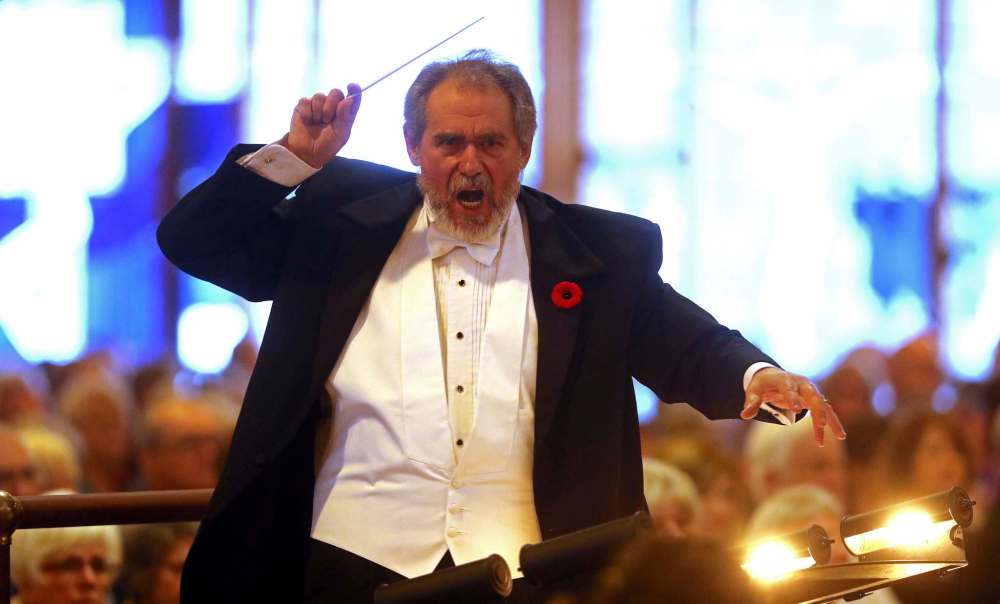
Conductor Yuri Klaz leads the Winnipeg Philharmonic Choir with the Winnipeg Symphony Orchestra during a concert at the St. Boniface Cathedral’s special 100 Years of Remembrance ceremony on Sunday.
PHOTOS BY TREVOR HAGAN / WINNIPEG FREE PRESS Conductor Yuri Klaz leads the Winnipeg Philharmonic Choir with the Winnipeg Symphony Orchestra during a concert at the St. Boniface Cathedral’s special 100 Years of Remembrance ceremony on Sunday.

The two-hour, sold-out concert led by maestro Yuri Klaz began with Samuel Barber’s sublime Adagio for Strings, that the American composer extracted from his String Quartet in B minor, Op. 11 and arranged string orchestra in 1936. It proved an ideal choice for an afternoon of contemplative gravitas, including its hushed opening where one molten phrase bleeds into the next, to its rise of shimmering close harmonies in the upper strings, before settling into a final quiet, albeit still-questioning close.

Mozart’s immortal Requiem in D minor, KV 626, based on the Roman Catholic funeral mass, and reputedly the final work the Wunderkind composed before his untimely death at age 35 in 1791 (ultimately completed by his pupil Sussmayr) takes listeners from the fiery gates of hell to everlasting, heavenly light.

It also demands that its four soloists and chorus members take their own leap of faith, called upon to navigate perilous fugal sections and bold choruses, as well as skillfully pacing, and shaping the 55-minute piece into an overall narrative arc that offers, ultimately, a musical affirmation and release from mortal bonds.

Mostly, the performers succeeded, with the singers clearly committed to the journey, and impeccably prepared by Klaz with crisp vocal entries and clear enunciation — despite the venue’s inherent acoustical challenges — particularly on display during the fire-and-brimstone Dies Irae, and later Domine Jesu, infused with buoyant lightness.

Other highlights include the more rhythmically driving Hostias, and lyrical Lacrimosa, while Confutatis shuddered with its evocation of “searing flames” as one of the most compellingly dramatic sections. Other choruses, including Rex tremendae might have benefitted from greater sweetness, and arguably, a relishing of the Latin text, such as during its final plea, “salva me” (save me).

Assembling a fine, well-balanced quartet of soloists is an art in itself, requiring certain alchemy to get it just right. The concert’s four guest artists are all wonderful singers in their own right, including Winnipeg-based powerhouse Huisman, and Engbrecht, a soloist we don’t hear nearly enough, who imbues every one of his all-too-rare performances with a sense of deep humanity and compassion.

Likewise, Froese, currently teaching at Providence University College, and the Juno Award-winning Tessier, also on faculty with the University of Alberta, in addition to each artist’s slate of solo engagements are also strong, compelling vocalists one would like to hear again — and often.
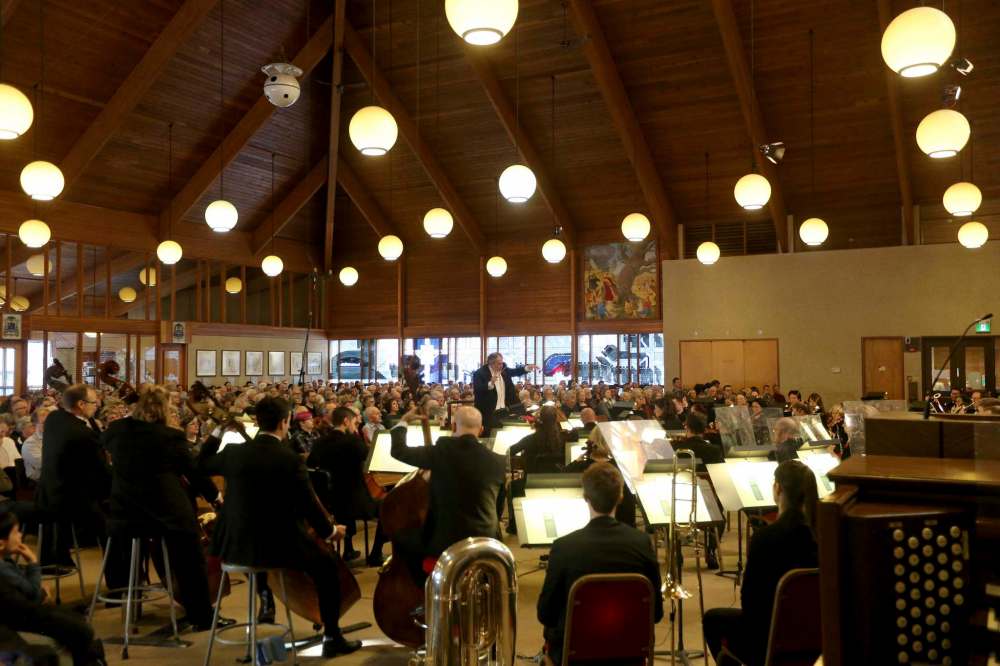
More than 700 people filled the cathedral to remember those who served the country 100 years ago and those who continue to serve.

However, all too frequently, the ensemble suffered an overall lack of cohesion during their highlighted sections, including Recordare, although fared better during the final, exultant Benedictus.

Having said all this, highlights include Tuba mirum, with Engbrecht and Tessier’s voices first sailing over the audience, quickly joined by Froese and Huisman, as well as the latter’s warmly benevolent assurance of Lux aeterna — eternal light — during the Agnus Dei sung against the choir’s oceanic waves of cresting sound, earning a rousing standing ovation from the mostly older crowd.

Finally, the program also included 19th century Russian Romantic composer Sergei Taneyev’s cantata John of Damascus, No. 1, based on poetry by Aleksey Tolstoy and popularly known as the Russian Requiem.

The three-movement work sung in Russian begins with a languorous, lyrical orchestral introduction before each vocal section joins in with sweeping lines and overlapping entries. The Russian-born Klaz, who has this music in his blood and bones, kept a taut rein on his choristers and musicians, imbuing this intensely dramatic work with a sense of grandeur and Russian soul.

A particular highlight proved to be its second movement that begins with its a cappella sacred Russian chant including pungent harmonies, leading to the final fugue with the performers digging in hard with crisply enunciated runs and rhythmic attack. At times teetering close to the rails, including overzealous tenors, this piece nevertheless became an enthralling highlight of the afternoon, replete with resounding trumpets heralding the triumph of eternal life over death.

However, the most spine-tingling moment ironically arose not during the concert itself, but immediately afterwards.
TREVOR HAGAN / WINNIPEG FREE PRESS
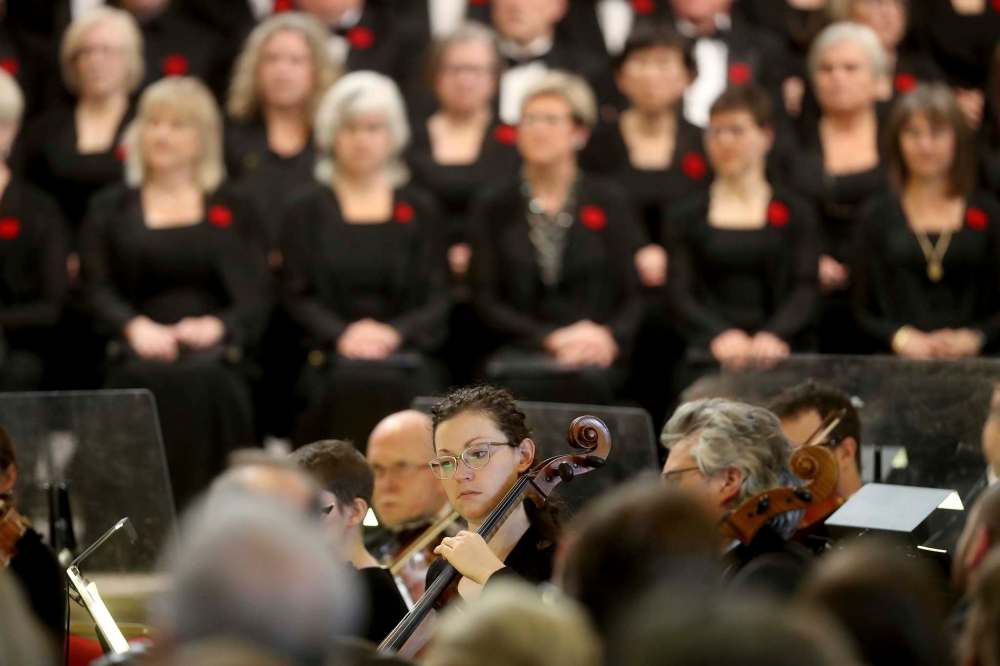
Conductor, Yuri Klaz, leading the Winnipeg Philharmonic Choir with the Winnipeg Symphony Orchestra, during a concert at the St.Boniface Cathedral, Sunday, November 11, 2018.
TREVOR HAGAN / WINNIPEG FREE PRESS Conductor, Yuri Klaz, leading the Winnipeg Philharmonic Choir with the Winnipeg Symphony Orchestra, during a concert at the St.Boniface Cathedral, Sunday, November 11, 2018.

As audience members exited the venue at sunset, they were greeted by the Cathedral’s own loudly tolling bell, ringing out 100 times as part of the countrywide “Bells of Peace” commemoration, just as bells pealed across Europe celebrating the end of the Great War on that first Remembrance Day in 1918.

This wholly visceral heralding of peace and freedom might ultimately be considered the sweetest sound of all, still welcomed and longed for now, and forever.

holly.harris@shaw.ca

Report Error Submit a Tip

More Stories

Strong, capable women rob Trudeau of moral authority

Dan Lett 6 minute read Preview

Strong, capable women rob Trudeau of moral authority

Dan Lett 6 minute read Wednesday, Mar. 6, 2019

The hole that Prime Minister Justin Trudeau fell into last week just got a little deeper, and his path back out significantly less certain.

Following an extraordinary week in which former Justice Minister Jody Wilson-Raybould publicly accused Trudeau and his senior staff of improper political pressure to help SNC-Lavalin, Treasury Board President Jane Philpott resigned from cabinet, saying she had lost confidence in the prime minister and cabinet. 

It was always going to be a challenge for Trudeau to survive the damage done by Wilson-Raybould following her resignation from cabinet, and testimony to a Commons committee last week. But Philpott's resignation has made that climb seem nearly unassailable.

At press time, Trudeau is reportedly hunkered down in his Ottawa office, contemplating some sort of statement of contrition. That's solid evidence that this latest development has pushed Trudeau's leadership to the brink of the abyss.

Read
Wednesday, Mar. 6, 2019

Concert something to remember

Holly Harris 6 minute read Preview

Concert something to remember

Holly Harris 6 minute read Monday, Nov. 12, 2018

One hundred years ago, a battered and bruised world held its breath as the Allies and Germany signed the armistice to end the “war of all wars,” First World War on Nov. 11th, 1918.

That auspicious centenary has been commemorated all around the globe this past weekend, including military parades, religious and secular services, poignant tributes, speeches, poetry and poppy projects paying homage to the fallen, as well as all those still proudly serving their country.

The Winnipeg Philharmonic Choir added its own collective voice to the mix Sunday afternoon, launching its 96th season with Lest We Forget: 100 Years of Remembrance 1918-2018, a “journey of remembrance” featuring guest artists: Monica Huisman, soprano; Laurelle Jade Froese, mezzo-soprano; John Tessier, tenor; and Victor Engbrecht, bass with the Phil’s 90 choristers joined by the Winnipeg Symphony Orchestra at the St. Boniface Cathedral.

The two-hour, sold-out concert led by maestro Yuri Klaz began with Samuel Barber’s sublime Adagio for Strings, that the American composer extracted from his String Quartet in B minor, Op. 11 and arranged string orchestra in 1936. It proved an ideal choice for an afternoon of contemplative gravitas, including its hushed opening where one molten phrase bleeds into the next, to its rise of shimmering close harmonies in the upper strings, before settling into a final quiet, albeit still-questioning close.

Read
Monday, Nov. 12, 2018

The number of Indigenous inmates in prison is a problem — but Ottawa has no plan to fix it

Ryan Thorpe 2 minute read Preview

The number of Indigenous inmates in prison is a problem — but Ottawa has no plan to fix it

Ryan Thorpe 2 minute read Thursday, Apr. 29, 2021

The number of Indigenous people being locked up in federal prisons is spiking despite overall declines in both incarceration and crime rates across the country.

Accounting for just five per cent of Canada's population, Indigenous people make up 30 per cent of the federal prison system's inmate population.

The crisis is particularly acute in the Prairies, where roughly 70 per cent of the people behind bars at Stony Mountain Institution north of Winnipeg are Indigenous.

Ryan Beardy, a former gang member and current justice advocate, mentor and freelance journalist, said that it was while he was incarcerated at Stony Mountain that he decided to begin speaking out about prison conditions in Canada.

Read
Thursday, Apr. 29, 2021

A foodborne parasite and government efficiency

Editorial 4 minute read Preview

A foodborne parasite and government efficiency

Editorial 4 minute read 2:01 AM CDT

Week-long explosive diarrhea.

There. Now that we’ve got your attention, here’s a cautionary tale about red-tape reduction and public health.

Government regulation is often described by those who have to adhere to it as “red tape,” and governments often set out on red-tape reduction campaigns, based on the conjoined goals of freeing business from unnecessary regulation and freeing governments from having to pay to employ public servants to implement that regulation.

Reduction campaigns often begin by finding the most ludicrous example of government regulation in sight and characterizing it as typical of government rule-making. The fact that many government regulations keep us safe and healthy isn’t usually part of the red-tape discussion.

Read
2:01 AM CDT

NDP handily retains northern seat in byelection

Carol Sanders 5 minute read Preview

NDP handily retains northern seat in byelection

Carol Sanders 5 minute read Tuesday, Jul. 21, 2026

Voters in The Pas-Kameesak stuck with the NDP — big time — in Tuesday’s byelection.

With all polls reporting, New Democrat Jennifer Flett received 74 per cent of the votes in the race to replace the late NDP MLA Amanda Lathlin. Flett, a former vice-chief and councillor for Opaskwayak Cree Nation, got a stronger mandate than the NDP received in the 2023 provincial election, when Lathlin received 67 per cent support.

Premier Wab Kinew welcomed Flett to the NDP caucus.

“She knows what families in her communities need, and I look forward to working with her to deliver better health care and more good jobs for The Pas-Kameesak,” he said in a release.

Read
Tuesday, Jul. 21, 2026

Doctors Manitoba contract shows fruitful talks possible amid wage freeze

Tom Brodbeck 4 minute read Preview

Doctors Manitoba contract shows fruitful talks possible amid wage freeze

Tom Brodbeck 4 minute read Wednesday, Jul. 17, 2019

If Manitoba doctors can successfully negotiate a tentative contract with the province in the face of a mandated wage freeze, there’s no reason other bargaining units can’t do the same.

Doctors Manitoba, which represent more than 3,000 physicians, has concluded a provisional, four-year deal with government. It includes freezes and caps on doctors’ pay, but it also contains some contract enhancements.

The Pallister government’s Bill 28 — which has still not been proclaimed into law (although it’s being treated as though it has) — calls for a two-year wage freeze for all public-sector workers, with maximum increases of 0.75 per cent and one per cent in years 3 and 4 of a contract. However, all other aspects are open to negotiations during the four-year “sustainability period.”

Despite claims by public-sector unions the government has severely curtailed their ability to negotiate, bargaining agents are still free to negotiate most aspects of their contracts — which is exactly what Doctors Manitoba did.

Read
Wednesday, Jul. 17, 2019