

Disability services organization workers move into new facility, give union strike mandate
Advertisement
Read this article for free:
or
Already have an account? Log in here »
To continue reading, please subscribe:
Digital Subscription
One year of digital access for only $1.44 a week*
- Enjoy unlimited reading on winnipegfreepress.com
- Read the E-Edition, our digital replica newspaper
- Access News Break, our award-winning app
- Play interactive puzzles
*Billed as $5.77 plus GST every four weeks. After 52 weeks, price increases to the regular rate of $19.95 plus GST every four weeks. Offer available to new and qualified returning subscribers only. Cancel any time.
To continue reading, please subscribe:
Add Free Press access to your Brandon Sun subscription for only an additional
$1 for the first 4 weeks*
- Enjoy unlimited reading on winnipegfreepress.com
- Read the E-Edition, our digital replica newspaper
- Access News Break, our award-winning app
- Play interactive puzzles
*Your next Brandon Sun subscription payment will increase by $1.00 and you will be charged $17.95 plus GST for four weeks. After four weeks, your payment will increase to $24.95 plus GST every four weeks.
Read unlimited articles for free today:
or
Already have an account? Log in here »
Manitoba Possible celebrated the opening of its new headquarters Wednesday amid employee complaints that wages haven’t kept pace with the cost of living.
The Manitoba Government and General Employees’ Union, which represents 132 workers at the non-profit organization — formerly called the Society for Manitobans with Disabilities — announced Tuesday its members have voted in favour of a strike mandate.
Bargaining began in May and reached an impasse over pay, the union said.
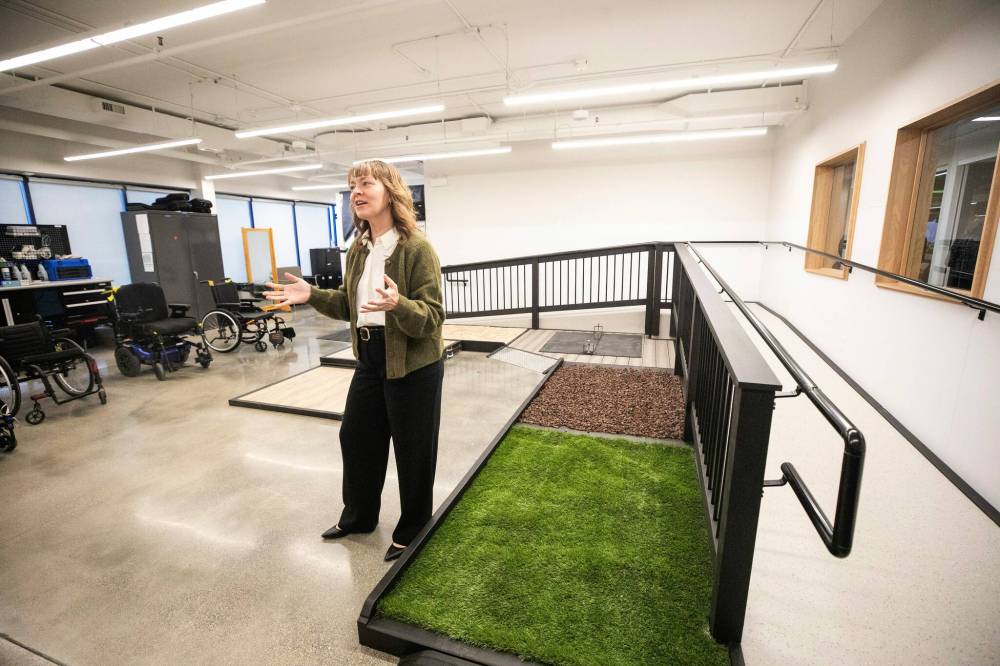
MIKAELA MACKENZIE / FREE PRESS
Manitoba Possible CEO Lindsey Cooke said Wednesday the organization moved in to a smaller space, partly to free up money for staff wages.
“I am embarrassed to say my wages are not enough to keep me from going to the food bank,” one employee said in an anonymous statement released by the union.
Another employee, a single mother, said she couldn’t afford to maintain her vehicle.
“Yet I am supposed to do more and more driving for my job,” she said.
In September, the Canadian Centre for Policy Alternatives calculated Winnipeg’s hourly “living wage” at $20.31 for each working parent in a family of four. For a single parent with one child, it was $26.56.
A wage schedule provided by the MGEU shows 16 of the organization’s 45 job classifications have starting wages below that level for a two-income family. Nearly two-thirds fall below the living wage for a single parent.
Recreation assistants and parking permit support clerks start at $16.82 an hour, while direct support professionals start at $17.65.
MGEU president Kyle Ross said even workers earning slightly above the living wage struggle to afford necessities.
“Anybody working full time shouldn’t just be getting by,” he said Wednesday.
Manitoba Possible, which adopted the name change in 2020, serves more than 75,000 Manitobans with disabilities annually. Services include employment training, American Sign Language instruction, recreation and wheelchair provision and maintenance.
It consolidated its offices at 825 Sherbrook St. and 1857 Notre Dame Ave. The new headquarters is at 1680 Notre Dame Ave.
CEO Lindsey Cooke said Wednesday the move reduced the organization’s footprint by 20 per cent from 44,000 square feet, partly to free up money for staff wages.
In a followup email, a spokesperson for Manitoba Possible said the organization was aiming at maintaining or reducing rental costs but didn’t disclose anticipated savings or whether they were factored into its wage offer.
“Manitoba Possible cares deeply about fair pay for our staff,” Cooke said. “At the same time, we’re obligated to ensure the continuity of disability services that people rely on here in Manitoba.”
The organization, which receives 40 per cent of its revenue from the province, confirmed it requested additional funding.
According to its 2025-26 annual report, Manitoba Possible generated $19.1 million in revenue and incurred $18.4 million in expenses. Winnipeg Regional Health Authority accounted for another 13 per cent of its revenue.
The organization provided and repaired nearly 6,000 wheelchairs in 150 communities and helped 745 Manitobans pursue employment and education, says the report.
More than 3,000 children received services such as physiotherapy, occupational therapy, speech-language therapy and audiology in their home communities.
Ross said the union is willing to work with Manitoba Possible to secure additional funding, pointing to a recent radio appearance in which Premier Wab Kinew acknowledged that disability support workers need a raise.
“(Their employees) are taking care of people. We should make sure we’re taking care of them,” Ross said.
The new headquarters, supported by the organization’s $3.8-million Breaking Barriers capital campaign, builds on its history of pioneering accessible design.
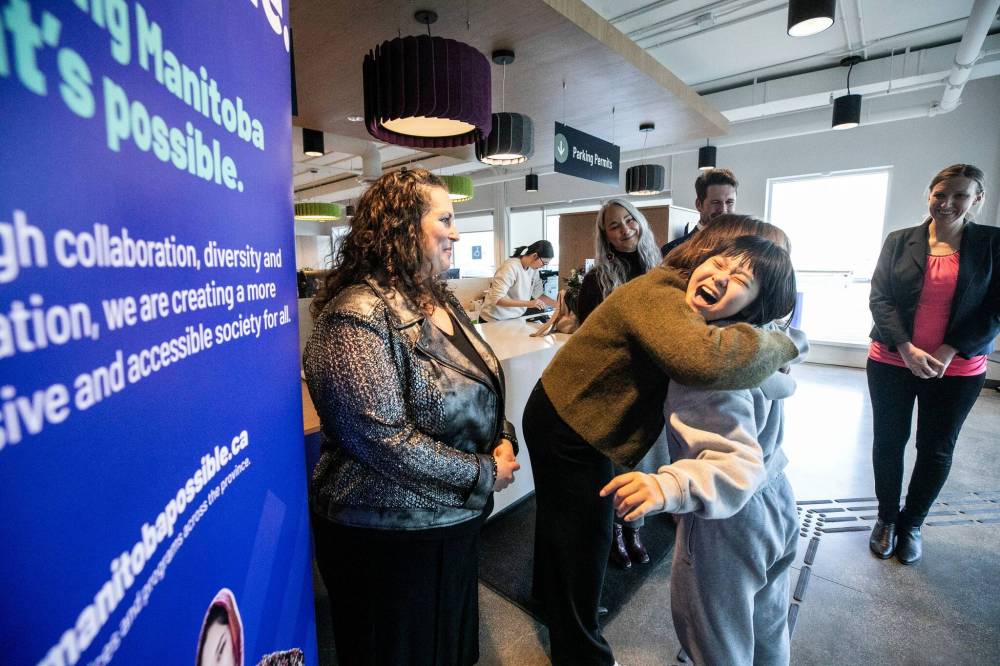
MIKAELA MACKENZIE / FREE PRESS
Hannah Yang (right), former youth ambassador for Manitoba Possible, hugs Manitoba Possible CEO Lindsey Cooke in its new space on Wednesday.
Its former Sherbrook Street headquarters, which opened in 1963, was considered a model of accessibility at the time.
The new space incorporates more than 80 per cent of the 400-plus accessibility recommendations developed with Manitobans with disabilities, staff and accessibility experts.
Despite its smaller footprint, Manitoba Possible has expanded some programming. Its supper club, which combats food insecurity and social isolation, can now accommodate at least 35 participants, up from 15.
“We finally have a space that matches the potential of the people who use it,” employee and ambassador Jeanette Diema said.
Among her favourite features is a height-adjustable toilet she can use without fear of falling or being unable to get up.
“Accessibility isn’t just a policy or a building code. It’s the difference between someone feeling included or feeling like an afterthought,” she said.
Ross, who toured the headquarters about a month ago, said employees likely appreciate the improvements, but retaining staff also requires investment in the workforce.
“When wages aren’t competitive, workers will go find a place that is,” he said.
Wage and staffing concerns extend beyond Manitoba Possible.
Abilities Manitoba, a network of 66 organizations supporting people with intellectual disabilities, including Manitoba Possible, presented a strategy to Families Minister Nahanni Fontaine in July to avert a workforce crisis.
It called for an immediate increase in the amount it provides agencies for hourly wages from an average of $19 to $27, along with funding increases to keep pace with inflation.

Manitoba Possible has spent several months working on an essential-services agreement to maintain critical operations. A strike mandate is a common step in bargaining and doesn’t mean a labour disruption is imminent, a Manitoba Possible spokesperson wrote in an email.
“We remain committed to reaching a fair and sustainable collective agreement,” the spokesperson said.
The union’s strike mandate vote was held on Nov. 6. Ross said turnout was strong but declined to disclose the percentages of votes for and against.
While discussions continue, no further bargaining dates have been scheduled.
kelly.riess@winnipegfreepress.com