

‘Nothing about us without us’: Indigenous women’s research institute launches to share knowledge

Advertisement
Read this article for free:
or
Already have an account? Log in here »
To continue reading, please subscribe:
Digital Subscription
One year of digital access for only $1.44 a week*
- Enjoy unlimited reading on winnipegfreepress.com
- Read the E-Edition, our digital replica newspaper
- Access News Break, our award-winning app
- Play interactive puzzles
*Billed as $5.77 plus GST every four weeks. After 52 weeks, price increases to the regular rate of $19.95 plus GST every four weeks. Offer available to new and qualified returning subscribers only. Cancel any time.
To continue reading, please subscribe:
Add Free Press access to your Brandon Sun subscription for only an additional
$1 for the first 4 weeks*
- Enjoy unlimited reading on winnipegfreepress.com
- Read the E-Edition, our digital replica newspaper
- Access News Break, our award-winning app
- Play interactive puzzles
*Your next Brandon Sun subscription payment will increase by $1.00 and you will be charged $17.95 plus GST for four weeks. After four weeks, your payment will increase to $24.95 plus GST every four weeks.
Read unlimited articles for free today:
or
Already have an account? Log in here »
There were many times over the course of Karine Duhamel’s career as a historian where she looked at the existing research into Indigenous women’s experiences, and noticed something was absent.
What was sometimes missing, the former director of research for the National Inquiry into Missing and Murdered Indigenous Women and Girls noticed, were the voices and perspectives of those women themselves.
For instance, she observed, research into Indigenous women’s health was sometimes not even specific to how Indigenous women actually move through the health-care system. The same was often true of research into how people experience the justice system, or make contact with child welfare authorities.
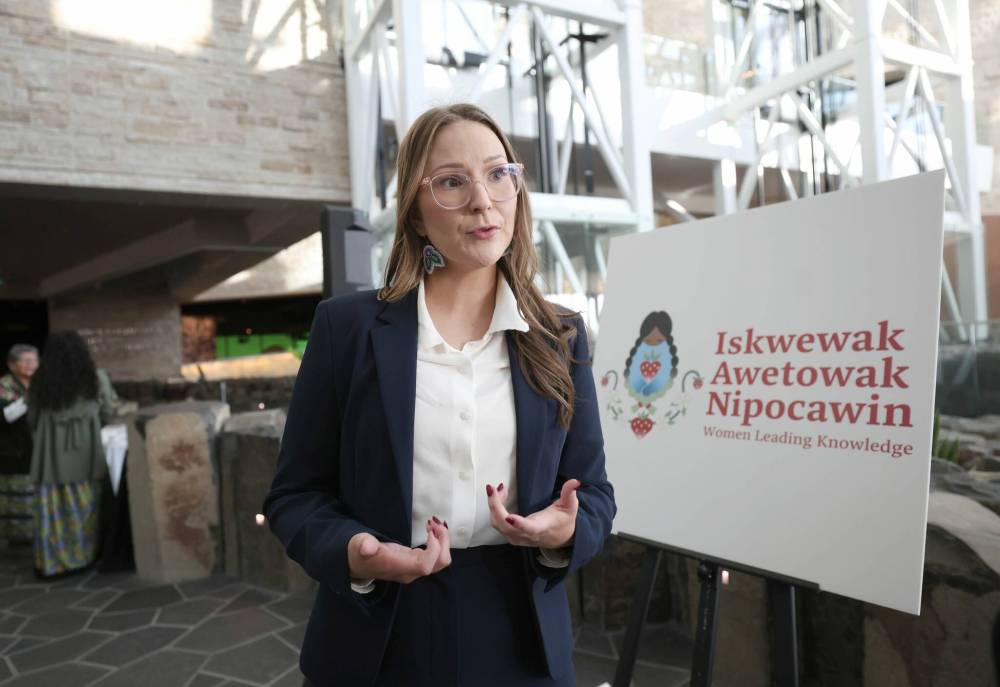
Ruth Bonneville / Free Press
Hope Ace, a member of M’Chigeeng First Nation, at the launch of Iskwewak Awetowak Nipocawin at the Canadian Museum for Human Rights, Tuesday.
“Experiences that we documented in the inquiry, and that we really need to dive into to better understand how the system can work better, don’t live in a textbook or somebody who went to a community that one time and met some people,” said Duhamel, who is Anishinaabe-Métis and a member of Opwaaganasiniing First Nation in northwestern Ontario.
“They live in the experiences of people who have been interacting with the system all their lives.”
Shortly before the COVID-19 pandemic, Duhamel and other researchers started discussing how they could better link those worlds. From those first talks, an idea was born — and now, that idea is taking wing as Iskwewak Awetowak Nipocawin, or Women Leading Knowledge, a new Indigenous women’s research institute based in Winnipeg.
“The idea was born out of a very simple acknowledgement that Indigenous women and gender-diverse people bring something really valuable to research, a very unique sort of perspective and approach,” Duhamel said, chatting after the launch of the centre Tuesday. “Fundamentally, it’s the idea of nothing about us without us.”
The new centre was announced at the Canadian Museum for Human Rights, amid bright winter light and the scent of smudge. It features a three-person staff under the leadership of research and partnerships director Hope Ace, who is a member of M’Chigeeng First Nation.
Its central aim will be to conduct Indigenous-led research that is responsive to community needs, and centres “Indigenous matriarchal wisdom to build a world worthy of future generations,” a release stated.
To Ace, that means including Indigenous women, girls and gender-diverse people in all they do, and sharing the knowledge they gather.
“We want all of this to be for community,” Ace said, speaking after the news conference. “We want the community to be able to utilize this research in any capacity they choose, whether it’s writing books, applying for funding, having youth in different spaces… we want to be responsive to community to support their decision-making, and ensure their goals are met.”

The institute’s first three projects were generated out of discussions with community about areas where resources are lacking. The first will be a resource guide and toolkit examining what mental health means to Indigenous women and girls; the second will explore what Indigenous-led service providers need to be supported during crises, such as wildfires. A third project will examine links between gender-based violence, human trafficking and resource extraction.
In March, the institute will partner with Manitoba organization Giganawenimaanaanig to host Time to Get It Right, a conference set to bring together thinkers from a range of sectors to explore how best to protect Indigenous women’s human rights, with the goal of preparing an eventual United Nations submission.
The hope, Duhamel said, is that through partnerships with academics, governments, and community, the institute will be able to share knowledge that shapes an evidence-based approach to tackling the challenges and barriers many Indigenous women, girls, two spirit, and gender-diverse people face.
“By centring Indigenous women gender-diverse people in their research, there’s a real opportunity to recognize how that agency and expertise can really point to like solutions that actually work,” Duhamel said. “So many times we’re just trying stuff, and I think we can actually achieve things in this context if we really apply the insight that’s generated.”
melissa.martin@freepress.mb.ca
Our newsroom depends on a growing audience of readers to power our journalism. If you are not a paid reader, please consider becoming a subscriber.
Our newsroom depends on its audience of readers to power our journalism. Thank you for your support.
Our newsroom depends on a growing audience of readers to power our journalism. If you are not a paid reader, please consider becoming a subscriber.
Our newsroom depends on its audience of readers to power our journalism. Thank you for your support.
Advertisement Advertise With Us
Advertisement Advertise With Us