

Fixed election dates meaningless if governments routinely disregard them

Advertisement
Read this article for free:
or
Already have an account? Log in here »
To continue reading, please subscribe:
Digital Subscription
One year of digital access for only $1.44 a week*
- Enjoy unlimited reading on winnipegfreepress.com
- Read the E-Edition, our digital replica newspaper
- Access News Break, our award-winning app
- Play interactive puzzles
*Billed as $5.77 plus GST every four weeks. After 52 weeks, price increases to the regular rate of $19.95 plus GST every four weeks. Offer available to new and qualified returning subscribers only. Cancel any time.
To continue reading, please subscribe:
Add Free Press access to your Brandon Sun subscription for only an additional
$1 for the first 4 weeks*
- Enjoy unlimited reading on winnipegfreepress.com
- Read the E-Edition, our digital replica newspaper
- Access News Break, our award-winning app
- Play interactive puzzles
*Your next Brandon Sun subscription payment will increase by $1.00 and you will be charged $17.95 plus GST for four weeks. After four weeks, your payment will increase to $24.95 plus GST every four weeks.
Read unlimited articles for free today:
or
Already have an account? Log in here »
There’s little point passing laws establishing fixed-election dates if premiers and prime ministers can disregard them whenever it suits their political interests.
And that seems to be happening with greater frequency these days, including in Manitoba.
The entire purpose of fixed-election legislation is to remove the political gamesmanship from elections by ensuring governing parties can’t choose the timing of a vote simply because they believe the circumstances give them an electoral advantage.
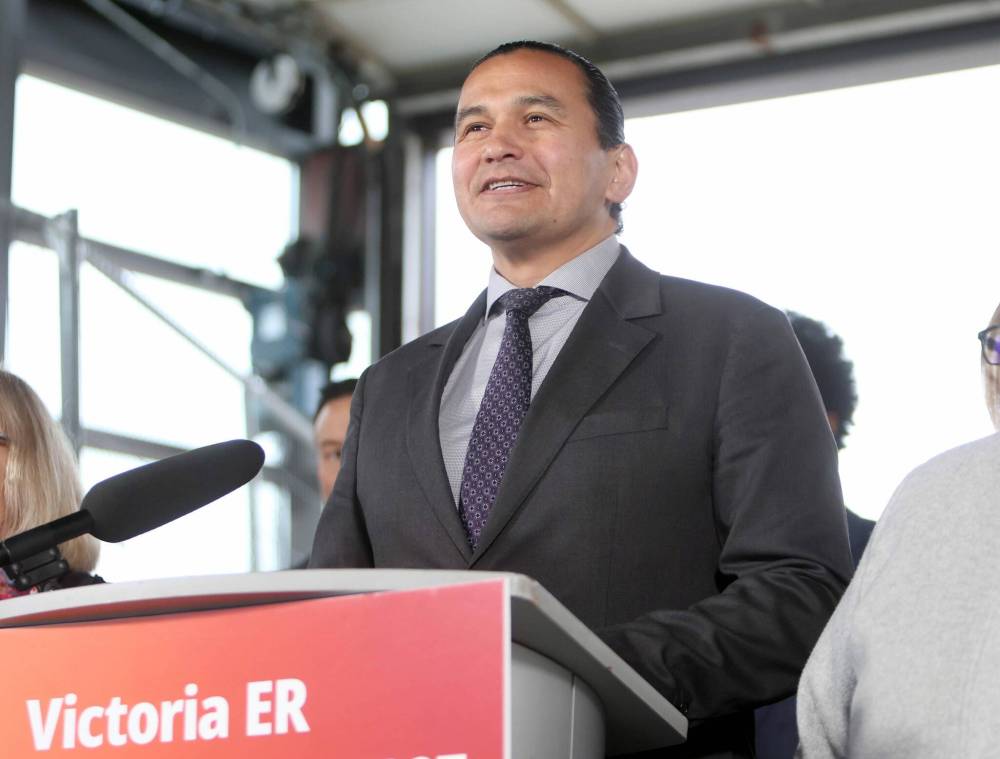
RUTH BONNEVILLE / FREE FILES
Premier Wab Kinew has suggested he may be considering calling an election in the spring.
Yet that’s exactly what many first ministers do.
Manitoba Premier Wab Kinew is providing another example of how little regard governments have for these supposed electoral safeguards.
His comments at the Manitoba NDP convention in Winnipeg earlier this month suggest he may be considering calling an election in the spring, roughly six months before the scheduled Oct. 5 vote.
Kinew stopped short of confirming an early election call but did little to dispel the possibility. Asked whether he was considering taking Manitobans to the polls ahead of schedule, he ruled out an election before the end of 2026 but left the door open to a spring campaign.
His comments suggested the prospect is not only on his radar, but one he finds appealing.
“I love the springtime and we’ll have a budget in the spring and lots of exciting things to talk about,” he said.
Manitoba doesn’t need an election six months early. There’s no compelling reason for it. If Kinew calls an early vote, it would be solely for some self-serving political reason.
Perhaps the premier wants to get a provincial election out of the way sooner so he can shorten the length of time he hopes to spend as premier. Maybe he has other political ambitions down the road, including a possible run at federal politics (after two or three terms as premier) and would like to get on with that sooner rather than later.
Who knows?
Maybe he’s just trying to throw the Opposition Tories off balance by keeping them guessing and forcing them to scramble to make early election plans.
It doesn’t matter what the reason is — it’s not supposed to happen under fixed-election dates. But those rules aren’t worth the paper they’re written on if they’re blatantly disregarded.
Former Progressive Conservative premier Brian Pallister called an early election in 2019, a full year ahead of the scheduled 2020 vote. There was no compelling reason to do so, at least not from a public-interest standpoint.
He decided the political circumstances were favourable to him, for whatever reason, and he pulled the trigger.
It didn’t hurt him politically — the Tories still won with a sizable majority.
British Columbia’s former premier David Eby recently called an early election, but paid a steep political price for it. His NDP government was roundly defeated last month in what many consider to be one of the worst political blunders in modern-day Canadian history.
Former prime minister Justin Trudeau and his minority Liberal government called an early election in 2021 in an effort to secure a majority.
Holding an early vote was not in the public interest, but Trudeau called one anyway, purely for self-serving reasons.
He didn’t get the majority he sought, but the Liberals did hold on to minority status. What it did do, though, was further erode the spirit and intent of fixed-election dates.
Holding elections every four years on a fixed date is supposed to strengthen democratic accountability. It should give opposition parties, potential candidates and voters a predictable timetable.
It’s supposed to prevent governing parties from exploiting the advantages of incumbency by choosing the moment when they believe they’re most likely to win (or to improve their standing in the House of Commons or provincial legislatures).
The problem is that fixed-election dates are impossible to enforce. Under Canada’s Constitution, governors-general and lieutenant-governors have the sole authority to dissolve Parliament and provincial legislatures, respectively, normally on the advice of the first minister.
There are good reasons for that, including if a government loses the confidence of the house.

And federal or provincial fixed-date election laws cannot override that provision.
So the question becomes: If premiers and prime ministers can disregard fixed-election dates whenever they see a political advantage, why do we have them at all? If politicians are going to ignore them at will, why not just scrap them altogether?
Even if Kinew ultimately doesn’t call an early election — and it seems unlikely he will — the mere fact that he’s publicly flirting with the idea violates the spirit and intent of the legislation. Like many first minsters in Canada, he obviously doesn’t respect fixed-date election dates at all.
So why bother having them?
tom.brodbeck@winnipegfreepress.com
Tom has been covering Manitoba politics since the early 1990s and joined the Winnipeg Free Press news team in 2019.
Our newsroom depends on a growing audience of readers to power our journalism. If you are not a paid reader, please consider becoming a subscriber.
Our newsroom depends on its audience of readers to power our journalism. Thank you for your support.
Advertisement Advertise With Us
Advertisement Advertise With Us