

Province undertaking wide-ranging effort to deal with attendance problems in schools

Advertisement
Read this article for free:
or
Already have an account? Log in here »
To continue reading, please subscribe:
Digital Subscription
One year of digital access for only $1.44 a week*
- Enjoy unlimited reading on winnipegfreepress.com
- Read the E-Edition, our digital replica newspaper
- Access News Break, our award-winning app
- Play interactive puzzles
*Billed as $5.77 plus GST every four weeks. After 52 weeks, price increases to the regular rate of $19.95 plus GST every four weeks. Offer available to new and qualified returning subscribers only. Cancel any time.
To continue reading, please subscribe:
Add Free Press access to your Brandon Sun subscription for only an additional
$1 for the first 4 weeks*
- Enjoy unlimited reading on winnipegfreepress.com
- Read the E-Edition, our digital replica newspaper
- Access News Break, our award-winning app
- Play interactive puzzles
*Your next Brandon Sun subscription payment will increase by $1.00 and you will be charged $17.95 plus GST for four weeks. After four weeks, your payment will increase to $24.95 plus GST every four weeks.
Read unlimited articles for free today:
or
Already have an account? Log in here »
The Kinew government is seeking missing student names and detailed reports outlining how schools plan to prevent others from disengaging, dropping out or failing to ever show up for orientation.
Deputy education minister Mona Pandey contacted school leaders over the summer to request their “unclaimed pupil files,” the Free Press has learned.
Superintendents received new reporting templates to compile individual files and now-annual, systemwide plans to engage children with spotty attendance. They were also asked to maintain attendance, presence and engagement committees.
Free Press Files
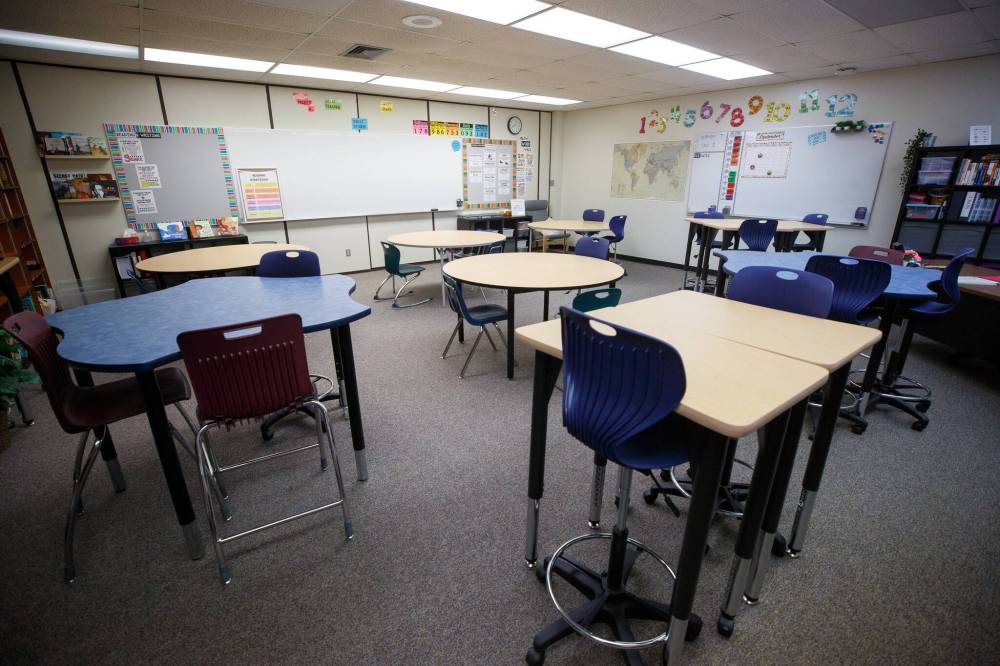
The provincial government sent a memo to school divisions this summer, calling on them to submit new attendance reports as well as develop plans to engage children with spotty attendance.
“The committee must include representation from the division or district, the schools, and the community. Its role is to identify local factors contributing to student absenteeism and inform the strategies and interventions included in the divisional attendance plan,” Pandey wrote in a June 29 letter.
Recipients were given about four months to submit their documents. The overwhelming majority of leaders of Manitoba’s 37 public school divisions handed in their paperwork before deadline.
Six of them — including the Winnipeg School Division, which has about 30,000 registrants, just under double the amount of students as the next-largest division — sought an extension.
At minimum, the reports are supposed to include proactive strategies to promote regular attendance, establish clear thresholds that trigger escalating responses when a child is absent and, in cases where absenteeism persists, “graduated, relational, and student-centred interventions.”
The Education Department has asked divisions to consider school-based supports and, as needed, co-ordinated, multi-agency strategies to engage individual families to identify and address barriers, which could involve transportation, caregiving responsibilities or something else.
“No longer will it be OK to just submit a report. Our government and our department will be ensuring that there’s accountability,” Education Minister Tracy Schmidt said in an interview.
Schmidt said her office will intervene if numbers do not trend in the “right” direction in response to an individual division’s plan.
The province has been systematically tracking severe chronic absenteeism since the start of the 2023-24 school year.
Data obtained by the Free Press via freedom of information shows 14 per cent of students in grades 9 to 12 were marked as “severely chronically absent” as of March 20, 2024.
Severe chronic absenteeism is defined as a teenager racking up 20 or more unexcused absences in a core course, such as English Language Arts.
“The percentage of students with severe chronic absenteeism increases by grade level, with Grade 12 showing the highest percentage at 16.78 per cent,” according to a June 2024 briefing note obtained via freedom of information request.
Students who self-identify as First Nations, Métis or Inuit are disproportionately impacted, accounting for about six in 10 of all students in this category. As of this fall, the Indigenous Excellence in Education unit is in charge of collecting detailed attendance data.
Just over a year ago, Premier Wab Kinew identified “Reach Out, Reach Up” as one of his government’s priorities.
The province appears to have abandoned the initiative or, at the very least, its branding, for a renewed proposal to tackle chronic absenteeism in K-12 schools.
“I don’t want us to resort to sloganeering for absenteeism,” Kinew told reporters last week when he was asked what happened to the project, of which few details were released in last year’s throne speech.
The Free Press asked the premier about the status of the project, shortly before Manitoba Lt.-Gov. Anita Neville delivered his latest speech from the throne Nov. 17.
Following repeated followup requests for details, Kinew’s office released documents detailing the Education Department’s current expectations for school leaders.
“It’s a very discouraging dodge to just brush it off,” said Kent Dueck, executive director of Inner City Youth Alive.
“Reach Out, Reach Up is sort of the ultimate sign of sloganeering.”
The province has not published any news releases containing the slogan over the last year.
Pandey’s June memo, which was sent three months after the Free Press reported on leaked documents exposing the troubling state of truancy, did not mention it.
A former school trustee, who was the education minister’s legislative assistant before he was kicked out of the NDP caucus in September 2024, tabled the statistics in the legislature in March.

“They said it was a priority for the government and they said that there would be legislation coming to ensure targets were met and progress was made on this. Neither was one of those things are true,” said Mark Wasyliw, now an independent MLA.
Wasyliw noted the NDP caucus, which he was ejected from in 2024, also recently dismissed his private member’s bill proposing principals be required to report annually on the number of students who are chronically absent.
The education minister said Monday that Reach Out, Reach Up is part of an interdepartmental government plan to address “the varied and complicated reasons that drive absenteeism.”
The new reporting directives apply to public school divisions, independent schools and the Manitoba School for the Deaf.
maggie.macintosh@winnipegfreepress.com
Maggie Macintosh reports on education for the Winnipeg Free Press. Funding for the Free Press education reporter comes from the Government of Canada through the Local Journalism Initiative.
Our newsroom depends on a growing audience of readers to power our journalism. If you are not a paid reader, please consider becoming a subscriber.
Our newsroom depends on its audience of readers to power our journalism. Thank you for your support.
Advertisement Advertise With Us
Advertisement Advertise With Us