Anger main ingredient in family stew
Cooking show host, son serve intergenerational tensions nice and hot
Advertisement
Read this article for free:
or
Already have an account? Log in here »
To continue reading, please subscribe:
Digital Subscription
One year of digital access for only $1.44 a week*
- Enjoy unlimited reading on winnipegfreepress.com
- Read the E-Edition, our digital replica newspaper
- Access News Break, our award-winning app
- Play interactive puzzles
*Billed as $5.77 plus GST every four weeks. After 52 weeks, price increases to the regular rate of $19.95 plus GST every four weeks. Offer available to new and qualified returning subscribers only. Cancel any time.
To continue reading, please subscribe:
Add Free Press access to your Brandon Sun subscription for only an additional
$1 for the first 4 weeks*
- Enjoy unlimited reading on winnipegfreepress.com
- Read the E-Edition, our digital replica newspaper
- Access News Break, our award-winning app
- Play interactive puzzles
*Your next Brandon Sun subscription payment will increase by $1.00 and you will be charged $17.95 plus GST for four weeks. After four weeks, your payment will increase to $24.95 plus GST every four weeks.
Read unlimited articles for free today:
or
Already have an account? Log in here »
Food may be love, but for award-winning Pakistani-Canadian actor and playwright Zorana Sadiq, it’s also the fodder for her sophomore play, Comfort Food, which turns up the heat on fraught family dynamics and how intergenerational tensions can too easily boil over.
This gripping two-hander is often as sharp as a butcher’s knife. There’s a lot of truth to Sadiq’s narrative, which focuses on Bette, a floundering TV cooking show host (also performed by Sadiq, marking her Royal Manitoba Theatre Centre debut) and her teenage son KitKat (a particularly riveting Noah Grittani, another local debut), who is consumed by the threat of climate change and the siren call of the internet as he increasingly spirals towards the dark web.
Directed originally by Mitchell Cushman in Toronto and remounted here by associate director Jill Harper, the play begins innocuously, as Bette whips up Belgian waffles in her functional TV kitchen (designed by Sim Suzer) and debates the merits of strawberry balsamic compote. The theatre audience, now morphed into an interactive TV studio audience, is egged on to applaud, deposit questions for Bette in an onstage cookie jar before curtain and shout out responses to her queries.
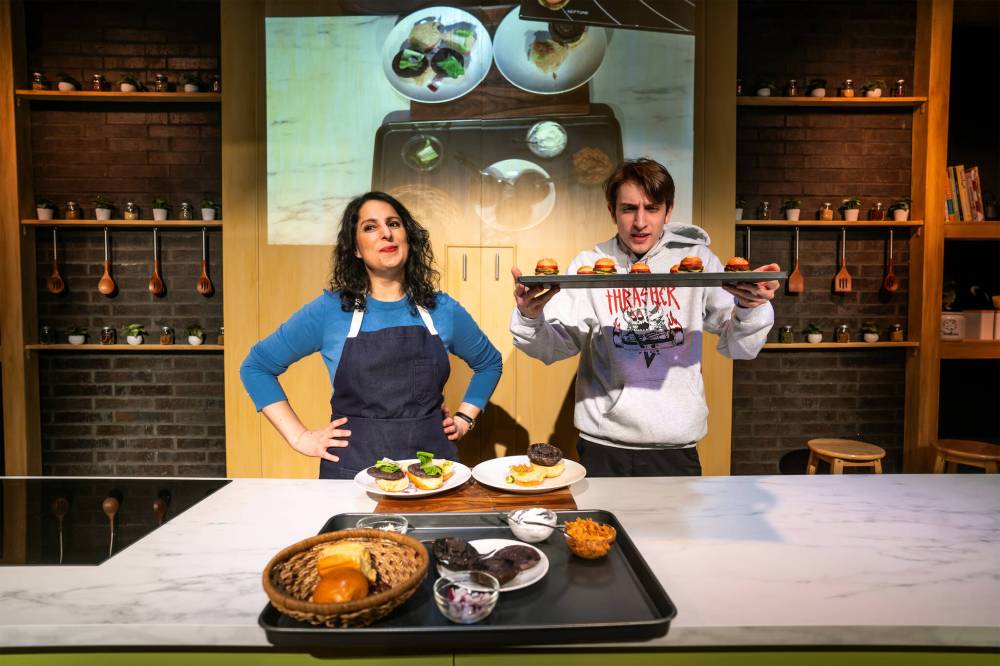
Dahlia Katz photo
Emotional temperatures rise between Zorana Sadiq (left) and Noah Grittani in Comfort Food. Both actors made their local debut in this production.
Bette’s initial banter with the crowd rambles and meanders, making one fear the rest of the 110-minute (billed as 90, sans intermission) production — but this is precisely the point. When Bette’s show-within-a-show, also called Comfort Food, is turned into a live broadcast to beef up its sagging ratings, she hatches a plan to have her son appear as a guest — a move that becomes a volatile pressure cooker.
One of Comfort Food’s most chilling aspects is video designer Tori Morrison’s slick integration of digital technology.
KitKat, who lives his life through screens, creates YouTube videos and TikTok reels that become part of the show; his looming face projected onto two sliding door panels that also display increasingly ominous tweets from the followers he is so hungry to secure. Witnessing an actor delivering lines second-hand through a screen is more than unsettling, heightened further by Thomas Ryder Payne’s pulsing electronic score and Echo Zhou’s dramatic lighting effects.
Anger is the main ingredient in this stew pot of family dysfunction, with KitKat’s character at times feeling too one-dimensional. Fleshing out why this alienated, troubled teen is driven towards screens and social media (admittedly an easy reach for many these days) would add greater overall context.
The Pandora’s box of the internet also obfuscates the overriding theme of the play; is this potent drama ultimately about familial ties that bind? Or is it a cautionary tale regarding the ever-lurking powers of the dark web, including its inherent handmaidens, “fake news” and, by corollary, artificial intelligence? It’s not entirely clear.
However, Sadiq also wisely peppers the script with dashes of humour, such as when Bette awkwardly attempts to speak in teenage colloquialisms, including asking about KitKat’s “vibe.” Watching her viciously punch down bread dough also speaks volumes as emotional temperatures rise.
One arguably missed opportunity comes when KitKat painfully confronts his mother about his own conception via a beekeeping, sperm-donor father, secured through an online profile. We need to see these vulnerable moments, especially with the teen as he struggles with the realities of his life, which includes ongoing power struggles with the president of his protest group, Eco-Citizens, in order for his outrage — and ultimate re-connection with his mother — to ring true.

Despite all this, Sadiq delivers a heartfelt, compelling performance with spot-on beat changes; her increasing distress is palpable as she loses her grip on her own cooking show, her identity and, most importantly, her son. Bette’s deliciously stirring monologue near the end about wanting to hold her beloved child forever, “steady in their rapture” becomes pure, deeply moving poetry, resonant with so many parents.
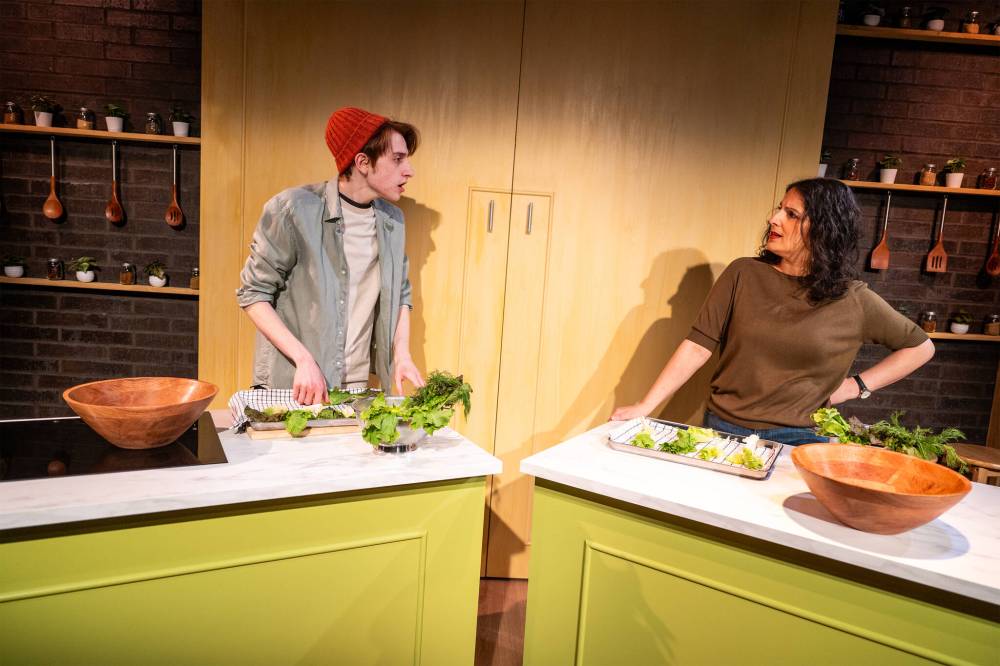
Dahlia Katz photo
Noah Grittani (left) and his mom Zorana Sadiq battle it out in the kitchen.
Grittani similarly crafted his rebellious, roiling character as a powder keg ready to blow, his escape into the vortex of cyberspace truly harrowing. This rising Canadian star also displayed a remarkable versatility as he spins through a rogue’s gallery of guest interviewees on the newly re-vamped TV show, fuelled by sound designer Thomas Ryder Payne’s peppy intro music. However these additional characters added little to the narrative arc, while dispelling its forward thrust, and could easily be sliced.
The ending also felt too abrupt and not wholly believable, as Bette and KitKat neatly reconcile after one of their most explosive scenes. The denouement in which KitKat, having now moved into sustenance gardening, is a bit of a puzzler, particularly when he had just walked a razor’s edge towards utter self-destruction.
Still, Comfort Food serves up hope that even the broadest generational chasm can be bridged through greater communication and understanding.
holly.harris@shaw.ca