Continuing journey
Updated take on once-obscure opera becomes a powerful testament to education, curiosity and leadership

Advertisement
Read this article for free:
or
Already have an account? Log in here »
To continue reading, please subscribe:
Digital Subscription
One year of digital access for only $1.44 a week*
- Enjoy unlimited reading on winnipegfreepress.com
- Read the E-Edition, our digital replica newspaper
- Access News Break, our award-winning app
- Play interactive puzzles
*Billed as $5.77 plus GST every four weeks. After 52 weeks, price increases to the regular rate of $19.95 plus GST every four weeks. Offer available to new and qualified returning subscribers only. Cancel any time.
To continue reading, please subscribe:
Add Free Press access to your Brandon Sun subscription for only an additional
$1 for the first 4 weeks*
- Enjoy unlimited reading on winnipegfreepress.com
- Read the E-Edition, our digital replica newspaper
- Access News Break, our award-winning app
- Play interactive puzzles
*Your next Brandon Sun subscription payment will increase by $1.00 and you will be charged $17.95 plus GST for four weeks. After four weeks, your payment will increase to $24.95 plus GST every four weeks.
Read unlimited articles for free today:
or
Already have an account? Log in here »
When Neema Bickersteth was invited to sing the title role in a concert version of Scott Joplin’s Treemonisha about a decade ago, she was floored by the fact she had never heard of it.
“I didn’t even know it existed. It was just like, what? This is an opera that Scott Joplin wrote, and we don’t know it?” the Alberta-born, Toronto-based soprano says.
Now, she knows it well. Bickersteth has been singing the role of Treemonisha in Scott Joplin’s Treemonisha: A Musical Reimagining since it was first developed by Toronto performance company Volcano and a creative team led by Black women artists in 2016.
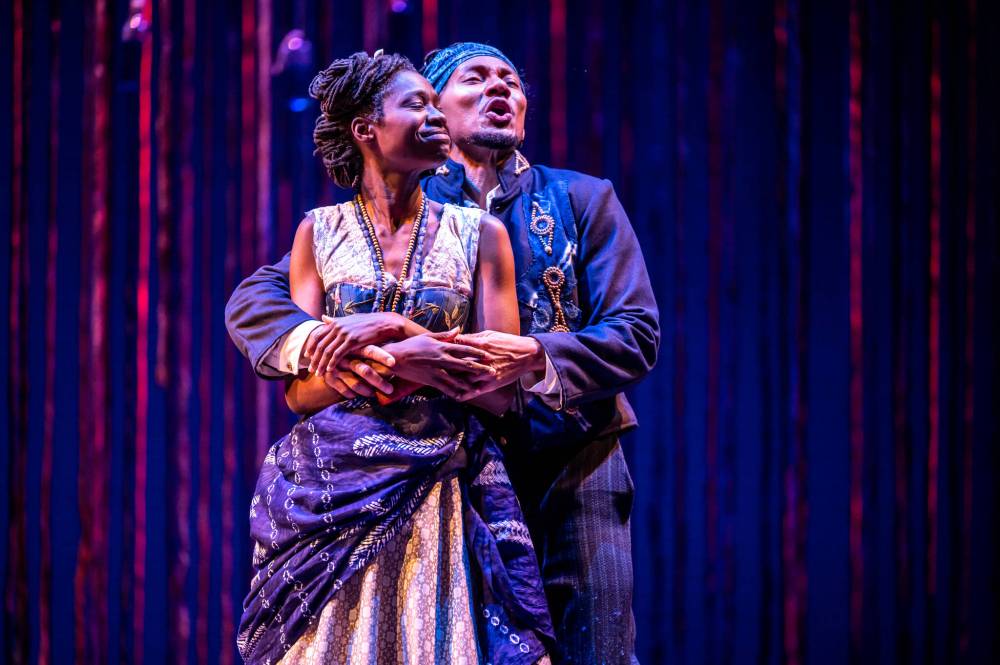
Dahlia Katz photo
Neema Bickersteth (front) stars as Treemonisha in Scott Joplin’s Treemonisha: A Musical Reimagining
But for too long, the original work, which makes its Western Canadian debut this week courtesy of Manitoba Opera at the Centennial Concert Hall, had languished in obscurity.
Joplin, an African-American ragtime composer, completed Treemonisha in 1910, seven years before his death at the age of 48. But his groundbreaking opera — about a strong young Black woman who shows her community that education is liberation — wasn’t fully staged until 1972, and Joplin was posthumously awarded a Pulitzer Prize for his contributions to American music in 1976.
Even though it wasn’t recognized as a foundational work during his lifetime, Joplin knew the value of what he had composed. In 1911, he famously hand-carried a copy of Treemonisha’s score — which he had paid $2,000 to self-publish — to the Library of Congress in Washington D.C. to ensure its preservation.
“I always think of it as, by putting in the Library of Congress, it’s like he threw a bottle in the ocean for a generation that would be ready for him,” says director Weyni Mengesha, who is part of the Black-women-led creative team, along with librettists Leah-Simone Bowen and Cheryl L. Davis, conductor Jeri Lynne Johnson, choreographer Esie Mensah and arrangers Jessie Montgomery and Jannina Norpoth.
When Volcano artistic director Ross Manson approached Mengesha about the project, she didn’t know Joplin had written an opera, either.
“When I heard the story about how he never saw it produced in his lifetime, I was immediately drawn to know more — the story of the story, in a way,” says the former artistic director of Toronto’s Soulpepper Theatre and director of the plays Da Kink in My Hair and Kim’s Convenience.
“And I was just taken by the music.”
Set in the Deep South, the opera blends Western classical music with blues, gospel and ragtime to tell the story of a young Black woman who, as a baby, is hidden in a tree by her mother in order to escape enslavement and is then raised by an adoptive family.
Treemonisha receives an education in exchange for her parents’ labour and becomes a leader and bridge between two communities who have more in common than not: the upwardly mobile Freedmen and the Maroons, who are rebuilding their connection to their African ancestry.
In Volcano’s reimagining, which premièred in Toronto in 2023, the team wanted to keep the original setting and characters of the English-language opera, but wanted to view the source material through a 21st century lens.
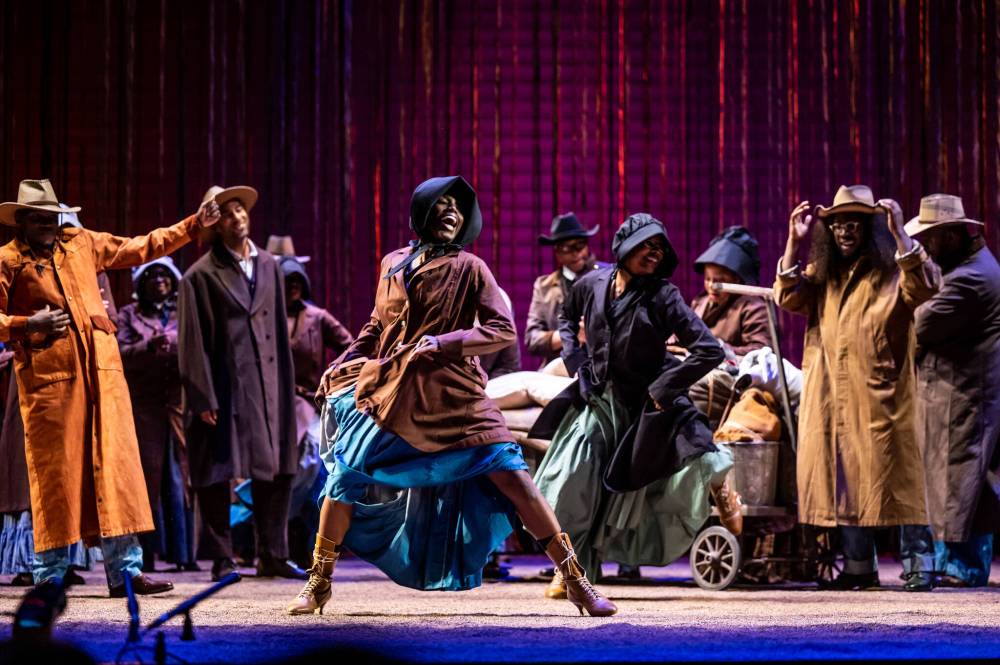
Dahlia Katz photo
Composer Scott Joplin hand-delivered a copy of Treemonisha to the Library of Congress before it was even produced.
In the original, Maroons are cast as “conjure men” — dangerous folks associated with witchcraft. Here, we get to hear from that community’s perspective; they are able to speak for themselves.
“That really came from us being interested in recognizing what he was talking about as actually African traditions and an important part of a reclamation that was happening with that community, versus something dangerous,” Mengesha says.
The character of Treemonisha is also given more agency in this version.
“In the (original), all the men decide what happens to her. She doesn’t actually say that much. She was the title character, but it was of the time where the men actually made all the choices. She was kidnapped and then she was saved,” Bickersteth says.
In this telling, Treemonisha runs away, instead of being kidnapped by the conjure men — a crucial difference, Bickersteth says.
“She makes all of the choices for her journey, and that’s so important. You make your own choices that lead you to where you are, and then you can speak on it. That, to me, is huge. That’s her main strength.”
Another strength is her curiosity, Bickersteth says.
“She knows how to read and write, and she shares that with her community. But beyond that, she’s curious. It’s not just having the skills; she has a curiosity that I think is so interesting about smart people. And that curiosity brings her to discover this neighbouring culture that turns out to be her own as well. This journey of learning who she is, that curiosity about herself, and digging into who she is, is what allows her to bring these two different peoples together.”
What hasn’t changed from the original is that Treemonisha is a leader.
“The essence of who she was, who (Joplin) imagined her to be — as somebody who would come between two communities and understand that, actually, co-operation between our communities, connection between our communities, is vital for the health of the whole Black community — that still is preserved, and I just think she’s this really fierce, strong woman,” Mengesha says.
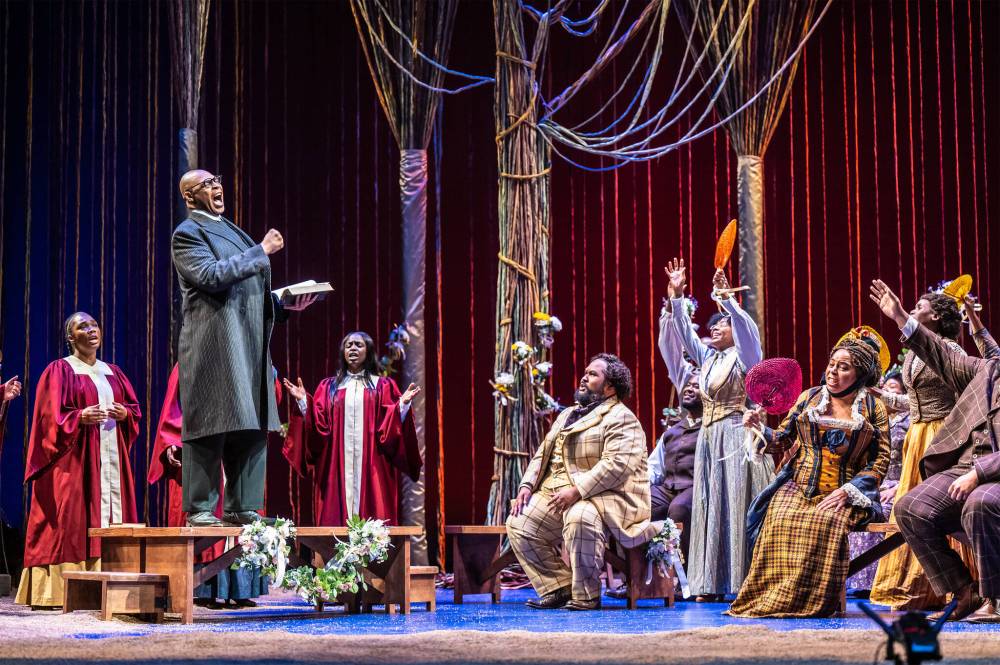
DAHLIA KATZ PHOTO
Scott Joplin’s Treemonisha: A Musical Reimagining opens Manitoba Opera’s new season.
It’s fitting, then, that this story of a Black woman leader has been brought back to life by Black women leaders.

“Basically, we just have a bunch of Treemonishas,” Bickersteth says of the creative team.
“The collaborative nature is so clear in the process and in the room right now. It’s about serving the work and each other, which is amazing to be led and to create a thing like that.”
That was another reason Bickersteth was initially attracted to the project: there wasn’t a lot of opera that had representation both on and off the stage “in such a rich and non-token way,” she says.
“There was a point in my career around the beginning of developing Treemonisha where I was like, ‘This is the direction I am meant to go in.’ This is what I need in order to grow as an artist, and to be able to feel freedom as an artist, and to be in spaces where I do feel free and safe, and that the stories that I’m telling directly connect.”
jen.zoratti@winnipegfreepress.com
Jen Zoratti is a Winnipeg Free Press columnist and author of the newsletter, NEXT, a weekly look towards a post-pandemic future.
Our newsroom depends on a growing audience of readers to power our journalism. If you are not a paid reader, please consider becoming a subscriber.
Our newsroom depends on its audience of readers to power our journalism. Thank you for your support.
OPERA PREVIEW
Scott Joplin’s Treemonisha: A Musical Reimagining
Centennial Concert Hall
Nov. 21, 7:30 p.m.; Nov. 25, 7 p.m.; and Nov. 27, 7:30 p.m.
Tickets $27-$159 at mbopera.ca
Jen Zoratti is a Winnipeg Free Press columnist and author of the newsletter, NEXT, a weekly look towards a post-pandemic future.
Our newsroom depends on a growing audience of readers to power our journalism. If you are not a paid reader, please consider becoming a subscriber.
Our newsroom depends on its audience of readers to power our journalism. Thank you for your support.
Advertisement Advertise With Us
Advertisement Advertise With Us