Giller winner not chosen until morning of awards
McNally Robinson’s Chris Hall talks about what went into selecting the best Canadian book of the year

Advertisement
Read this article for free:
or
Already have an account? Log in here »
To continue reading, please subscribe:
Digital Subscription
One year of digital access for only $1.44 a week*
- Enjoy unlimited reading on winnipegfreepress.com
- Read the E-Edition, our digital replica newspaper
- Access News Break, our award-winning app
- Play interactive puzzles
*Billed as $5.77 plus GST every four weeks. After 52 weeks, price increases to the regular rate of $19.95 plus GST every four weeks. Offer available to new and qualified returning subscribers only. Cancel any time.
To continue reading, please subscribe:
Add Free Press access to your Brandon Sun subscription for only an additional
$1 for the first 4 weeks*
- Enjoy unlimited reading on winnipegfreepress.com
- Read the E-Edition, our digital replica newspaper
- Access News Break, our award-winning app
- Play interactive puzzles
*Your next Brandon Sun subscription payment will increase by $1.00 and you will be charged $17.95 plus GST for four weeks. After four weeks, your payment will increase to $24.95 plus GST every four weeks.
Read unlimited articles for free today:
or
Already have an account? Log in here »
On Nov. 16, a fisherman/carpenter from Murray Harbour, P.E.I. took to a Toronto stage to accept one of Canada’s most lucrative literary prizes — 43-year-old Nicholas Herring had just been named the winner of the $100,000 Giller Prize for his sophomore novel Your Breath in Charcoal.
Chosen from over 150 works of Canadian fiction, Herring’s novel follows a couple of Maritime lads in the 1990s who venture off the island to Ontario to try and make a go of it in construction. His book was chosen as this year’s Giller winner by a nine-person jury of independent booksellers from across Canada, a first for the prize.
Among those booksellers was McNally Robinson Booksellers co-owner Chris Hall.
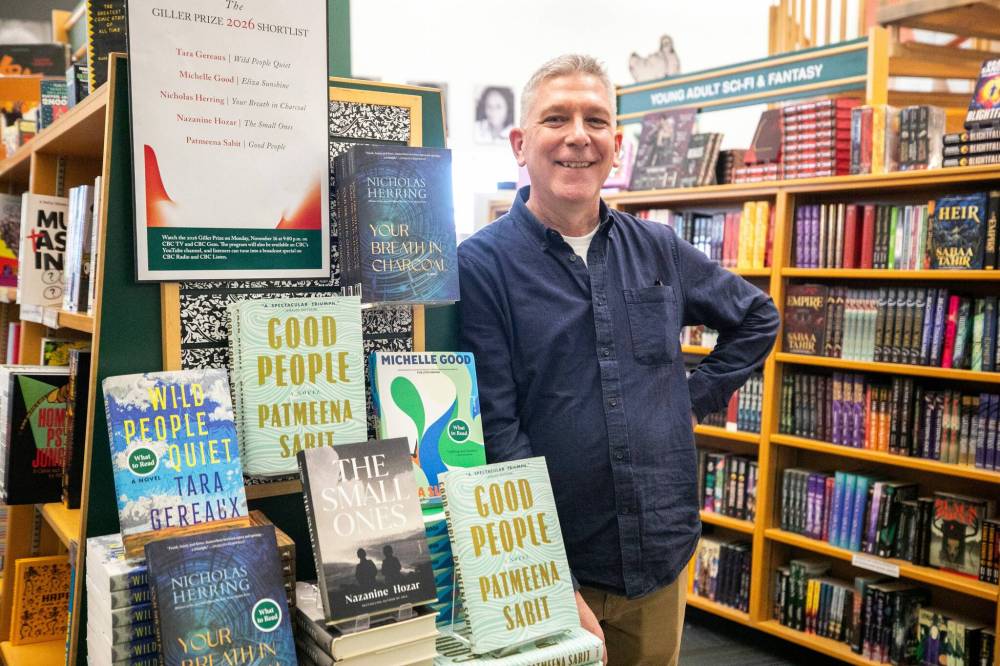
MIKAELA MACKENZIE / FREE PRESS
McNally Robinson co-owner and Giller prize juror Chris Hall poses with a display of this year’s finalists.
The typical Giller jury is made up of five people: a mix of Canadian and international authors, including a former winner of the prize. In August 2025, however, Hall received a call from Giller Prize executive director Elana Rabinovitch asking if he would be interested in being a 2026 juror on a larger jury with other booksellers.
“I think I was the first one they called — I was quite happy and excited, and so I think that gave them confidence,” Hall said by phone the day after the Giller ceremony.
“They’d had a tough couple of years, so I think they were trying to feel their way back to something positive, accepted.”
Those tough years included boycotts by authors based on the Giller Prize’s former title sponsor, Scotiabank, and the financial institution’s ties to Elbit Systems, an Israeli arms supplier. Scotiabank divested itself of those ties but also exited as title sponsor of the Giller last year, after 20 years.
For their jury duties, each of the nine jurors received an e-reader loaded with some of the 150 books submitted for the prize, divvied up between them. After whittling away some of the books that most obviously wouldn’t be Giller-calibre works, a smaller group of titles was then discussed among jurors via video calls and eventually whittled down to a 10-book short list.
“Some of my theories of reading were confirmed — every reader is different. I’m fond of saying that we all take our own journey through the bookstore. We read books in different order, and different books, and it’s such a unique reading life, a unique experience,” Hall says.
He also noted that this year’s Governor General’s literary award, the Writers’ Trust fiction prize and the Giller short lists had no crossover books.
“That’s 15 unique books for the top three prizes — an indication of how subjective and individual reading is,” he says.
The conversations the Giller jurors had were spirited but never confrontational, Hall says.
“There was no arguing — there was debating, I guess, or sharing — that’s probably the best word, because it always felt like sharing our enthusiasm for a particular book or some disagreement. It happens at the bookstore, too.”
The jurors had an August deadline to narrow the submissions down to a 10-book long list and a five-book short list so organizers could deal with marketing, design and other such matters. The long list was announced Sept. 8, and the short list revealed on Oct. 5.
Hall and his fellow jurors selected Herring’s book as the winner on the morning of the ceremony, Nov. 16.
“We had a meeting in a private room in the hotel to decide who wins. I mean we couldn’t leak it, because we had no idea who it was,” he says.
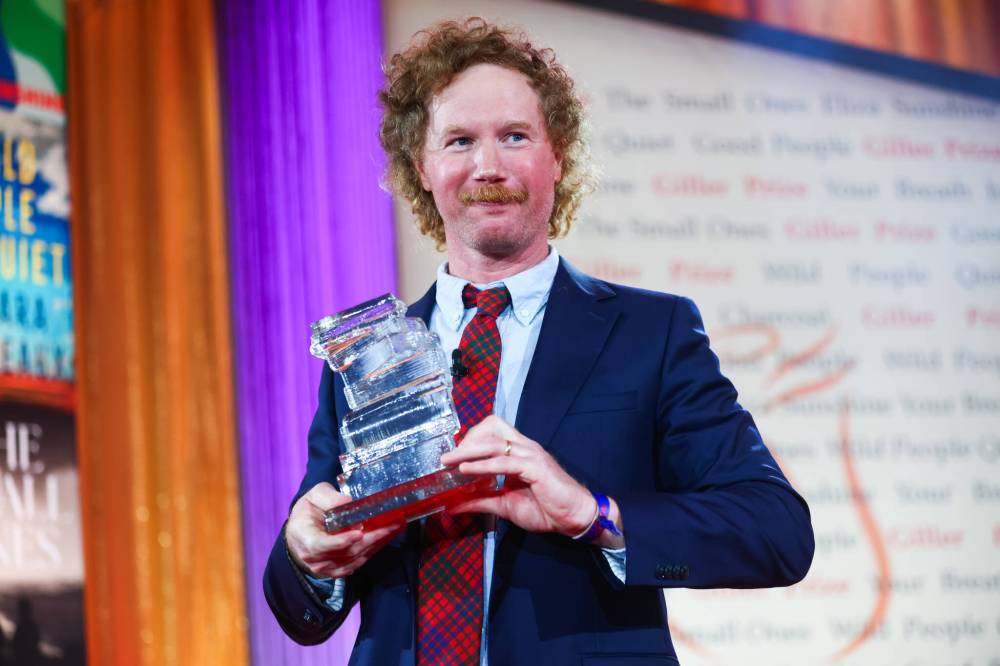
The Canadian Press
Nicholas Herring’s Your Breath in Charcoal won the 2026 Giller Prize for English-language fiction.
The final discussion saw jurors systematically go through the five finalists over the course of an hour and a half, making cases for various titles and deciding which should win $100,000 prize. (The remaining finalists each received $10,000.)
Having an odd number of people on the jury meant there would be no tie — although in Hall’s mind, all the finalists are winners.
“My take is that a short list is just a tie for first. If the winner doesn’t appeal to you, read a different one. They’re all good books, and I’ve discovered some great authors by following that advice myself,” Hall says.
As a reader, juror and bookseller, Hall found the overall process rewarding and he had nothing but praise for Herring’s Giller-winning novel.
“(Your Breath in Charcoal) is a remarkable book at a sentence-by-sentence level. It’s this working-class young fellow who has the language you’d expect from a fisherman/construction worker,” he says. “There’s lots of filthy language, but then the writing all of a sudden moves from an f-bomb to a sentence that just lifts right off the page — it’s remarkable, the way he has with words.”

On stage, with no prepared speech written, Herring swore once during his brief acceptance speech, then barely caught himself from dropping an f-bomb of his own.
Hall saw Herring’s reaction to the win as a reflection of the kind of person the author is, and the type of book he penned in Your Breath in Charcoal.
“I described it as heart. There’s so much heart in Herring’s book — I think that came across in his acceptance speech,” says Hall.
“He’s just such a real guy, and his character is so real and struggling, but genuine, making mistakes — but also this amazing heart in the middle of that.”
ben.sigurdson@winnipegfreepress.com
Our newsroom depends on a growing audience of readers to power our journalism. If you are not a paid reader, please consider becoming a subscriber.
Our newsroom depends on its audience of readers to power our journalism. Thank you for your support.
Our newsroom depends on a growing audience of readers to power our journalism. If you are not a paid reader, please consider becoming a subscriber.
Our newsroom depends on its audience of readers to power our journalism. Thank you for your support.
Advertisement Advertise With Us
Advertisement Advertise With Us