With great horsepower comes great responsibility

Advertisement
Read this article for free:
or
Already have an account? Log in here »
To continue reading, please subscribe:
Digital Subscription
One year of digital access for only $1.44 a week*
- Enjoy unlimited reading on winnipegfreepress.com
- Read the E-Edition, our digital replica newspaper
- Access News Break, our award-winning app
- Play interactive puzzles
*Billed as $5.77 plus GST every four weeks. After 52 weeks, price increases to the regular rate of $19.95 plus GST every four weeks. Offer available to new and qualified returning subscribers only. Cancel any time.
To continue reading, please subscribe:
Add Free Press access to your Brandon Sun subscription for only an additional
$1 for the first 4 weeks*
- Enjoy unlimited reading on winnipegfreepress.com
- Read the E-Edition, our digital replica newspaper
- Access News Break, our award-winning app
- Play interactive puzzles
*Your next Brandon Sun subscription payment will increase by $1.00 and you will be charged $17.95 plus GST for four weeks. After four weeks, your payment will increase to $24.95 plus GST every four weeks.
Read unlimited articles for free today:
or
Already have an account? Log in here »
Like many Winnipeggers, I was once an elementary school patrol.
In the morning and after school in the mid-1990s, you could find me holding it down on the corner of Brock Street and Kingsway Avenue with my orange flag, which I snapped closed with a flourish.
As a junior bossypants, I loved the gig; the rules and routine of it, but also the responsibility I was entrusted with. I felt, for the first time in my life, responsible for something larger and more important than myself.
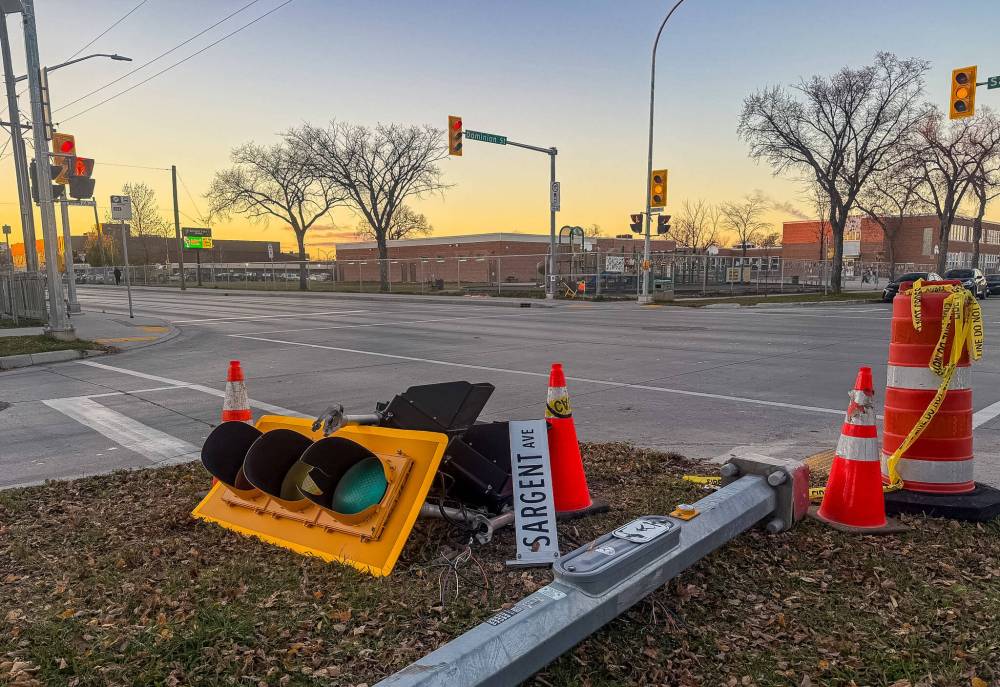
MORGAN MODJESKI / FREE PRESS FILES
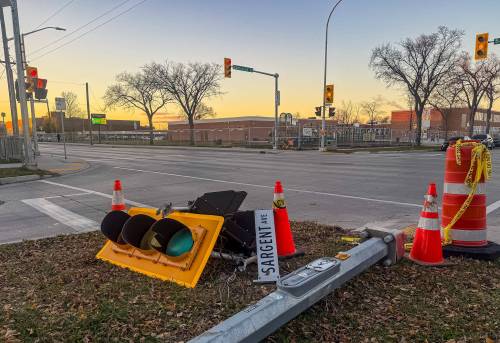
Damaged street lights near Sargent Park School caused by a vehicle collision that sent one of the school’s patrols to hospital, Wednesday.
Plus, at the end of the year, you got to go to Fun Mountain.
This level of responsibility — and commitment — is a good thing to teach kids, which is why I think the school patrol program is important. Though, I admit: when I let the children cross me and my dog at the very same corners I once guarded, it strikes me as a bit wild that we outsource road safety to 10-year-olds in high-viz vests. They all just seem so … little and vulnerable.
So, like many Winnipeggers, I was very upset to see that a patrol from Sargent Park School was hit by a car, in what sounds like a truly scary experience. Two motorists collided at traffic lights outside the school, and the student — who was on the sidewalk, working — was struck.
The student is recovering from his injuries, but this story could have ended very differently, and it illustrates that school-zone speed limits should be consistent — 30 km/h — regardless of where the schools are located.
There has been a spate of concerning pedestrian-involved collisions of late, a lot of them at intersections and pedestrian corridors.
This, to me, is reflective of a broader cultural issue, which is that this is a city in which cars are king.
As a person who walks her dog a lot, I am practically a professional pedestrian, and I have borne witness to truly shocking behaviour from drivers. I can’t tell you how many times I have almost been hit by a car turning left against the walk signal at Queenston Street at Academy Road. Or how many times people have treated a zebra crossing as a suggestion. Or how many times I’ve entered the intersection after “doing everything you’re supposed to” — make eye contact, etc. — only to have a car slowly roll through the stop sign towards me and my dog.
What if I slipped and fell? What if my dog got loose?
I also refuse to do that humiliating little jog some pedestrians feel compelled to do at an intersection to get out of the way of a stopped car. No. I have the right of way. You can feel slightly inconvenienced by me for 30 seconds.
Now, I’m not saying pedestrians don’t engage in poor behaviour, because we’ve all seen that in the wild, too. Inattention — phones, headphones, lost in thought, wrangling dogs, etc. — is a very real problem. So, too, is Froggering across multiple lanes of traffic.
But with great horsepower comes great responsibility, and I think it’s incumbent on the person operating the two-tonne killing machine to exercise extra caution. Pedestrian errors are no match for driver errors. Because in the proverbial rock-paper-scissors between metal and meat sack, metal beats meat sack.

And yet, the weight of responsibility for safety is often transferred back to the pedestrian. Make eye contact with the driver. Wear visible clothing. Only walk in brightly lit places. Sounds a lot like advice given to women to avoid being sexually assaulted.
What’s next, blow a whistle so I don’t get run over? I don’t know, how about you leave earlier?
The language used to describe collisions — pedestrians are always “struck by a vehicle” not “struck by a driver” — creates a sense of distance. But the fact is, we all have a shared responsibility out there, and we’re all just people trying to get home at the end of the day.
Those of us who were school patrols learned that well.
jen.zoratti@winnipegfreepress.com
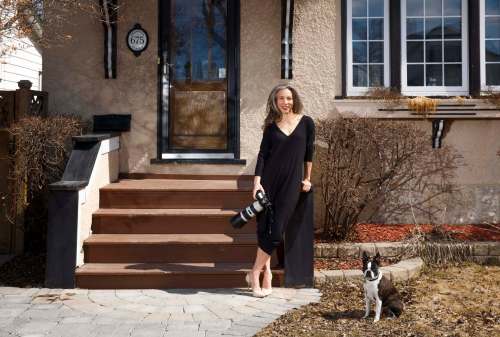
Jen Zoratti is a Winnipeg Free Press columnist and author of the newsletter, NEXT, a weekly look towards a post-pandemic future.
Our newsroom depends on a growing audience of readers to power our journalism. If you are not a paid reader, please consider becoming a subscriber.
Our newsroom depends on its audience of readers to power our journalism. Thank you for your support.
Advertisement Advertise With Us
Advertisement Advertise With Us