

Liberals gambling with Canadians’ chips at the high-risk, high-reward table

Advertisement
Read this article for free:
or
Already have an account? Log in here »
To continue reading, please subscribe:
Digital Subscription
One year of digital access for only $1.44 a week*
- Enjoy unlimited reading on winnipegfreepress.com
- Read the E-Edition, our digital replica newspaper
- Access News Break, our award-winning app
- Play interactive puzzles
*Billed as $5.77 plus GST every four weeks. After 52 weeks, price increases to the regular rate of $19.95 plus GST every four weeks. Offer available to new and qualified returning subscribers only. Cancel any time.
To continue reading, please subscribe:
Add Free Press access to your Brandon Sun subscription for only an additional
$1 for the first 4 weeks*
- Enjoy unlimited reading on winnipegfreepress.com
- Read the E-Edition, our digital replica newspaper
- Access News Break, our award-winning app
- Play interactive puzzles
*Your next Brandon Sun subscription payment will increase by $1.00 and you will be charged $17.95 plus GST for four weeks. After four weeks, your payment will increase to $24.95 plus GST every four weeks.
Read unlimited articles for free today:
or
Already have an account? Log in here »
The federal government’s latest budget is a gamble. It’s betting that tens of billions of dollars in new spending, business tax incentives and other affordability measures will generate enough economic growth to make the investment worthwhile.
If the Liberals are right, Canadians could reap some handsome dividends in the form of more jobs, higher wages and a stronger economy.
But if they’re wrong, or if an unexpected economic shock derails their projections, the gamble could become an expensive one for taxpayers.
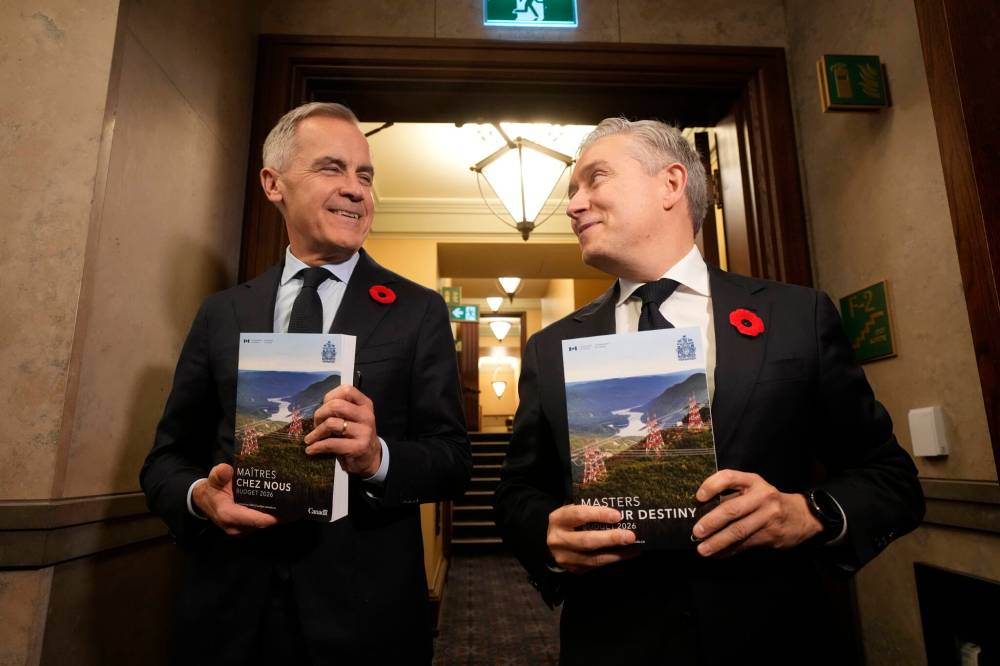
Prime Minister Mark Carney (left) and Finance and National Revenue Minister Francois-Philippe Champagne presented the federal budget yesterday on Parliament Hill. (Adrian Wyld / The Canadian Press)
That’s the risk at the heart of Finance Minister François-Philippe Champagne’s 2026 budget, introduced Thursday. The Liberals are promising to give Canada greater economic independence and resilience by spending heavily now to stimulate investment and productivity.
There’s certainly an economic logic to that approach. Canada needs more private-sector investment, better productivity and a stronger, more diversified economy.
The federal government’s productivity mega-deduction, which allows businesses to write off the full cost of new machinery and equipment in the first year (rather than amortize those capital investments over time), is intended to encourage precisely that.
Ottawa estimates that measure alone could add $22 billion annually to Canada’s GDP and create 80,000 jobs over a decade.
Other tax incentives, including a new capital gains exemption for eligible business investments, are designed to encourage entrepreneurs and investors to put more money into the Canadian economy.
If those measures deliver the results Ottawa is forecasting, the benefits could be substantial. More investment means more economic activity, more employment opportunities and better-paying jobs.
But there is a considerable difference between projecting economic growth and actually delivering it.
The budget forecasts real GDP growth of just one per cent this year, improving to 1.7 per cent next year and two per cent by 2028. Those aren’t spectacular numbers. But it is modest growth.
However, a worsening trade relationship with the United States, a recession or some other unforeseen event could quickly undermine those projections.
Ottawa is projecting a $62.3-billion deficit this fiscal year and $62.5 billion in 2027-28. The annual shortfall is projected to fall slightly to $52.9 billion by 2030-31. That’s a staggering amount of red ink.
The federal government argues its finances remain sustainable, pointing to projections showing the debt-to-GDP ratio hovering around 40 per cent over the next five years before eventually declining.
That’s an important distinction. Canada’s federal debt burden is nowhere near the dangerous territory it occupied in the mid-1990s, when the debt-to-GDP ratio reached roughly 67 per cent and was climbing.
At that time, Ottawa was facing mounting borrowing costs and the very real prospect of multiple credit-rating downgrades. It was forced into deep spending cuts, mostly by slashing transfer payments to the provinces.
Today’s fiscal circumstances are considerably less precarious. A debt-to-GDP ratio of around 40 per cent is manageable, especially if it remains relatively stable.
At the same time, Ottawa’s debt-servicing costs — the amount of interest it pays on the debt — is growing rapidly and is forecast to take up an increasingly larger share of the budget. That’s concerning.
Still, Canada is not, by any means, facing an imminent debt crisis.
But manageable doesn’t mean unlimited.
The federal government is committing itself to an enormous amount of new spending and corporate tax relief at a time when economic growth remains modest. Even with stronger-than-expected revenues helping offset some of the new measures, Ottawa is using up considerable fiscal capacity.
If the economy performs as projected, the government could be rewarded for its willingness to invest in Canada’s productive capacity. But if growth disappoints, the deficit could quickly balloon and the federal debt could start rising at a much less comfortable pace.
And unlike governments that enter an economic downturn with balanced books or relatively small deficits, Ottawa would have considerably less room to respond.
That’s why this is such a high-risk, high-reward budget.
Governments need fiscal flexibility to deal with major economic disruptions. The COVID-19 pandemic demonstrated how quickly circumstances can change and how much public money can be required to protect businesses, workers and vulnerable Canadians during an emergency.
A government that has already committed itself to substantial deficits has fewer options when the next crisis hits.
It would have been more prudent for the Liberals to use some of their improved revenue projections to bring down the deficit more aggressively, rather than commit so much additional money to new programs and business tax relief.

Nobody is suggesting Ottawa needs to balance its books immediately. Nor should it ignore the need to stimulate investment, improve productivity and help Canadians struggling with affordability.
Those are legitimate priorities. Failing to act in those areas would have been reckless and irresponsible. But a more reasonable balance could have been achieved.
There’s nothing wrong with making ambitious bets on Canada’s economic future, as long as they are calculated risks.
The problem is making them while running deficits of more than $60 billion and leaving relatively little room to manoeuvre if the economy takes a turn for the worse.
tom.brodbeck@winnipegfreepress.mb.ca
Tom has been covering Manitoba politics since the early 1990s and joined the Winnipeg Free Press news team in 2019.
Our newsroom depends on a growing audience of readers to power our journalism. If you are not a paid reader, please consider becoming a subscriber.
Our newsroom depends on its audience of readers to power our journalism. Thank you for your support.
Tom has been covering Manitoba politics since the early 1990s and joined the Winnipeg Free Press news team in 2019.
Our newsroom depends on a growing audience of readers to power our journalism. If you are not a paid reader, please consider becoming a subscriber.
Our newsroom depends on its audience of readers to power our journalism. Thank you for your support.
Advertisement Advertise With Us
Advertisement Advertise With Us