Soviet Union’s downfall chronicled in vivid narrative

Advertisement

Advertise with us

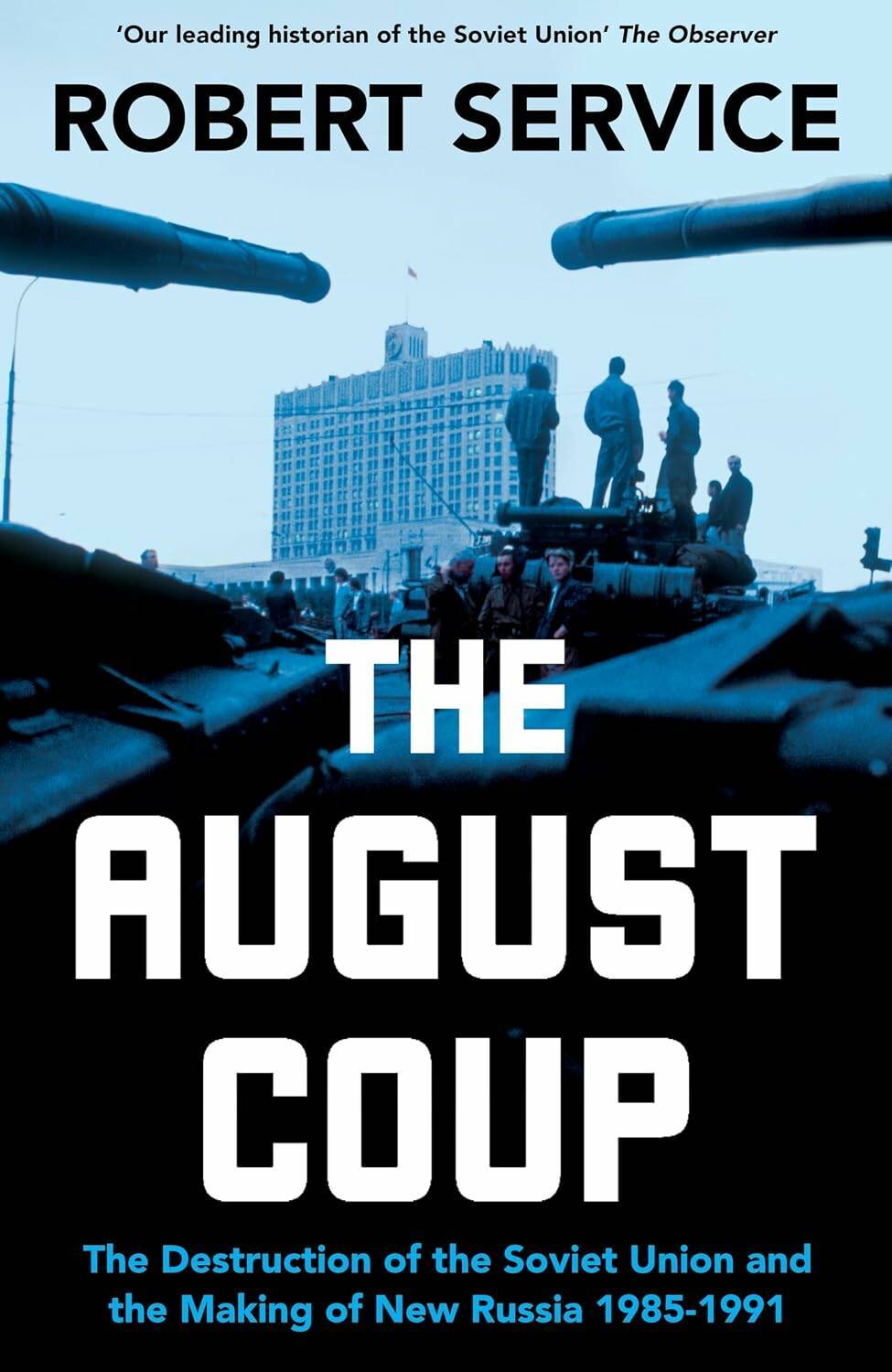
The tumultuous politics of the final years of the Soviet Union, 1985 to 1991, are recounted by British academic historian Robert Service in a vivid, intense narrative.

Read this article for free:


By clicking the button above, an account will be created and you will begin to receive some of our recommended newsletters. You may opt out of any newsletter by visiting your Email and Communication Preferences page or by clicking "unsubscribe" at the bottom of any email.

or

Already have an account? Log in here »

To continue reading, please subscribe:

Digital Subscription

One year of digital access for only $1.44 a week*

  • Enjoy unlimited reading on winnipegfreepress.com
  • Read the E-Edition, our digital replica newspaper
  • Access News Break, our award-winning app
  • Play interactive puzzles

*Billed as $5.77 plus GST every four weeks. After 52 weeks, price increases to the regular rate of $19.95 plus GST every four weeks. Offer available to new and qualified returning subscribers only. Cancel any time.

To continue reading, please subscribe:

Add Free Press access to your Brandon Sun subscription for only an additional

$1 for the first 4 weeks*

  • Enjoy unlimited reading on winnipegfreepress.com
  • Read the E-Edition, our digital replica newspaper
  • Access News Break, our award-winning app
  • Play interactive puzzles
Start now

*Your next Brandon Sun subscription payment will increase by $1.00 and you will be charged $17.95 plus GST for four weeks. After four weeks, your payment will increase to $24.95 plus GST every four weeks.

The tumultuous politics of the final years of the Soviet Union, 1985 to 1991, are recounted by British academic historian Robert Service in a vivid, intense narrative.

Central to Service’s depiction of this period is the botched coup of August 1991. A coterie of plotters, dissatisfied with the rule of Soviet president Mikhail Gorbachev, sought to oust him from power. But the attempted coup was ill-advised and only accelerated the demise of the Soviet Union — the opposite of what the plotters wanted.

The most interesting aspect of The August Coup is Service’s account of the personality and policies of Gorbachev and his nemesis, Russian leader Boris Yeltsin (Russia was the largest of the constituent republics of the former Soviet Union).
The August Coup

The August Coup

When he assumed power as general secretary of the Communist Party of the Soviet Union in 1985, Gorbachev sought to remake what had become an ossified political and economic system.

He embarked on a massive project of reform, epitomized by the slogans “glasnost” (media openness) and “perestroika” (reconstruction).

Overturning decades of communism, Gorbachev ended one-party rule, allowed dissent and released political prisoners. Religious liberties were introduced. And steps were taken to effect a gradual liberalization of the economy.

Yet Gorbachev, Service writes, was a paradox. Despite his project of reform, he never abandoned his commitment to Marxist-Leninist ideology. He believed that he was building “communism with a human face.” And he was certain his brand of communism would triumph over capitalism and liberal democracy.

Perhaps most anomalously, his political hero was Vladimir Lenin, the Russian revolutionary leader whose rule was characterized by terror and dictatorship.

Gorbachev’s economic reforms were unsuccessful. As Service says, “the government’s priorities resulted in a little economic improvement followed by much deterioration.” He failed to deliver better living conditions for the ordinary person; instead there was inflation and food shortages. The Soviet people became disenchanted with Gorbachev.

Exploiting this discontent was Boris Yeltsin, a major figure in Russian politics.

Yeltsin was often seen as an unintelligent oaf and bumbling drunk. But Service has a more sympathetic view of the former Russian president.

Yeltsin, Service writes, showed courage in rejecting Marxism-Leninism when it was still the official ideology. He read widely and denounced totalitarianism.

However, Yeltsin’s economic reforms, like Gorbachev’s, only enriched a few, and exacerbated material inequalities.

Service has written a magnificent narrative detailing the dissolution of the Soviet Union, focusing on the roles of Gorbachev and Yeltsin in these historic events.

Graeme Voyer is a Winnipeg writer.

Report Error Submit a Tip

More Stories

Apathy becoming Jets’ toughest foe

Mike McIntyre 7 minute read Preview

Apathy becoming Jets’ toughest foe

Mike McIntyre 7 minute read Tuesday, Apr. 5, 2022

When it comes to the Winnipeg Jets and their fading playoff hopes, it seems like we’ve reached the point where fan anger has given way to acceptance. The current season is circling the drain, and even the most optimistic supporters see the writing on the wall.

“Go 12 for 12. That’s the only thing we can hope for right now,” is how goaltender Connor Hellebuyck answered my question Tuesday on what the mindset is for the final dozen games. Considering his team’s longest winning streak of the year is just four games — and that happened way back in October — I’d put their chances of running the table on par with my odds of winning a Pulitzer.

As we prepare to write the inevitable obituary on a 2021-22 NHL season that began with so much promise, most of the focus is going to be on what went wrong with the on-ice product. But I’d suggest True North might be facing an even bigger challenge off the ice when it comes to injecting some life back into the patient.

The toughest opponent of all might just be apathy.

Read
Tuesday, Apr. 5, 2022

Rec strategy will wreck finances, councillors predict

Joyanne Pursaga 5 minute read Preview

Rec strategy will wreck finances, councillors predict

Joyanne Pursaga 5 minute read Thursday, Mar. 3, 2022

A proposed civic recreation strategy with $426 million in capital projects is facing plenty of criticism at city hall, triggering calls to scrap or pause the process.

The strategy was created to guide recreation priorities for 25 years and pitches a major 10-year investment in arenas and aquatic, community and leisure centres, along with outdoor pools and spray pads, beginning in 2024.

However, one city councillor fears the proposal to improve recreation access and address aging facilities would pretty much “ignore” his Charleswood-Tuxedo-Westwood ward.

“I think that entire plan needs to be scrapped and we need to do it as a council, not as a public service,” said Coun. Kevin Klein. “This is ludicrous and it should be… stopped immediately.”

Read
Thursday, Mar. 3, 2022

Providing assistance in time of crisis can benefit your mental health

Sabrina Carnevale 8 minute read Preview

Providing assistance in time of crisis can benefit your mental health

Sabrina Carnevale 8 minute read Monday, Apr. 20, 2020

Tough times often bring out the best in people. Neighbours helping neighbours, strangers helping strangers. All out of the goodness of their hearts, because that’s just what you do.

Read
Monday, Apr. 20, 2020

Students report inappropriate behaviour by The King’s School teacher

Maggie Macintosh 6 minute read Preview

Students report inappropriate behaviour by The King’s School teacher

Maggie Macintosh 6 minute read Thursday, Jun. 2, 2022

Current and former students at The King’s School say a male teacher, who has been put on leave amid an investigation, overstepped boundaries by massaging them, disclosing intimate secrets to teenagers, and asking deeply personal questions in return — including the status of their relationships with their fathers.

One Grade 12 student at the independent Winnipeg school, which is run in partnership with Gateway Church and partially funded by the provincial government, said she immediately noticed the educator’s inappropriate behaviour when she enrolled.

“It just didn’t sit right with me,” she told the Free Press.

The student described the educator’s conduct as “intimate.” He offered what he called “fatherly hugs” and asked teenage girls, herself included, about what their relationship with their fathers was like, she said.

Read
Thursday, Jun. 2, 2022

What is Canada’s new nation-building story?

Ana Serrano and André Côté 4 minute read Yesterday at 2:01 AM EST

Americans have spoken. The midterm elections were a decisive repudiation of President Donald Trump’s agenda. The polls and pundits attributed the “Blue Tsunami” to the impacts on grocery bills and gas prices, broken commitments on foreign wars, egregious cronyism, and perhaps even a demand for greater decency in the fractured politics of our closest neighbour.

For Canadians watching from across the border, the general sense is probably a mix of relief that Americans are pushing back on an agenda that targets Canada, and schadenfreude at the expense of a president who sought to humiliate and exploit his northern friends.

Yet, if new polling is correct, we do not think this will turn back the clock. An Abacus Data survey conducted for The Logic before the midterms found that nearly two-thirds of Canadians believe we should build our economy on the assumption that our relationship with the United States will never return to what it was. This sentiment crosses regional and political lines.

It’s a striking shift. And it raises an important question. If Canadians are finally prepared to move on from a collective national identity of simply “not being American,” what is the new collective story for Canada’s next phase?

Tent settlement remains a home for street family

Ryan Thorpe, Photography by John Woods 12 minute read Preview

Tent settlement remains a home for street family

Ryan Thorpe, Photography by John Woods 12 minute read Tuesday, Dec. 29, 2020

Desirae has a pair of lungs on her. “Don’t stare at the zoo animals!” she screams, as people walk down Henry Avenue, past the encampment, just off the Main Street strip, where she lives. The world around her is chaos.

Read
Tuesday, Dec. 29, 2020