Getting a boost from berries
Canadian scientists on the cutting edge of food crop research
Advertisement
Read this article for free:
or
Already have an account? Log in here »
To continue reading, please subscribe:
Digital Subscription
One year of digital access for only $1.44 a week*
- Enjoy unlimited reading on winnipegfreepress.com
- Read the E-Edition, our digital replica newspaper
- Access News Break, our award-winning app
- Play interactive puzzles
*Billed as $5.77 plus GST every four weeks. After 52 weeks, price increases to the regular rate of $19.95 plus GST every four weeks. Offer available to new and qualified returning subscribers only. Cancel any time.
To continue reading, please subscribe:
Add Free Press access to your Brandon Sun subscription for only an additional
$1 for the first 4 weeks*
- Enjoy unlimited reading on winnipegfreepress.com
- Read the E-Edition, our digital replica newspaper
- Access News Break, our award-winning app
- Play interactive puzzles
*Your next Brandon Sun subscription payment will increase by $1.00 and you will be charged $17.95 plus GST for four weeks. After four weeks, your payment will increase to $24.95 plus GST every four weeks.
Read unlimited articles for free today:
or
Already have an account? Log in here »
As we gather around the table this Thanksgiving, many of us will enjoy and share the local seasonal harvest. Whether the food we serve comes from our backyard garden, a farmer’s market or the grocery store, often a direct line can be traced to the work of research scientists at Agriculture and Agri-Food Canada (AAFC).
AAFC scientists and researchers play a vital role in developing nutritious food crops, testing methods to protect soil health and finding ways to boost crop resilience in extreme weather. Canadian research and innovation in fruits and vegetables is at the forefront of strengthening food security and self-reliance. In addition to enhancing biodiversity, AAFC scientists and researchers are also contributing significantly to the development of nutrient-dense foods.
Let’s start with the research by Samir Debnath, who has been working with northern berry crops, including blueberry, lingonberry, cranberry, huckleberry, raspberry and strawberry. In the interest of space, I will focus on lingonberry.
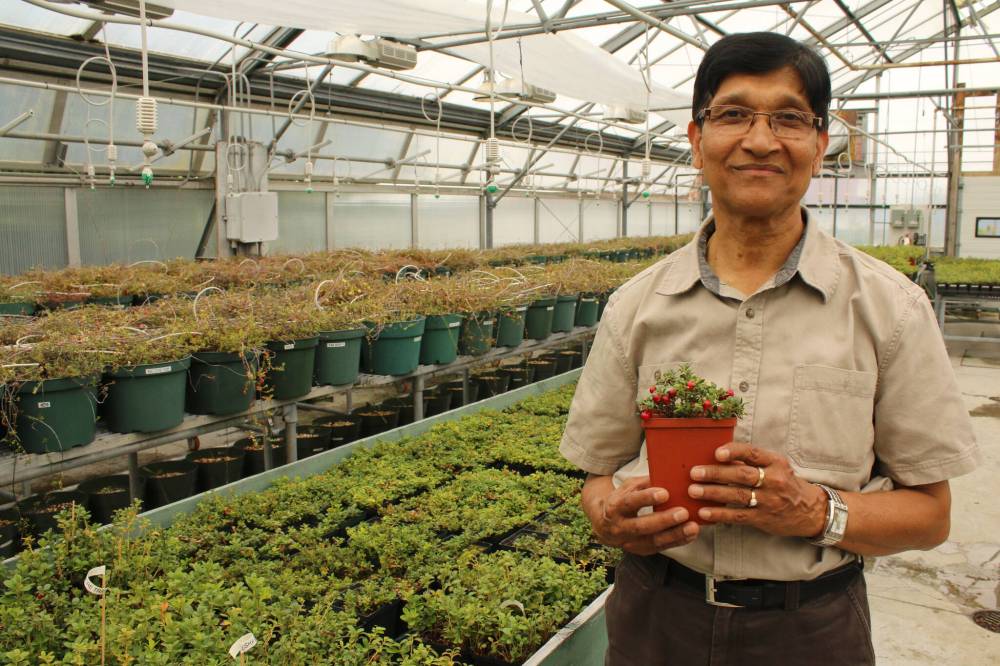
AAFC photo
Samir Debnath with one of the lingonberry varieties he studies in the Research and Development Centre greenhouse in St. John’s, N.L.
Wild lingonberry grows in abundance in northern Manitoba. It is also native to British Columbia, Saskatchewan and Atlantic Canada.
“Lingonberry is a very health-promoting crop,” says Debnath. “We have developed hybrids by crossing Canadian wild lingonberries and European lingonberries.”
Although European cultivars are more productive, he says, Manitoba’s wild lingonberries have higher antioxidant properties.
“By combining these two, we can get more production, good figure of the plant and high antioxidant activity. The hybrids we have developed can be good candidates for the northern climates of Canada.”
In addition to being rich in antioxidants, lingonberry has anti-inflammatory properties. Debnath has worked on lingonberry research in collaboration with Chris Siow, a retired research scientist with AAFC.
“This berry from the north has untapped potential as a versatile, flavourful and nutritious approach to maintaining kidney health,” said Siow.
Debnath sent plant material to AAFC’s Research and Development Centre in Morden where Oscar Molina conducted an evaluation trial. In 2023, the Kitchen Garden at The Leaf at Assiniboine Park received 50 lingonberry plants from food science researchers at the Canadian Centre for Agricultural Research in Health and Medicine and AAFC’s Research and Development Centre in Morden.
It’s tantalizing to think that lingonberry could be grown in backyards across Manitoba someday. Debnath notes, however, that lingonberry prefers acidic soil conditions which are found in northern Manitoba. Alkaline soils in southern Manitoba have a higher pH.
The real potential lies in commercial production. If lingonberry can be grown successfully on a commercial scale in Manitoba, everyone would have access to a range of Manitoba-grown lingonberry products with beneficial health properties. Ongoing research hopes to establish hybrids that can adapt to conditions here in Manitoba.

Susan Southern photo
AAFC researchers are studying the potential use of nannyberries in treating prostate cancer.
Work continues both in the field but also the laboratory where Debnath uses bioreactors for rapid plant growth. In bioreactors, leaves and stems taken from native lingonberry plants grow numerous shoots, that once transplanted, become new lingonberry shrubs. This technology can produce thousands of plants from a single sample.
Equally amazing is the research by Raju Soolanayakanahally at AAFC’s Research and Development Centre in Saskatoon. He works extensively with berry-bearing shrubs including sea buckthorn, buffaloberry, chokecherry, pin cherry and hawthorn. One of his goals is to strengthen landscape resilience, enhance biodiversity and diversify agricultural landscapes to help growers grow more of the food we love in a way that is both economically and environmentally sustainable.
Sea buckthorn (Hippophae rhamnoides) is a deciduous shrub that produces masses of orange berries. Armed with sharp thorns, it has been grown on the Prairies for decades as a formidable shelterbelt plant. But sea buckthorn’s berries are also part of the global wellness industry. AAFC research is discovering their untapped potential.
“Sea buckthorn is not native to Canada,” says Soolanayakanahally. “It was brought from Eurasia, mainly from Siberia and immigrating folks from Ukraine and northern Russia in the early 1930s. It was introduced mainly as an ornamental shrub to enhance biodiversity on farms.”
A male and female cultivar is required for producing fruit.
“Sea buckthorn is useful for erosion control. It fixes nitrogen in the soil, similar to legumes and it can be planted on marginal soils where other crops may not be productive. It’s a very hardy shrub and a good pollinator. Early on, the berries were mostly used for making jams and jellies.”
AAFC sourced genetics of sea buckthorn from the Himalayas, Nepal, China, Mongolia, Kazakhstan, Uzbekistan and Finland. A diversity gene bank was created at Indian Head, Sask. Breeding began to develop varieties with soft thorns.
“They can’t be eliminated completely,” says Soolanayakanahally.
A pivotal moment came in 2011 when Dr. Mehmet Oz, who had a popular television show at the time, said that sea buckthorn offered a wide range of health benefits, including obesity control.

Bill Schroeder photo
Bill Schroeder, a seabuckthorn expert, stands next to Orange September, one of the many cultivars he developed.
“Suddenly, growers wanted to know where they could get sea buckthorn,” says Soolanayakanahally.
In 2011, North American sea buckthorn expert W.R. (Bill) Schroeder was the lead researcher at AAFC. He worked with sea buckthorn for almost 30 years and released eight high-yield, extremely hardy cultivars with larger fruit and fewer, softer thorns. Four of the varieties he introduced are Harvest Moon, Orange September, Autumn Glow and Prairie Sunset. When Schroeder retired, Soolanayakanahally took over the breeding program.
“When we compare the Canadian varieties against Russian varieties, we produce bigger weight berries. They are rich in Vitamin C, Vitamin E and beta carotenoids. But sea buckthorn berries are also very low in sugar. They are rich in flavonoids and antioxidants, which are very good for human health.”
Soolanayakanahally’s research also extends to the properties of seed oil and pulp oil extracted from sea buckthorn berries.
“The beauty of the seed oil is that it is very rich in alpha linoleic acid. The pulp is very rich in palmitoleic acid. High concentrations of palmitoleic acid (omega-7), one of the rarest omegas, lowers cholesterol.”
Scientific research has spurred the development of an emerging product industry that uses sea buckthorn berries or leaves to make everything from bright orange ice cream sorbet to herbal teas, nutri-bars, licorice, even lip gels and nutritious pet food.
Sea buckthorn’s use in recipes is endless, says Soolanayakanahally. Every fall, after he harvests the berries, he asks his colleagues to rate their flavours in smoothies or with yogurt. He also brings the berries to culinary events. “At Thanksgiving, pan-roasted chicken with a bit of sea buckthorn sorbet is delicious or with beef, lentils, mushrooms and roasted garlic.”
Buffaloberry (Shepherdia) is a native, thorny shrub that is hardy across the Prairies. It also has potential for commercial fruit production because of its nutritional value.
“The berries are rich in carotenoids — beta-carotene, lutein and lycopene — and antioxidants,” says Soolanayakanahally.


The fruit of the nannyberry (Viburnum lentago), a popular shrub grown in many local backyards, is also part of his research.
“We are studying the phytochemistry,” he says.
Nannyberry is native to southern Manitoba and eastern Saskatchewan and preliminary results suggest it may prove to be an effective chemoprotective or chemopreventative agent against prostate cancer.
Leading research by AAFC scientists is helping growers grow healthier food for Canadians.
colleenizacharias@gmail.com