Top court sets sentencing framework for cases involving Indigenous offenders, victims

Advertisement

Advertise with us

OTTAWA - The Supreme Court of Canada says in cases where an Indigenous offender commits an offence against an intimate partner who is an Indigenous woman, a judge must apply sentencing principles related to both Indigenous offenders and victims of crime in a harmonious way.

Read this article for free:


By clicking the button above, an account will be created and you will begin to receive some of our recommended newsletters. You may opt out of any newsletter by visiting your Email and Communication Preferences page or by clicking "unsubscribe" at the bottom of any email.

or

Already have an account? Log in here »

To continue reading, please subscribe:

Digital Subscription

One year of digital access for only $1.44 a week*

  • Enjoy unlimited reading on winnipegfreepress.com
  • Read the E-Edition, our digital replica newspaper
  • Access News Break, our award-winning app
  • Play interactive puzzles

*Billed as $5.77 plus GST every four weeks. After 52 weeks, price increases to the regular rate of $19.95 plus GST every four weeks. Offer available to new and qualified returning subscribers only. Cancel any time.

To continue reading, please subscribe:

Add Free Press access to your Brandon Sun subscription for only an additional

$1 for the first 4 weeks*

  • Enjoy unlimited reading on winnipegfreepress.com
  • Read the E-Edition, our digital replica newspaper
  • Access News Break, our award-winning app
  • Play interactive puzzles
Start now

*Your next Brandon Sun subscription payment will increase by $1.00 and you will be charged $17.95 plus GST for four weeks. After four weeks, your payment will increase to $24.95 plus GST every four weeks.

OTTAWA – The Supreme Court of Canada says in cases where an Indigenous offender commits an offence against an intimate partner who is an Indigenous woman, a judge must apply sentencing principles related to both Indigenous offenders and victims of crime in a harmonious way.

In a 5-4 judgment Friday, the top court provided guidance and set out a new framework for determining an appropriate sentence in such cases.

The court said Indigenous people are disproportionately and excessively imprisoned, while Indigenous women and girls suffer from unacceptably high levels of violence and abuse.

It said both of these issues have been shaped by the experiences of colonization, and addressing them together is central to the ongoing process of reconciliation.

Parliament has tried to address both concerns through the criminal sentencing process, the court noted.

The Supreme Court said the sentencing methodology in such cases is not a mathematical formula but a guide to help judges take into account the circumstances of Indigenous offenders and the vulnerability of Indigenous women and girls to abuse and violence.

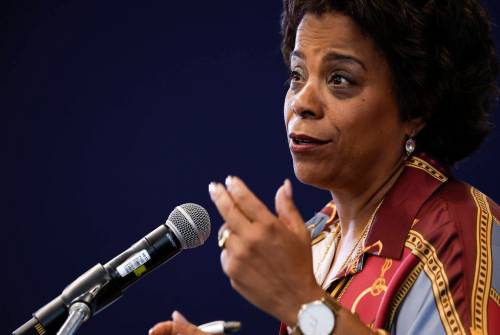
“Proportionality requires due attention to the circumstances of the offender and of the victim in light of relevant sentencing objectives,” Justice Michelle O’Bonsawin wrote on behalf of the majority. “The appropriate balancing will inevitably vary depending on the specific circumstances of the offence.”

The ruling comes in the case of a Mi’kmaq man with severe mental health challenges who was sentenced to five years in prison after pleading guilty to aggravated assault against his partner, a Mi’kmaq woman.

The Nova Scotia Court of Appeal reduced the sentence to three years, and the Supreme Court ruled Friday the three-year sentence should stand.

The top court found the sentencing judge did not recognize that the offender’s mental illness contributed to the commission of the aggravated assault and did not consider the effect of that illness on the relevant sentencing objectives.

The sentencing judge would have settled on a shorter prison term had she properly considered the offender’s significant mental health factors, particularly when viewed in light of a sentencing circle’s recommendations in the case, the Supreme Court said.

This report by The Canadian Press was first published Oct. 9, 2026.

Report Error Submit a Tip

More Stories

Property tax promise will be hardest pledge to keep

Tom Brodbeck 4 minute read Preview

Property tax promise will be hardest pledge to keep

Tom Brodbeck 4 minute read Wednesday, Sep. 11, 2019

The majority of the promises made by Brian Pallister and the PC party in the provincial election campaign were modest ones. Most should be easy to implement.

The pledges, including spending $2 billion more on health care over four years, building 20 schools and working closer with police to fight crime, are largely continuations of what government was already doing.

This election was more about Pallister seeking approval for his government’s agenda – especially in health care – than getting a new mandate.

But there was one surprise election commitment – phasing out education property taxes – that will be far more difficult and controversial to implement.

Read
Wednesday, Sep. 11, 2019

Exiro Nickel takes ownership of Thompson Mine Complex

Gabrielle Piché 4 minute read Friday, Oct. 16, 2026

Exiro Nickel Company is officially the majority owner of nickel mining operations in Thompson.

The new firm announced its intent to buy Vale Base Metals’ mining complex in February. Ink dried on the deal Thursday evening, Exiro chief executive Shastri Ramnath said.

Leadership aims to double mining production — to two million tonnes from one million annually — over the next five years.

Such output used to be seen in Thompson, Ramnath said.

Team president locked out, day after speaking out on arena’s closure

Morgan Modjeski 5 minute read Preview

Team president locked out, day after speaking out on arena’s closure

Morgan Modjeski 5 minute read Friday, Oct. 16, 2026

A longtime team official in Manitoba’s hockey community says he’s being punished by the City of Winnipeg for speaking out about the poor condition of one of its rinks.

Barry Bonni, president of the River East Royal Knights, has occupied an office at Terry Sawchuk Memorial Arena for more than four decades.

On Friday, he was locked out.

“They’re on the war path,” Bonni said.

Read
Friday, Oct. 16, 2026

Health ministers meeting ends without long-term funding commitment from Ottawa

Carol Sanders 3 minute read Preview

Health ministers meeting ends without long-term funding commitment from Ottawa

Carol Sanders 3 minute read Yesterday at 2:01 AM CDT

Canada’s health minister failed to deliver the promises of long-term funding increases that her provincial and territorial counterparts, who were gathered in Winnipeg this week, had been seeking.

Instead, Marjorie Michel reiterated the federal government’s commitment to working collaboratively towards renewing bilateral funding agreements and to meet again before the end of the year to discuss long-term funding.

“The decision we all agreed on is to have our public service… start the work on what will be the next step for the next negotiation on Canada Health Transfer and other agreements,” Michel said Friday at a news conference after meeting with the other health ministers.

When asked why the federal government couldn’t commit to maintaining funding levels geared, at a minimum, to the rate of inflation over the long term, Michel said that it’s time to update agreements signed a decade ago.

Read
Yesterday at 2:01 AM CDT

Increasingly cited financial term, ‘nut,’ is worth knowing, says best-selling author

Joel Schlesinger 5 minute read Preview

Increasingly cited financial term, ‘nut,’ is worth knowing, says best-selling author

Joel Schlesinger 5 minute read Yesterday at 2:01 AM CDT

It’s nuts. That might be some folks’ reaction if they knew their “nut” in the financial sense of the word.

If that stirs visions of squirrels fighting over acorns, you are not far off.

Nut is increasingly used in popular culture, especially in the United States as the struggle increases for millions of consumers with each passing day.

A couple of high-profile TV examples are South Park and Your Friends & Neighbors, where the nut is discussed in the context of what someone’s spend rate is based on their lifestyle.

Read
Yesterday at 2:01 AM CDT

New chapter for Yellowquill University College

Tory McNally 7 minute read Preview

New chapter for Yellowquill University College

Tory McNally 7 minute read Yesterday at 2:01 AM CDT

Sometimes, a milestone is about much more than a degree. It is about opportunity, recognition and the doors that open for the people who come next.

Yellowquill University College reached a historic milestone on Oct. 1, when new Manitoba legislation came into effect formally recognizing the institution within the province’s post-secondary education system and granting it authority to award degrees.

Established in 1984, Yellowquill is now Manitoba’s first fully recognized First Nations-owned and operated post-secondary institution with degree-granting authority.

It is an achievement worth celebrating, not only for Yellowquill and the communities it serves, but also for what it represents about education, career development and the future of Manitoba’s workforce.

Read
Yesterday at 2:01 AM CDT