

Fewer health system critical incidents reported in 2025 than in previous two years, data shows
Advertisement
Read this article for free:
or
Already have an account? Log in here »
To continue reading, please subscribe:

Digital Subscription
One year of digital access for only $205*
- Enjoy unlimited reading on winnipegfreepress.com
- Read the E-Edition, our digital replica newspaper
- Access News Break, our award-winning app
- Play interactive puzzles
*First annual payment billed as $205.00 + GST for one year. This annual subscription will automatically renew at $233.00 + GST every 52 weeks (10% off the regular annual price of $259.35). Offer available to new and qualified returning subscribers only. Cancel any time.
To continue reading, please subscribe:
Add Free Press access to your Brandon Sun subscription for only an additional
$1 for the first 4 weeks*
- Enjoy unlimited reading on winnipegfreepress.com
- Read the E-Edition, our digital replica newspaper
- Access News Break, our award-winning app
- Play interactive puzzles
*Your next Brandon Sun subscription payment will increase by $1.00 and you will be charged $17.95 plus GST for four weeks. After four weeks, your payment will increase to $24.95 plus GST every four weeks.
Read unlimited articles for free today:
or
Already have an account? Log in here »
The number of critical incidents reported within Manitoba’s health-care system declined again in 2025, with delays, gaps and “missed opportunities” among the most common circumstances of deaths or injuries.
Quarterly reports from Manitoba Health listed 121 critical incidents, including 32 deaths, in hospitals, personal-care homes and other settings, down from 134 incidents in 2024, when 32 deaths were also reported, and 166 incidents (42 deaths) in 2023.
“We’d obviously like to see those at zero,” said Jason Linklater, president of the Manitoba Association of Health Care Professionals, which represents more than 7,700 allied health workers.
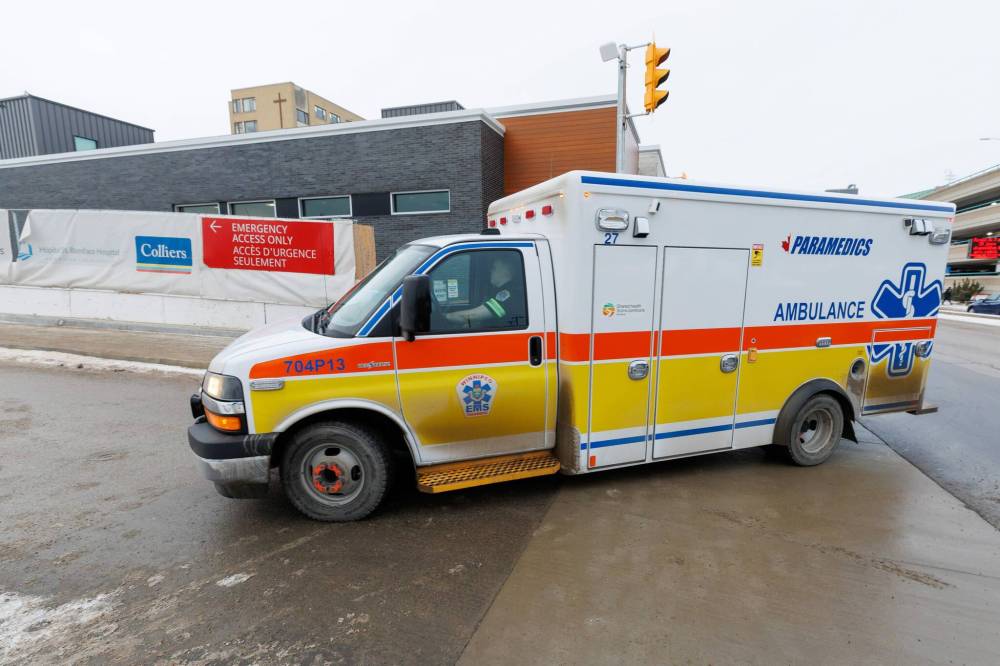
MIKE DEAL / FREE PRESS FILES
Quarterly reports from Manitoba Health listed 121 critical incidents in 2025.
“It’s good that they’ve come down. What we really want to see is those numbers drastically reduced overall, and I just fear that’s not going to happen until staffing is dealt with.”
The number and the types of issues cited in the reports point to critical shortages of front-line staff, including laboratory technologists, mental-health clinicians and respiratory therapists, he said.
“When departments are short-staffed, it increases the risk for error,” Linklater said.
A critical incident is defined in legislation as an unintended event that occurs when health services provided to a person result in “serious and undesired” consequences, and does not result from the person’s underlying health condition or “from a risk inherent in providing the health services.”
Reviews are required after each incident to prevent similar occurrences.
In a statement, Health Minister Uzoma Asagwara said their thoughts are with patients, families and staff affected by the incidents.
“Every critical incident is serious, every single one affects real people and, in some cases, lives are lost,” Asagwara said.
“We have to keep that at the centre of this work as we learn from these incidents and work to make care safer for Manitobans. That means making sure incidents are reported, investigated thoroughly and used to improve care.”
Asagwara said the government is adding workers, rebuilding capacity and improving how patients move through the system to strengthen patient safety, but officials know there is more to do.
“We will keep listening to patients, families and front-line health-care workers, learning from these incidents and doing the work needed to make care safer.”
Data for the 2025 calendar year became available this week when the latest report (from October to December), was published on the government’s website.
The total (which reflects the number of completed reviews) was one of the lowest in recent years and similar to 2018, when 124 incidents were reported. Data for 2026 is not yet available.
Quarterly reports provide brief incident descriptions, with no details that could identify patients, staff or locations.
In the final quarter of 2025, eight reported deaths included a patient who faced a delay in diagnosis of a serious medical condition, a patient who was discharged and then readmitted for further care and a patient who suffered a serious injury after a fall.
The other patients died after their medical conditions changed or deteriorated. In some of those cases, opportunities for earlier intervention, consultation or treatment were missed or “not realized.”
Of the 22 major incidents in 2025’s final quarter, a patient attempted suicide while under the care of a mental-health facility, a client attempted suicide during a transition of care and two people required emergency care after receiving an incorrect dosage of medication.
Three patients who needed treatment for acute medical conditions faced delays in recognition, diagnosis or referral for care.
A patient required a second surgery due to the use of an incorrect medical device. Four people suffered pressure injuries and three were injured in falls.
“These are exactly the risks nurses are speaking up about when they warn that their patient loads are unmanageable,” Manitoba Nurses Union president Darlene Jackson said in a statement.
“Nurses need the time and resources to assess each patient, recognize changes in their condition and intervene before a situation becomes critical.”
Jackson said proposed minimum nurse-to-patient ratios will lead to a stronger health-care system where “patients receive the attention they need, and nurses can feel confident that no one is being missed.”
Linklater again called on Manitoba to develop a health human resource plan. Creating and implementing a plan is part of Shared Health’s 2025-30 strategy.
“The numbers show we’re not seeing staffing gains in allied health comparable to nursing and some other professions,” he said.

“We cannot afford to lose people right now, so huge efforts have to be put towards retention of health-care professionals in every single area.”
Progressive Conservative health critic Kathleen Cook said she is concerned about the number of deaths attributed in quarterly reports to care delays.
“We’re seeing that reflected in some of the other data that we measure in health care, including median ER wait times, (and) the number of people waiting for placement in a personal care home, which we know has a direct impact on ER wait times,” she said.
“We hear it from nurses, too, and others who are working on the front lines of health care who say they’re overwhelmed, who say this is the worst it’s ever been.”
chris.kitching@freepress.mb.ca
As a general assignment reporter, Chris covers a little bit of everything for the Free Press.
Our newsroom depends on a growing audience of readers to power our journalism. If you are not a paid reader, please consider becoming a subscriber.
Our newsroom depends on its audience of readers to power our journalism. Thank you for your support.