

Canada-U.S. trade relationship is broken, but the damage can — and will — be repaired

Advertisement
Read this article for free:
or
Already have an account? Log in here »
To continue reading, please subscribe:

Digital Subscription
One year of digital access for only $205*
- Enjoy unlimited reading on winnipegfreepress.com
- Read the E-Edition, our digital replica newspaper
- Access News Break, our award-winning app
- Play interactive puzzles
*First annual payment billed as $205.00 + GST for one year. This annual subscription will automatically renew at $233.00 + GST every 52 weeks (10% off the regular annual price of $259.35). Offer available to new and qualified returning subscribers only. Cancel any time.
To continue reading, please subscribe:
Add Free Press access to your Brandon Sun subscription for only an additional
$1 for the first 4 weeks*
- Enjoy unlimited reading on winnipegfreepress.com
- Read the E-Edition, our digital replica newspaper
- Access News Break, our award-winning app
- Play interactive puzzles
*Your next Brandon Sun subscription payment will increase by $1.00 and you will be charged $17.95 plus GST for four weeks. After four weeks, your payment will increase to $24.95 plus GST every four weeks.
Read unlimited articles for free today:
or
Already have an account? Log in here »
Canada needs to get serious about diversifying its trade beyond the United States. But at the same time, Canadians should expect relations with the U.S. to normalize after Donald Trump is no longer in the White House.
For generations, Canada-U.S. trade was considered almost a fact of geography. The two countries share the world’s longest undefended border, deeply integrated supply chains and a century of commercial relationships.
Canadian manufacturers depend on American customers. American manufacturers depend on Canadian suppliers. Energy, agriculture, automotive production and countless other industries operate across the border as though it barely exists.
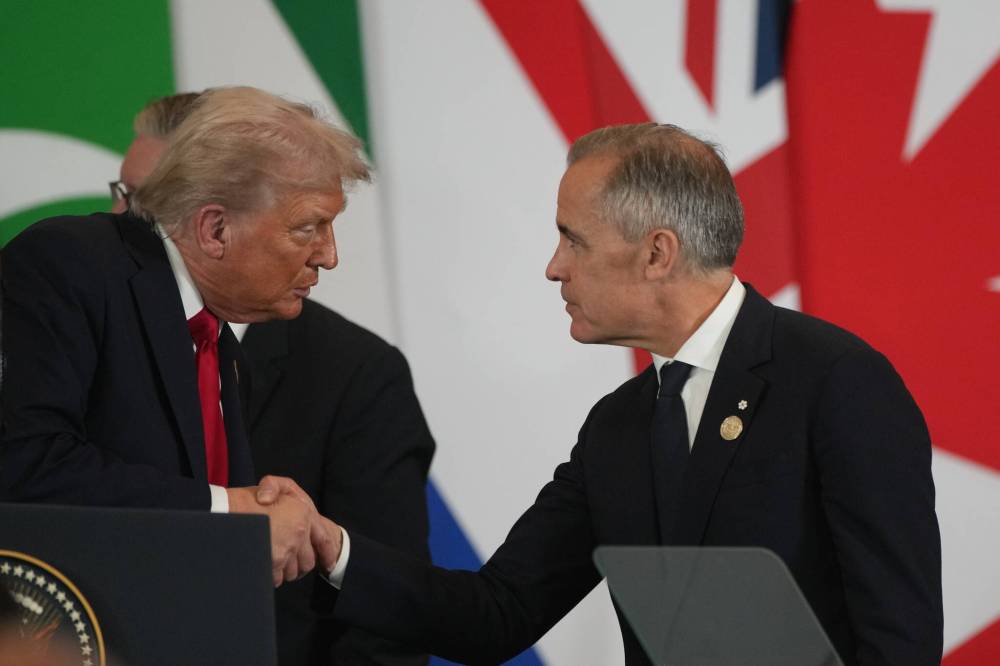
THE ASSOCIATED PRESS FILES
President Donald Trump (left) shares a moment with Prime Minister Mark Carney last year. Even if Canada expands its trade with other countries — which it must do — the United States will almost certainly remain Canada’s most important trading partner.
That isn’t going to change dramatically, even in the midst of a bitter trade war unleashed by the U.S. president.
Even if Canada expands its trade with Europe, Asia, India, Mexico and other markets — which it must do — the United States will almost certainly remain Canada’s most important trading partner.
Geography alone makes that difficult to avoid.
But that doesn’t mean Canada should remain as dependent on the U.S. market as it is today.
Trump has demonstrated the risk of putting too many economic eggs in one basket. Tariffs, threats, shifting trade policies and attacks on Canada’s sovereignty have injected an extraordinary amount of uncertainty into what was once one of the world’s most stable trading relationships.
Still, Canada’s response to the U.S. president shouldn’t be to abandon the relationship, it should be to make sure we have alternatives.
That means doing the hard work of opening new markets, reducing internal trade barriers, improving port and rail infrastructure, speeding up approvals and negotiating trade agreements that give Canadian businesses more places to sell their products.
It also means recognizing something that should have been obvious long ago: diversification isn’t a rejection of the United States, it’s insurance against political and economic disruption.
But there is also reason to believe Canada-U.S. trade relations won’t remain this dysfunctional forever. Trump won’t be president forever.
The next U.S. presidential election is just over two years away. Whatever happens then, it is difficult to imagine that the next administration — even a Republican one — would continue down Trump’s destructive path.
The damage Trump has inflicted on America’s relationships with its closest allies will not disappear overnight. Businesses don’t make billion-dollar investments based on what they hope a politician might do two years from now. They make decisions based on stability and predictability.
Trump has provided neither.
Companies don’t like uncertainty. They don’t like not knowing whether a product crossing the border today will face a tariff tomorrow. They don’t like having supply chains disrupted by political decisions. And they certainly don’t like making long-term investments when the rules of international trade can change with the president’s next social-media post.
Some investment will inevitably be delayed or redirected as a result.
That is part of the lasting damage of Trump’s trade war. Even if the president’s tariffs disappear in two years, businesses will remember how quickly a supposedly dependable trading relationship can become a political weapon
But there’s an important distinction between recognizing that damage and assuming the Canada-U.S. trading relationship is permanently broken.
It isn’t.
American public opinion provides some reason for optimism. Polling has repeatedly shown significant opposition among Americans to Trump’s attack on Canada. The political consequences may become even clearer in the November midterm elections, where Republicans are expected to face significant losses.
Those elections won’t necessarily be a referendum solely on Trump’s trade policies. Voters have many reasons not to vote Republican, including Trump’s war on Iran, which the majority of Americans oppose.
But they will provide another measure of how voters are responding to the direction the U.S. president has taken the country.
And if the political price of a trade war becomes sufficiently obvious, future presidents will have an incentive to avoid repeating it.
Trade with Canada isn’t a zero-sum game. The United States benefits enormously from Canadian energy, resources, agricultural products and manufactured goods. American companies also depend on Canadian inputs and consumers.
That’s why Trump’s trade war has been so disruptive.
He’s not simply punishing Canada, he’s undermining an economic relationship that benefits both countries.

But eventually, there will be a new president sitting in the White House. That president will have to deal with the economic reality Trump cannot wish away: Canada is America’s neighbour, a major supplier of critical resources and an enormous trading partner.
Normalizing that relationship should be in the interests of both countries.
The lesson from the Trump years should be clear: America will remain Canada’s biggest customer. It will remain our closest economic partner. It will remain the natural market for a huge portion of Canadian exports.
There’s no question that Trump has caused long-term damage to that relationship. But when the next American president takes office, there’s every reason to believe that Canada and the United States will start repairing the damage that’s been done.
tom.brodbeck@freepress.mb.ca
Tom has been covering Manitoba politics since the early 1990s and joined the Winnipeg Free Press news team in 2019.
Our newsroom depends on a growing audience of readers to power our journalism. If you are not a paid reader, please consider becoming a subscriber.
Our newsroom depends on its audience of readers to power our journalism. Thank you for your support.
Tom has been covering Manitoba politics since the early 1990s and joined the Winnipeg Free Press news team in 2019.
Our newsroom depends on a growing audience of readers to power our journalism. If you are not a paid reader, please consider becoming a subscriber.
Our newsroom depends on its audience of readers to power our journalism. Thank you for your support.
Advertisement Advertise With Us
Advertisement Advertise With Us