

Port of Churchill expansion could chase belugas away, U of M researcher says
Advertisement
Read this article for free:
or
Already have an account? Log in here »
To continue reading, please subscribe:
Digital Subscription
One year of digital access for only $1.44 a week*
- Enjoy unlimited reading on winnipegfreepress.com
- Read the E-Edition, our digital replica newspaper
- Access News Break, our award-winning app
- Play interactive puzzles
*Billed as $5.77 plus GST every four weeks. After 52 weeks, price increases to the regular rate of $19.95 plus GST every four weeks. Offer available to new and qualified returning subscribers only. Cancel any time.
To continue reading, please subscribe:
Add Free Press access to your Brandon Sun subscription for only an additional
$1 for the first 4 weeks*
- Enjoy unlimited reading on winnipegfreepress.com
- Read the E-Edition, our digital replica newspaper
- Access News Break, our award-winning app
- Play interactive puzzles
*Your next Brandon Sun subscription payment will increase by $1.00 and you will be charged $17.95 plus GST for four weeks. After four weeks, your payment will increase to $24.95 plus GST every four weeks.
Read unlimited articles for free today:
or
Already have an account? Log in here »
As plans to expand the Port of Churchill into a four-season trade corridor gathers momentum, a University of Manitoba researcher has published a report on what ship traffic could mean for the beluga whales that gather in the Churchill River estuary each summer.
Veronica Coppolaro said more vessels in the waterways bring a risk that belugas will stop using the estuary for migration, which would impact the ecological landscape, tourism and communities that rely on the animals for food and cultural purposes.
“There are studies showing that (noises) change the way they swim, they change the way (the whales) are vocalizing, they change their main activity, and so this (expansion) can have consequences at different levels,” she said.
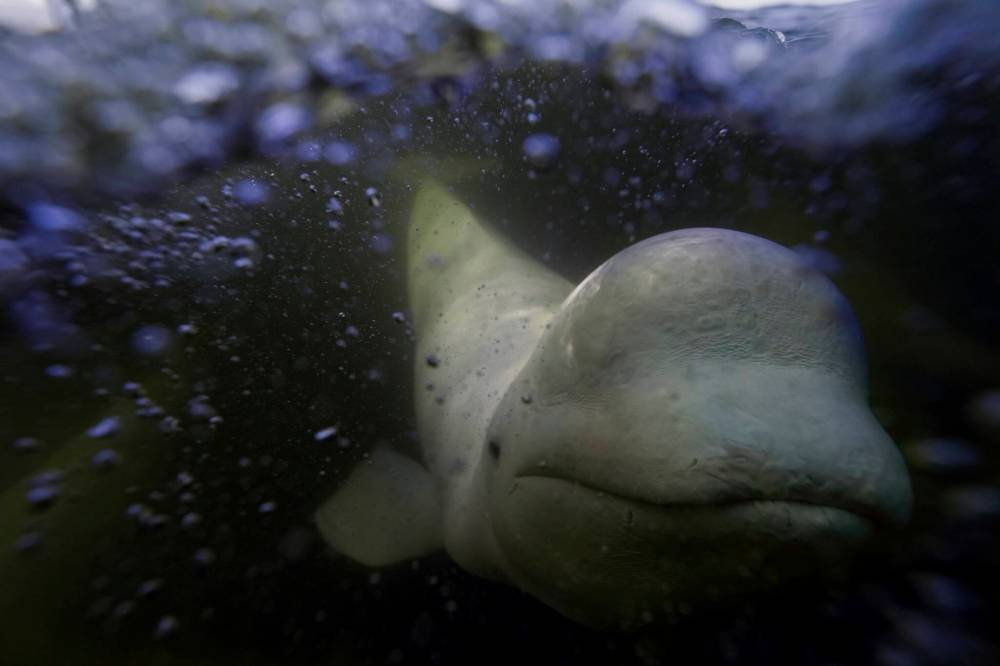
A beluga whale swims behind a boat through the Churchill River. (Joshua A. Bickel / The Associated Press files)
The Churchill river estuary is a marine habitat where the Churchill River empties into Hudson Bay. During the summer months belugas gather in the area to feed and give birth.
Belugas have sensitive hearing and use echolocation — a biological sonar system — for food and keeping track of their pods, so if they can’t hear due to the noise from ships, they will need to change their habitats.
In 2019 as part of her PhD research, Coppolaro began tracking beluga whale activity by using passive acoustic monitoring, a non-invasive way of “listening” to the estuary underwater. Coppolaro and her colleagues found persistently high activity in the areas that overlap directly with Port of Churchill operations.
The recordings were collected before and during the COVID-19 pandemic, when port activity was limited. The data is now being analyzed, but it offers a baseline for what future activity can be compared to when ships are consistently passing through the region.
The disturbances could stress the animals and affect reproduction levels, Coppolaro hypothesized. The disruption could also cause other fish to leave the areas, causing a disruption to food sources.
The estimated population of belugas in the Churchill River is hard to estimate, but at any given time in the day during summer migration hundreds could be swimming in the area, making it a popular tourist destination.
“There isn’t really a lot of disturbance, but once you have ships and a lot more vessel traffic in general, everything is going to change underwater,” she said. “This is why we need continued monitoring.”
The provincial and federal governments have taken the marine habitat into consideration. In February the province announced it was spending $250,000 to study the feasibility of a new national marine conservation area in western Hudson Bay as it moves forwards with the port’s expansion.
National marine conservation areas are federally protected sections of freshwater or marine coastlines. The Parks Canada-managed areas are intended to represent the nation’s various marine ecosystems.
At the time, premier Wab Kinew said economic development and environmental protection can co-exist.
In August the provincial and federal governments, alongside the Arctic Gateway Group — which owns the Port of Churchill — presented new research confirming the feasibility of year-round shipping from the port.

The reports stated advances in marine technology and declining sea ice due to climate change mean shipping could be possible all year.
With that, Coppolaro said, ships would essentially be following belugas around the bay and potentially disturb them in other areas, too.
Other research groups are interested in continuing the monitoring of beluga activity as shipments enter and exit the port to see the short-term impacts of the expansion, Coppolaro said, adding she supports the port’s expansion, but wants to see a balance.
“I hope that the province and the government will find a way to kind of have it hand in hand: the port expansion, the economic side and the conservation,” she said.
nicole.buffie@freepress.mb.ca