

How to make National Day for Truth and Reconciliation personal

Advertisement
Read this article for free:
or
Already have an account? Log in here »
To continue reading, please subscribe:

Digital Subscription
One year of digital access for only $205*
- Enjoy unlimited reading on winnipegfreepress.com
- Read the E-Edition, our digital replica newspaper
- Access News Break, our award-winning app
- Play interactive puzzles
*First annual payment billed as $205.00 + GST for one year. This annual subscription will automatically renew at $233.00 + GST every 52 weeks (10% off the regular annual price of $259.35). Offer available to new and qualified returning subscribers only. Cancel any time.
To continue reading, please subscribe:
Add Free Press access to your Brandon Sun subscription for only an additional
$1 for the first 4 weeks*
- Enjoy unlimited reading on winnipegfreepress.com
- Read the E-Edition, our digital replica newspaper
- Access News Break, our award-winning app
- Play interactive puzzles
*Your next Brandon Sun subscription payment will increase by $1.00 and you will be charged $17.95 plus GST for four weeks. After four weeks, your payment will increase to $24.95 plus GST every four weeks.
Read unlimited articles for free today:
or
Already have an account? Log in here »
It’s September — the month that culminates in the National Day for Truth and Reconciliation.
For Indigenous communities, the last day of September used the be the day the Indian agent, the priest or the RCMP arrived to remove children from their homes and take them to residential school.
Nowadays, Sept. 30 is the day Canadians show up to prove that history will never be repeated.
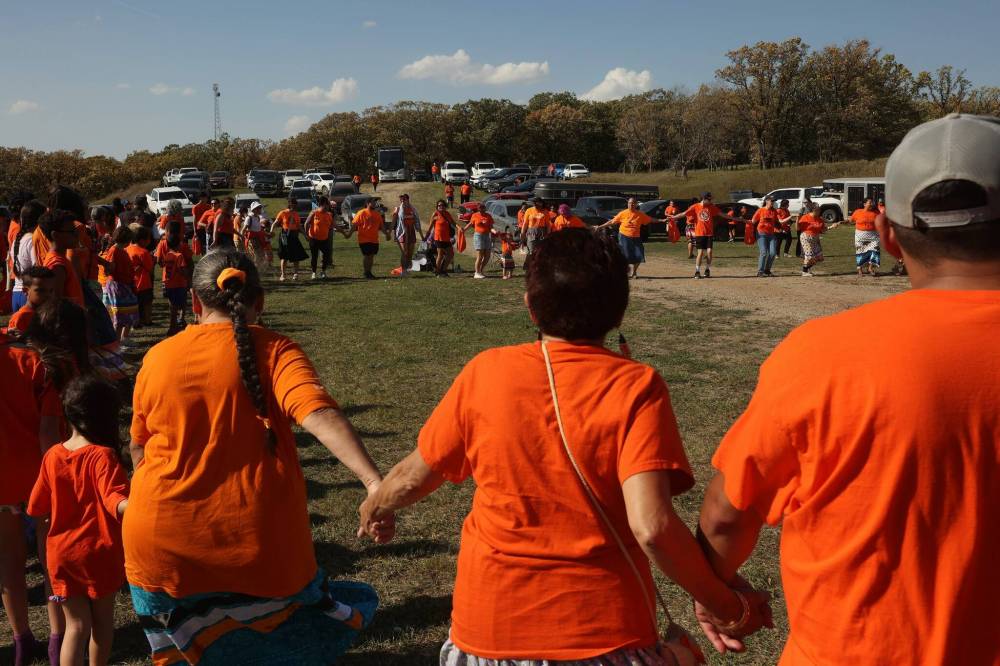
Participants take part in a round dance following an Orange Shirt Day Walk last September in Brandon. (Tim Smith / The Brandon Sun files)
This is the fifth National Day for Truth and Reconciliation, and the annual event has quickly become one of the most important and highly participatory days in the country.
In 2025, a Leger poll found that 53 per cent of Canadians were planning to take some sort of action to acknowledge the importance of reconciliation with Indigenous Peoples, including by wearing orange (23 per cent) and listening to Indigenous voices (17 per cent).
That’s represented more than 20 million Canadians.
One day might not feel like much, until you realize that reconciliation isn’t a one-day event.
For instance, throughout September in communities across this country, there will be thousands of opportunities to participate in the interests of truth, reconciliation and building a Canada that is inclusive, just and a place all citizens — not just a few — can be proud of.
For many, this will involve attending a march or ceremony, or witnessing one of the many commemorations to honour the residential school survivors who enabled the National Day to happen. For others, it will be something more subtle, like attending an event at work, having a conversation or reading something new.
I’ll be attending dozens of events, giving close to 50 talks and ending September by once again co-hosting CBC coverage of the National Day for Truth and Reconciliation on Parliament Hill in Ottawa.
If you run out of ideas for taking part, here are a few things you can do:
Learn the history of residential schools in Canada. Consider how every single thing — from our collective culture, our daily practices and every dollar in our economy — begins with our relationships with Indigenous Peoples.
While you’re at it, read the final report of the Truth and Reconciliation Commission and its 94 calls to action.
Learn whose traditional land you live and work on and share your life with, and build a relationship with those people.
Practise saying local Indigenous place names. Read about the treaties signed in your region.
Talk with your friends, family and kids about all of the above. Then, together, watch online videos, listen to podcasts or watch TV shows or documentaries made by Indigenous creators. Read a book written by an Indigenous author. Or, watch APTN.
You can support Indigenous businesses or buy art or fashion accessories directly from Indigenous artists.
Eat at an Indigenous-owned restaurant or food truck.
Hire Indigenous-owned businesses for your next party or event.
Visit an Indigenous art gallery exhibit.
Attend a local powwow (the Southern Chiefs organization is hosting one on Sept. 30).
Take a free online course on Indigenous history.
Listen to Indigenous music.
There are many well-known musicians like Susan Aglukark, Robbie Robertson and Tom Jackson or bands like Kashtin, Redbone, C-Weed and Eagle & Hawk. There are award-winning powwow singers like Northern Cree and the Black Bear Singers.
There are musicians you may not have heard of, like Charlie Panigoniak, Willie Dunn, Kelly Fraser, and the bands Quantum Tangle, Blue Moon Marquee, The Pappy Johns Band.
More recent artists making splashes in the music industry include Tanya Tagaq, Don Amero, Jeremy Dutcher, Aysanabee, Crystal Shawanda, Logan Staats, William Prince, Celeigh Cardinal, Julian Taylor, Elisapie Isaac, Shauit, Cris Derksen, and groups like Snotty Nose Rez Kids, Digging Roots, and The Halluci Nation.
You can also listen to some of the great work by Canadian musicians who have put out music committed to truth and reconciliation. I’ve been doing a deep dive lately.
There is, of course, the late Gord Downie’s album Secret Path or try Downie’s band The Tragically Hip, whose members wrote the song Looking for a Place to Happen.
There’s some great collaborations between Canadian and Indigenous musicians, too, such as Jim Cuddy’s work with Indian City on a song called Star People, Chantal Kreviazuk’s collaboration with Amanda Rheaume called Red Dress, and Glass Tiger’s famous song Diamond Sun, which they performed with Susan Aglukark, an Inuk singer.
Canadian musicians, it seems, have sung a lot about Indigenous issues. There’s Bruce Cockburn’s Red Brother, Red Sister, Maestro Fresh Wes’s Nothin’ at All, Bryan Adams’ Native Son and Avril Lavigne’s Two Rivers (an homage to the work of legendary Mohawk poet E. Pauline Johnson or Tekahionwake).
In all cases, take in everything you see, taste, feel and learn.
Challenge your own ideas and assumptions, and be open, especially if you’re being exposed to perspectives for the first time.

Reflect on what reconciliation means in your daily life.
Spend quiet time in nature to reflect on what it means to respect the land.
Make a personal promise to support reconciliation next month, and then the month after that.
And then all year long.
niigaan.sinclair@freepress.mb.ca
Niigaan Sinclair is Anishinaabe and is a columnist at the Winnipeg Free Press.
Our newsroom depends on a growing audience of readers to power our journalism. If you are not a paid reader, please consider becoming a subscriber.
Our newsroom depends on its audience of readers to power our journalism. Thank you for your support.
Niigaan Sinclair is Anishinaabe and is a columnist at the Winnipeg Free Press.
Our newsroom depends on a growing audience of readers to power our journalism. If you are not a paid reader, please consider becoming a subscriber.
Our newsroom depends on its audience of readers to power our journalism. Thank you for your support.
Advertisement Advertise With Us
Advertisement Advertise With Us