Don’t delete organ concert tickets when scrubbing digital life

Advertisement
Read this article for free:
or
Already have an account? Log in here »
To continue reading, please subscribe:

Digital Subscription
One year of digital access for only $205*
- Enjoy unlimited reading on winnipegfreepress.com
- Read the E-Edition, our digital replica newspaper
- Access News Break, our award-winning app
- Play interactive puzzles
*First annual payment billed as $205.00 + GST for one year. This annual subscription will automatically renew at $233.00 + GST every 52 weeks (10% off the regular annual price of $259.35). Offer available to new and qualified returning subscribers only. Cancel any time.
To continue reading, please subscribe:
Add Free Press access to your Brandon Sun subscription for only an additional
$1 for the first 4 weeks*
- Enjoy unlimited reading on winnipegfreepress.com
- Read the E-Edition, our digital replica newspaper
- Access News Break, our award-winning app
- Play interactive puzzles
*Your next Brandon Sun subscription payment will increase by $1.00 and you will be charged $17.95 plus GST for four weeks. After four weeks, your payment will increase to $24.95 plus GST every four weeks.
Read unlimited articles for free today:
or
Already have an account? Log in here »
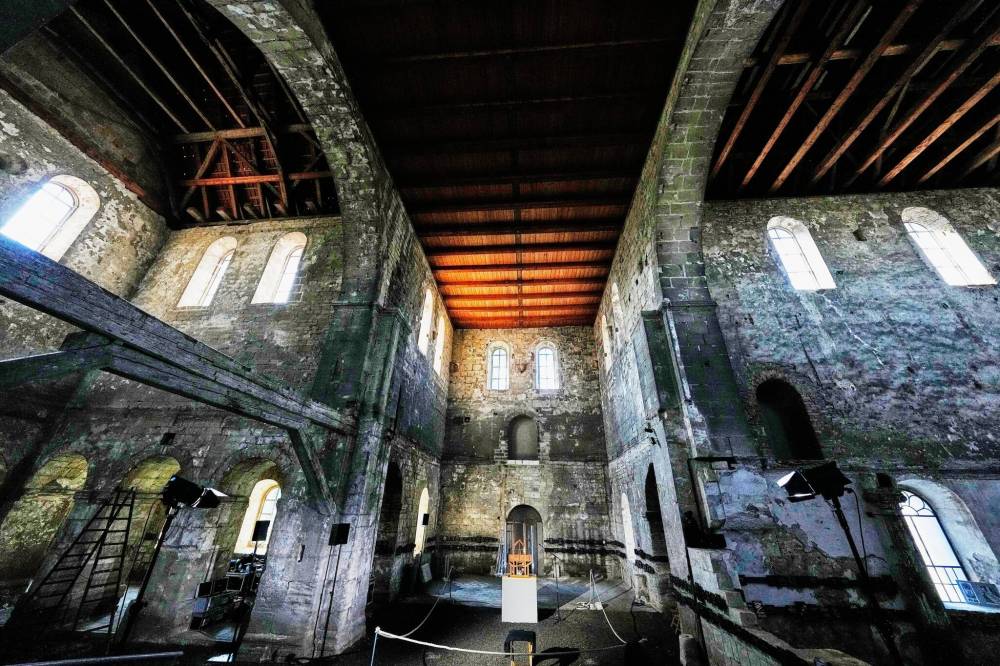
There is an organ in Germany that is playing one composition until 2640.
What’s billed as the world’s slowest concert features a piece by American composer John Cage, and was back in the news because it had its first chord change in two years. It’s already been playing for 25 years; only 614 more to go.
Organ music at the end of the world.
Markus Schreiber / The Associated Press files
The organ inside the medieval Burchardi Church in Halberstadt, Germany will play its final note on Sept. 4, 2640.
The real take-home for me, however, is the fact that there are already “inheritable” tickets for the final Sept. 4, 2640, event being sold for 2,640 euros (US$3,045).
Two things came to mind when I read that, besides the thing about money and fools. One, it’s cute to believe that there’s even going to be a Sept. 4, 2640. And two, are these digital tickets?
I had a vision of the future, 614 years from now:
“Oh, look, Theta-5000, that big final organ show in Germany is tonight.”
“You know, Gamma-Epsilon, I think we actually have tickets to that? I remember my grandmother saying that her grandmother bought them in the year 2026.”
“Ugh, we have to go then, right? We should probably go. Where are the tickets? Did they come pre-downloaded in your Temporal Lobe Wallet?”
“Oh no. I ran a brain scan and it appears they are locked in something called a ‘Gmail account.’”
• • •
I will be dust in the year 2640, but this story, as well as the University of Manitoba’s new study on digital legacy planning, got me thinking about all the digital detritus I will leave behind to my niece and whichever one of my friends’ kids visits me at the retirement castle the most.
The passwords and photos and emails and messages and files. We all have digital footprints of varying sizes and, in the future, grandma’s proverbial china set will be replaced by terabyte hard drives and social media accounts.
My plan is to scrub my social media, since I will have to haunt whoever shares my Facebook posts from 2012 with the same ruthlessness as those posts have haunted me and I fear I won’t have the energy. Ditto if you make a chatbot out of me. I’ll be a zombie of my own volition, thank you so much.
As for the other stuff, I like to think of myself as a minimalist when it comes to physical things, but I am absolutely a digital hoarder.
Do I need hundreds of photos of my dog on my phone’s camera roll? (How dare you, yes.) What about all those screenshots that I might “need”? Also yes.
My laptop is another story. I keep my recorded interviews for work for whatever reason, but they are a disaster. For every audio file cleanly labelled with the subject’s first name, last name and title, there are just as many saved as “Artist” or “Streeter Dave.”
And then there are things I’m ruthless about. I don’t keep draft files of articles, for example, a fact that some writers would be aghast at. Why would I keep a Google Doc of something that’s been printed in an actual historical record of some repute?
(Speaking of, I have fantasies about some enterprising Girl Friday of the future stumbling upon my work in a newspaper archive one day and being like “Who IS this, she is so funny, I bet she was also very beautiful.”)
But here’s the thing. You cannot control what people do with their inheritances — including the digital ones you’ve willed to them, which is why I am not going to appoint a custodian for my Facebook page that I barely want to maintain as an alive person.
Of course, you can hope things you loved outlive you. I joke, but I actually kind of love that a little organ might play us all out at a glacial pace, a phrase that will have no meaning to future generations. There’s a kind of optimism about that, that idea of permanence. I think we hope that what we create will outlive us, that the notes of an organ will still ring out.
The inheritable tickets, who knows. As for the organ? I hope it’s still there. That it, like all art, will have new stewards.

All of this is about being remembered, and we often think it’ll be through the stuff we can’t take with us — digital or physical — when it’s actually about our character when we were alive. Maybe someone will find value in my funny meme or collection of witty text banter among my friends or photos of my dog in the same way they might find value in my books or art or things I’ve collected on my travels because they meant something to me, but maybe not.
Maybe someone will save something to “remember me by” — and I truly hope it’s the text banter — but maybe not.
Ultimately my stuff is mine. So, like life, I just try to appreciate it while I have it and not worry too much about what happens to it when I don’t. I actually do look back through my camera roll on my phone; I saved these photos — and, in them, tried to save those moments — for a reason.
Whoever gets my passwords or has to use my corpse face to unlock my phone: enjoy all the photos of dogs I loved and places I went and the meals I ate and the screenshots of my friends’ funniest text messages. I know I sure did.
jen.zoratti@winnipegfreepress.com
Jen Zoratti is a Winnipeg Free Press columnist and author of the newsletter, NEXT, a weekly look towards a post-pandemic future.
Our newsroom depends on a growing audience of readers to power our journalism. If you are not a paid reader, please consider becoming a subscriber.
Our newsroom depends on its audience of readers to power our journalism. Thank you for your support.
Jen Zoratti is a Winnipeg Free Press columnist and author of the newsletter, NEXT, a weekly look towards a post-pandemic future.
Our newsroom depends on a growing audience of readers to power our journalism. If you are not a paid reader, please consider becoming a subscriber.
Our newsroom depends on its audience of readers to power our journalism. Thank you for your support.
Advertisement Advertise With Us
Advertisement Advertise With Us