

Libau man warns Manitobans after contracting West Nile Virus
Criticizes province for not announcing case
Advertisement
Read this article for free:
or
Already have an account? Log in here »
To continue reading, please subscribe:

Digital Subscription
One year of digital access for only $205*
- Enjoy unlimited reading on winnipegfreepress.com
- Read the E-Edition, our digital replica newspaper
- Access News Break, our award-winning app
- Play interactive puzzles
*First annual payment billed as $205.00 + GST for one year. This annual subscription will automatically renew at $233.00 + GST every 52 weeks (10% off the regular annual price of $259.35). Offer available to new and qualified returning subscribers only. Cancel any time.
To continue reading, please subscribe:
Add Free Press access to your Brandon Sun subscription for only an additional
$1 for the first 4 weeks*
- Enjoy unlimited reading on winnipegfreepress.com
- Read the E-Edition, our digital replica newspaper
- Access News Break, our award-winning app
- Play interactive puzzles
*Your next Brandon Sun subscription payment will increase by $1.00 and you will be charged $17.95 plus GST for four weeks. After four weeks, your payment will increase to $24.95 plus GST every four weeks.
Read unlimited articles for free today:
or
Already have an account? Log in here »
A Manitoba man is warning others about the presence of West Nile virus in the region, as he’s concerned his case has not been announced by the province.
Todd Holmes was informed he had contracted West Nile virus on Friday, several days after he attempted to donate blood in Selkirk. Canadian Blood Services called to tell him his sample tested positive for the virus.
Holmes said he was contacted by the province about his diagnosis on Tuesday afternoon, yet a website that logs cases of West Nile in the province continues to reads zero.
SUPPLIED
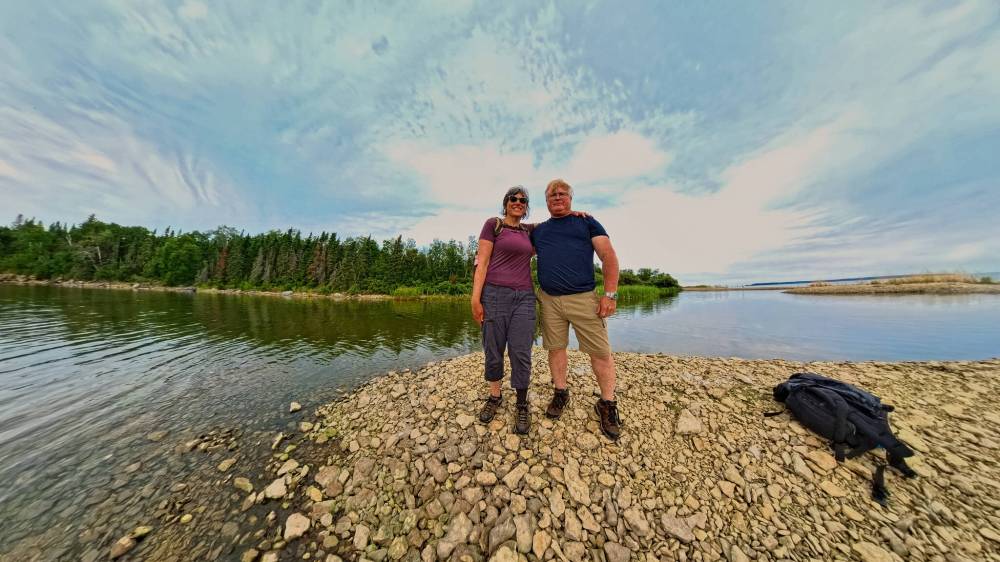
Brigit (left) and Todd Holmes, on one of their many adventures together. Todd said it was Canadian Blood Services who notified him about a West Nile virus diagnosis last Friday.
He decided to take matters into his owns hands by posting about his plight on social media.
“When I realized this had not been done — that no one is aware — that’s when I reached out and I put things on Facebook, so everyone could be aware,” he said. “Because knowing this has happened to me, I wanted to try to prevent others from having the same experience.”
The 58-year-old from Libau said his symptoms started with deep chills and evolved to include headaches, pressure behind his eyes, exhaustion, joint pain and a lack of appetite.
The call from Canadian Blood Services shed light on the illness.
“They indicated that they were screening people for West Nile and my blood sample showed that I had West Nile,” he said. “Automatically, my wife and I were saying: ‘OK, this is making some sense, just because I’ve been feeling odd.’”
He suspects he contracted the virus, which has sickened him for about a week, after a hike in Hecla-Grindstone Provincial Park. He had forgotten he cleared out his bag of bug repellent for an earlier bike ride, and was swarmed by mosquitoes as a result.
A provincial spokesperson said all possible cases of West Nile virus are reported to the Manitoba Health, Seniors and Long-Term Care department and to regional health authorities, which includes notifications from Canadian Blood Services. It said these cases are verified by public health before being posted online, with the sites updated every Friday.
“The province also communicates about the elevated risk of WNV through social media and may also issue news bulletins if a high number of human WNV cases are identified,” the statement said.
Holmes said the stats are important and people should be aware about confirmed cases.

“When I was reviewing the Facebook post, there were people who had said they had gone to Hecla and shortly thereafter, they’ve been suffering from these major headaches, and that is one of the signs that you have it,” he said, stressing had people known that West Nile was present in Manitoba, they might have gotten checked out.
“We’re all responsible for helping each other,” he said.
Canada’s public health agency says on its website the majority of people infected with West Nile Virus do not feel sick. Others have mild symptoms that tend to appear two to 15 days after infection, including fever, aches and headache.
People can protect themselves by using insect repellent, the agency said.
morgan.modjeski@freepress.mb.ca