

A measure of hope a decade after senseless death, injustice

Advertisement
Read this article for free:
or
Already have an account? Log in here »
To continue reading, please subscribe:

Digital Subscription
One year of digital access for only $205*
- Enjoy unlimited reading on winnipegfreepress.com
- Read the E-Edition, our digital replica newspaper
- Access News Break, our award-winning app
- Play interactive puzzles
*First annual payment billed as $205.00 + GST for one year. This annual subscription will automatically renew at $233.00 + GST every 52 weeks (10% off the regular annual price of $259.35). Offer available to new and qualified returning subscribers only. Cancel any time.
To continue reading, please subscribe:
Add Free Press access to your Brandon Sun subscription for only an additional
$1 for the first 4 weeks*
- Enjoy unlimited reading on winnipegfreepress.com
- Read the E-Edition, our digital replica newspaper
- Access News Break, our award-winning app
- Play interactive puzzles
*Your next Brandon Sun subscription payment will increase by $1.00 and you will be charged $17.95 plus GST for four weeks. After four weeks, your payment will increase to $24.95 plus GST every four weeks.
Read unlimited articles for free today:
or
Already have an account? Log in here »
I’m a few hundred kilometres from the farm near Biggar, Sask. — the place where 22-year old Colten Boushie from Cree Red Pheasant First Nation was shot and killed by farmer Gerald Stanley precisely 10 years ago.
“You need to remind people about the 10-year anniversary,” a nearby, rural school principal tells me at the education conference I just finished speaking at.
“That death is a wound that continues to bleed in all of us,” a principal from Regina adds. “I hear about it from our students all the time.”
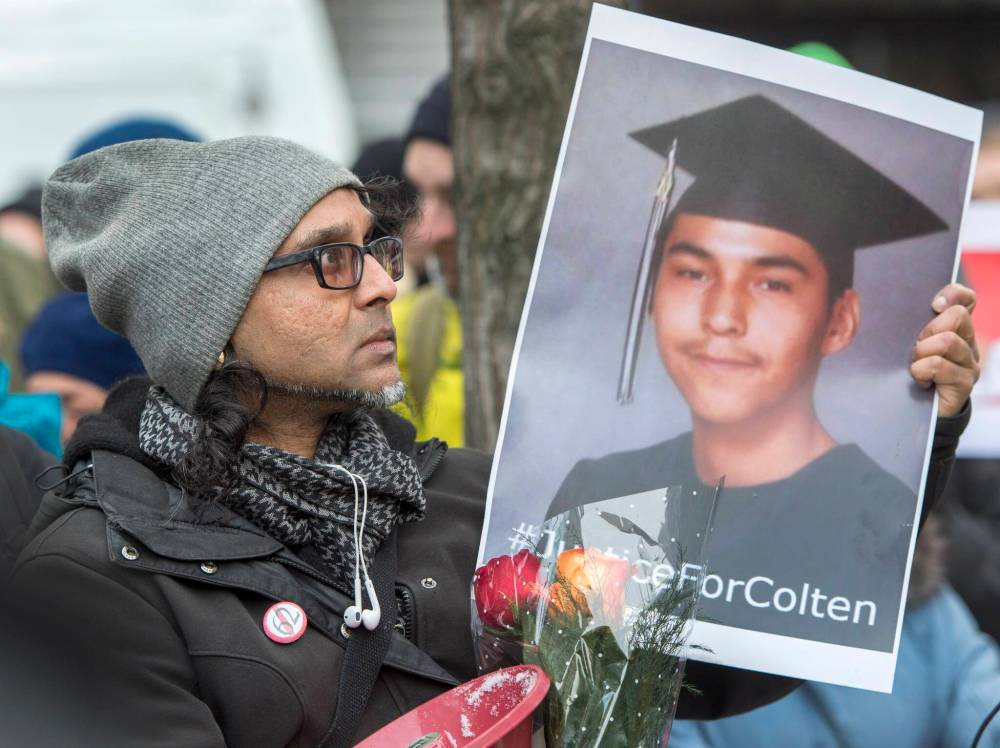
People take part in a vigil in support of Colten Boushie’s family in February 2018, following the acquittal of Saskatchewan farmer Gerald Stanley on charges in connection with Boushie’s death. (Ryan Remiorz / The Canadian Press files)
On Aug. 9, 2016, Boushie’s death entered the Canadian consciousness, representing what then-Saskatoon mayor Charlie Clark declared “a defining moment for this community and this country.”
The circumstances are well-documented, so I’ll just briefly recount the event.
After experiencing a flat tire on their car, Boushie and four of his friends arrived at a farmhouse owned by Stanley in late afternoon.
After a confrontation in which one of Boushie’s friends allegedly tried to steal an ATV vehicle, Stanley grabbed his TT-30 handgun and fired two shots in the air.
Stanley then approached the car Boushie was in and the gun went off, shooting the young man in the head and killing him instantly.
Stanley claimed it was a “hang-fire” incident — when a gun malfunctions and goes off unexpectedly. Experts later disputed this claim.
Later, a jury — every single potential Indigenous candidate was “peremptory challenged” and rejected by Stanley’s lawyer — accepted his argument and acquitted him on the charge of second-degree murder.
There is history and other facts in the case, of course — and well-documented shoddy work, evidence collection and racially problematic actions by RCMP officers — but the message of the Stanley case was clear: when it comes to the value of Indigenous lives versus Canadian rights, property and “freedoms,” the latter will win out.
I had been sitting with my family when we had heard the verdict. I remember a silence coming over all of us. My father, normally a hopeful person, swore. My mother stopped eating.
A long silence was interrupted when my cell rang about a half-hour after Stanley’s acquittal and kept ringing.
“This is a night when you want to give up hope,” I told reporters asking for a comment. “This is a night when you think, ‘What’s the point of it? What’s the point of trying to change a country that doesn’t want to change?’”
I stand by those comments.
Stanley wasn’t defending anything by killing Boushie, who was sitting in an immobile car. The claim of an “accidental” firing of a gun is irrelevant. In virtually any case of death, if someone carries a gun into any situation they are responsible for what it does.
That is, I suppose, unless the person killed is a young Indigenous man.
What I have slightly changed my opinion on is hope.
“That death is a wound that continues to bleed in all of us.”
Colten Boushie’s name is being remembered a decade after his death. Stanley, meanwhile, couldn’t find a publisher willing to let him “tell his side” in 2018.
The impact of Boushie’s death and the trial has been studied in multiple ways.
Many books have been written on the subject. The best, in my opinion, is Storying Violence: Unravelling Colonial Narratives in the Stanley Trial by Indigenous scholars Gina Starblanket and Dallas Hunt. And there is the excellent documentary Nîpawistamâsowin: We Will Stand Up, directed by Cree filmmaker Tasha Hubbard (still available on streaming platforms).
The injustice of the trial led the federal government in 2019 to reform the criminal justice system and abolish peremptory challenges to prevent race-based jury exclusion. The Supreme Court later agreed that change was constitutional.
The RCMP was impacted by the case, with internal reports admitting there was poor handling of evidence, treatment of Indigenous witnesses and communication with Boushie’s family, along with an acknowledgement of the need for more training and accountability.
Boushie’s death and the trial had an immense impact on other Canadians, many of whom learned about the injustice Indigenous communities know all too well for the first time.

And it served to galvanize tens of thousands of young Indigenous people who vowed never to sit idly by and let it happen again.
After writing multiple social media posts on the Stanley trial a decade ago, I was asked to write a column on the subject for the Free Press.
The newspaper hired me a few weeks later.
Indigenous peoples who grew up in the time of Colten Boushie’s death will never forget the sacrifice of a young Cree man few knew, but will always be impacted by.
niigaan.sinclair@freepress.mb.ca
Niigaan Sinclair is Anishinaabe and is a columnist at the Winnipeg Free Press.
Our newsroom depends on a growing audience of readers to power our journalism. If you are not a paid reader, please consider becoming a subscriber.
Our newsroom depends on its audience of readers to power our journalism. Thank you for your support.
Niigaan Sinclair is Anishinaabe and is a columnist at the Winnipeg Free Press.
Our newsroom depends on a growing audience of readers to power our journalism. If you are not a paid reader, please consider becoming a subscriber.
Our newsroom depends on its audience of readers to power our journalism. Thank you for your support.
Advertisement Advertise With Us
Advertisement Advertise With Us