

Nine-block walk on Portage Avenue reveals difficult present, some cause for optimism

Advertisement
Read this article for free:
or
Already have an account? Log in here »
To continue reading, please subscribe:

Digital Subscription
One year of digital access for only $205*
- Enjoy unlimited reading on winnipegfreepress.com
- Read the E-Edition, our digital replica newspaper
- Access News Break, our award-winning app
- Play interactive puzzles
*First annual payment billed as $205.00 + GST for one year. This annual subscription will automatically renew at $233.00 + GST every 52 weeks (10% off the regular annual price of $259.35). Offer available to new and qualified returning subscribers only. Cancel any time.
To continue reading, please subscribe:
Add Free Press access to your Brandon Sun subscription for only an additional
$1 for the first 4 weeks*
- Enjoy unlimited reading on winnipegfreepress.com
- Read the E-Edition, our digital replica newspaper
- Access News Break, our award-winning app
- Play interactive puzzles
*Your next Brandon Sun subscription payment will increase by $1.00 and you will be charged $17.95 plus GST for four weeks. After four weeks, your payment will increase to $24.95 plus GST every four weeks.
Read unlimited articles for free today:
or
Already have an account? Log in here »
On a recent visit back to Winnipeg, I got to witness the multitudes of Portage Avenue.
From my Airbnb on Hargrave Street, I had the opportunity to do quite a bit of walking on Portage Avenue, from Portage and Memorial all the way down to the recently opened intersection at Portage and Main. Along the way, I saw it all: huge and dynamic construction projects, persistent urban decay and the occasional oasis of revitalization.
All in the space of nine blocks.
MIKE DEAL / FREE PRESS FILES
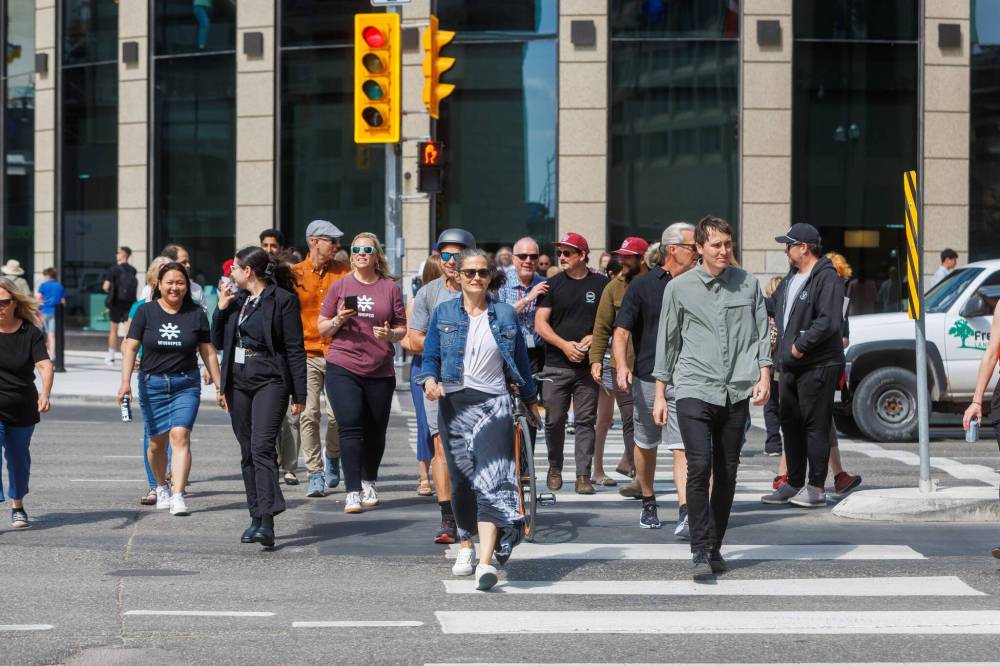
Pedestrians cross Portage and Main during the historic reopening of the intersection in 2025.
As Walt Whitman would say, Portage Avenue truly contains multitudes.
The newly reopened Portage and Main is surprisingly attractive. I supported the return of pedestrians to the famed intersection as a way of making it more functional for the surrounding neighbourhood. But the removal of the crumbling brutalist barricades has left an expansive and esthetically pleasing focal point for downtown.
The northwest corner of Portage Avenue features the BMO Bank of Montreal Building with its diminutive, but functional, public plaza. On most days I walked by, there were bands playing at lunchtime and quite a few people outside playing cornhole.
Farther west, the environment turned a lot darker.
There was more trash, and the sidewalks — with their ornamental brick inlay — were stained and crumbling. More homeless people could be seen hiding in the shade of taller buildings to escape the driving sunshine.
It’s like that all the way down to Portage and Carlton, where pedestrians are suddenly confronted by the enormity of the True North Real Estate redevelopment of Portage Place mall.
The eastern-most section of the mall, including the atrium at Edmonton Street, has been largely demolished, and work is well underway for a new mixed-income residential tower that is expected to be completed late next year. Other parts of the mall will be redeveloped in due course in the hopes that it becomes, once again, a hub of positive downtown activity.
Farther along from that project, however, the decay returns with a vengeance. More homeless people congregating, more empty storefronts, more trash. The mall is, for the most part, a ghost town with few functioning stores.
Continuing along Portage to Memorial, there is the Southern Chiefs Organization’s redevelopment of the former Hudson’s Bay department store. There is a dramatic reimagining going on inside what is downtown’s biggest single building, although onlookers cannot see beyond the stoic stone facade.
Nine blocks delivers a multitude: from full-blown gentrification to profound urban decay. Put them together, and Portage Avenue provides glimpses of the past, a troubled present and a potentially positive future.
How likely is that positive outcome? It appears that Portage Avenue is, thankfully, clinging on by its fingernails to a more dynamic future. But it’s far from a sure thing.
My time in Winnipeg began in the late 1980s when Portage Place and the North Portage residential development was just being built, giving me a certain perspective on the various attempts at revitalizing downtown.
I got a front-row seat — closer than most thanks to my job — to the angst, debate, decision-making and effort put into finding ways of returning downtown to former glory.
The city has tried it all: government projects such as the Manitoba Hydro tower; expansion of RRC Polytech in the West Exchange; Waterfront Drive and adjacent residential development in the East Exchange; redevelopment of Central Park; the evolution of The Forks Market; the construction of a new downtown arena for professional hockey and live music; the development by Indigenous organizations of the former rail station on Higgins Avenue.
No one ever promised that, on their own, any of these projects would be a panacea for what ails the core of the city. Even taken together, most proponents agree that building big, new, beautiful things won’t overcome underlying social problems that include homelessness, addictions and mental-health concerns.
In that context, the future of Portage Avenue — and, indeed, much of the city’s core — will ultimately be determined by how those underlying problems are addressed.

On the positive side of that equation, every level of government — supported by philanthropic organizations and the private sector — is certainly trying to make downtown better by helping the vulnerable people who call the core their home. The negative side is that it seems the wheels are spinning on some of those files.
The province is building homes for the homeless, but not fast enough to help all of the people displaced by the city’s efforts to clear encampments. The province is also trying to open a supervised injection site for addicts, but is having trouble fighting through waves of local opposition. There’s lots of talk about a fourth arm of emergency response focused on mental health and addictions, but to date, it’s only talk.
Winnipeg needs more co-ordination, more resources and more resolve if Portage Avenue and other streets downtown are to become better, safer, cleaner. Not by rousting or displacing people; it needs to be safe for everyone.
The good news is that there are blocks downtown where that better future seems to have taken root. It just needs to grow.
dan.lett@freepress.mb.ca
Born and raised in and around Toronto, Dan Lett came to Winnipeg in 1986, less than a year out of journalism school with a lifelong dream to be a newspaper reporter.
Our newsroom depends on a growing audience of readers to power our journalism. If you are not a paid reader, please consider becoming a subscriber.
Our newsroom depends on its audience of readers to power our journalism. Thank you for your support.
Born and raised in and around Toronto, Dan Lett came to Winnipeg in 1986, less than a year out of journalism school with a lifelong dream to be a newspaper reporter.
Our newsroom depends on a growing audience of readers to power our journalism. If you are not a paid reader, please consider becoming a subscriber.
Our newsroom depends on its audience of readers to power our journalism. Thank you for your support.
Advertisement Advertise With Us
Advertisement Advertise With Us