

Canadian military team in Parkland region to assist flood-ravaged communities
Residents facing big cleanups as basements flooded in hundreds of homes
Advertisement
Read this article for free:
or
Already have an account? Log in here »
To continue reading, please subscribe:
Digital Subscription
One year of digital access for only $1.44 a week*
- Enjoy unlimited reading on winnipegfreepress.com
- Read the E-Edition, our digital replica newspaper
- Access News Break, our award-winning app
- Play interactive puzzles
*Billed as $5.77 plus GST every four weeks. After 52 weeks, price increases to the regular rate of $19.95 plus GST every four weeks. Offer available to new and qualified returning subscribers only. Cancel any time.
To continue reading, please subscribe:
Add Free Press access to your Brandon Sun subscription for only an additional
$1 for the first 4 weeks*
- Enjoy unlimited reading on winnipegfreepress.com
- Read the E-Edition, our digital replica newspaper
- Access News Break, our award-winning app
- Play interactive puzzles
*Your next Brandon Sun subscription payment will increase by $1.00 and you will be charged $17.95 plus GST for four weeks. After four weeks, your payment will increase to $24.95 plus GST every four weeks.
Read unlimited articles for free today:
or
Already have an account? Log in here »
A Canadian Armed Forces reconnaissance team is in western Manitoba’s Parkland region to plot out how the military will help flood-hit communities.
Department of National Defence spokesperson Andrée-Anne Poulin said CAF members, including engineering specialists, arrived in the area Saturday.
“The team is conducting on-the-ground assessments, liaising with local authorities, and helping identify priority community needs to inform ongoing response efforts,” Poulin wrote in an email Monday.
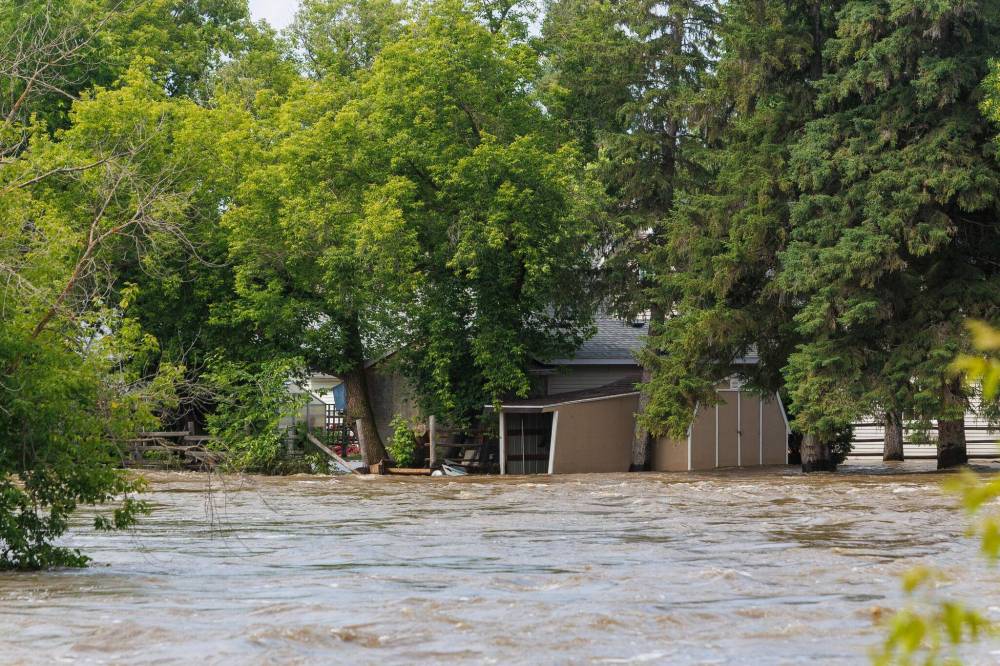
Mike Deal / Free Press files
The Swan River overflows its banks, flooding nearby homes in Swan River on July 2.
Volunteers from Team Rubicon Canada, a veteran-led disaster response organization, are headed to the region to help with recovery work.
Four two-person teams are scheduled to arrive in Manitoba Tuesday, a provincial spokesperson said. A liaison officer arrived Saturday.
The Office of the Fire Commissioner will allocate the resources where required.
Swan River, Minitonas and Dauphin are among the Parkland communities that suffered significant overland flooding last week when rain-swollen rivers burst their banks. Hundreds of homes had flooded basements — some for the second time in less than a month.
Swaths of farm land were inundated, dozens of highways and rural roads had washed-out sections, and bridges and rail lines were damaged. Communities throughout western Manitoba declared states of local emergency.
Federal Emergency Management Minister Eleanor Olszewski said Friday a small team of CAF members will provide logistical assistance, resource co-ordination and the assessment of ongoing response needs in the “immediate” term, following a request from the Manitoba government.
Swan River Mayor Lance Jacobson said CAF and Team Rubicon officials toured Swan Valley on Sunday.
“What I’m told is they will determine out of those assessments what is needed, so if the military is more needed (elsewhere) right now then that’s where they will mobilize, but they’ll make those decisions however they’re made,” Jacobson said.
“I’m hoping those decisions are made now and quick versus leaving us for a week when it almost will be too late.”
He said Team Rubicon may be a better fit for the town because it is in a cleanup and recovery phase after water levels receded.
Team Rubicon could help homeowners, such as seniors, who are unable to pump water out of their basements or remove belongings that were in floodwater, officials have said.
Swan River lifted a mandatory evacuation order for several streets Saturday after floodwaters receded by 0.7 metres (2.3 feet) from their peak. The town estimated 140 to 200 homes flooded when the Swan River surged June 30 and July 1.
Some organizations, including Christian Aid Ministries and Samaritans Purse Canada, sent volunteers to help homeowners affected by flooding in early June.
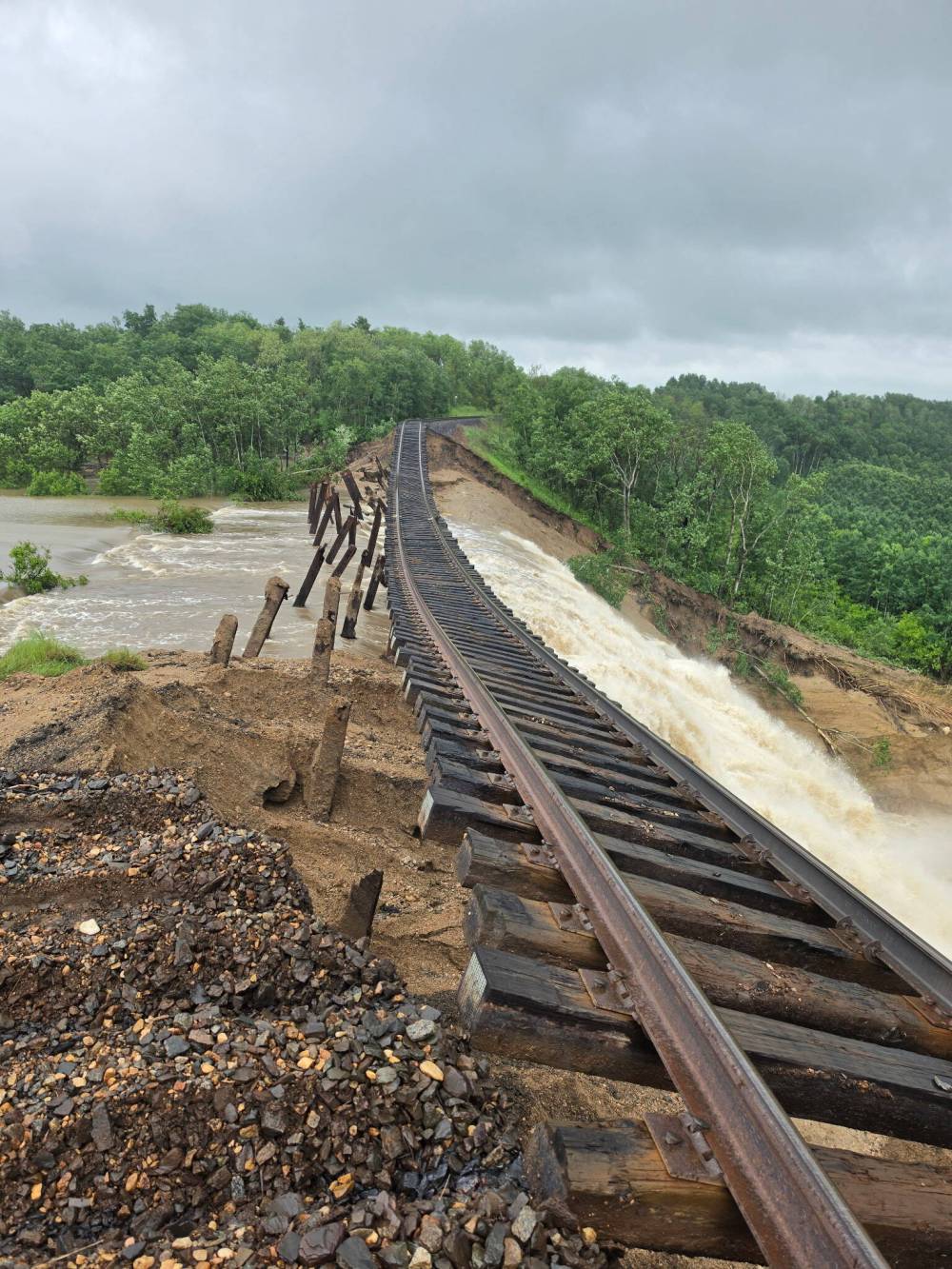
Richard Suidak photo
A section of CN Rail track can be seen almost buckling under the pressure of flood waters in the Parkland region on June 30.
Dauphin Mayor David Bosiak said CAF and other officials visited Saturday to begin assessments. Residents of flood-hit homes began cleaning up late last week.
“I was told they’re still in the assessment phase, and this week sometime will determine whether we need them and whether they will be here in terms of a boots-on-the-ground presence,” Bosiak said.
The federal and provincial governments are providing disaster financial assistance.
While Parkland residents moved into the recovery phase, flood preparations continued in other western communities, including Brandon, Minnedosa, Sioux Valley Dakota Nation and St. Lazare, which previously declared states of local emergency.
In Minnedosa, the Little Saskatchewan River is expected to peak by the end of Wednesday. Lake Minnedosa, a manmade reservoir, was about 2.5 centimetres (one inch) from full supply.
Town staff, emergency personnel and volunteers put up flood barriers, including sandbag dikes, to protect homes, businesses and other buildings in low-lying areas. The province planned to remove additional stop logs from Minnedosa’s spillway to help manage water levels, the town said.
“We’re expecting a couple feet of water to come, which will probably put the river over its banks,” Mayor Ken Cameron said. “We’re preparing. We got lots of warning.”
Flood barriers, sandbags and water pumps were used to protect properties in St. Lazare, where the Assiniboine and Qu’Appelle rivers burst their banks.
The Assiniboine is expected to peak in St. Lazare and Sioux Valley Dakota Nation by the end of Wednesday.
Volunteers helped put sandbags around some homes in Sioux Valley. About 180 residents could be affected by flooding, but evacuations were not necessary as of Monday, Chief Jennifer Bone said.
“We did have some who were put on notice on Friday just to be prepared in case an evacuation happens,” she said.
Brandon expects the Assiniboine to peak there July 12. A temporary dike was completed at Grand Valley Road and 18th Street on Friday.
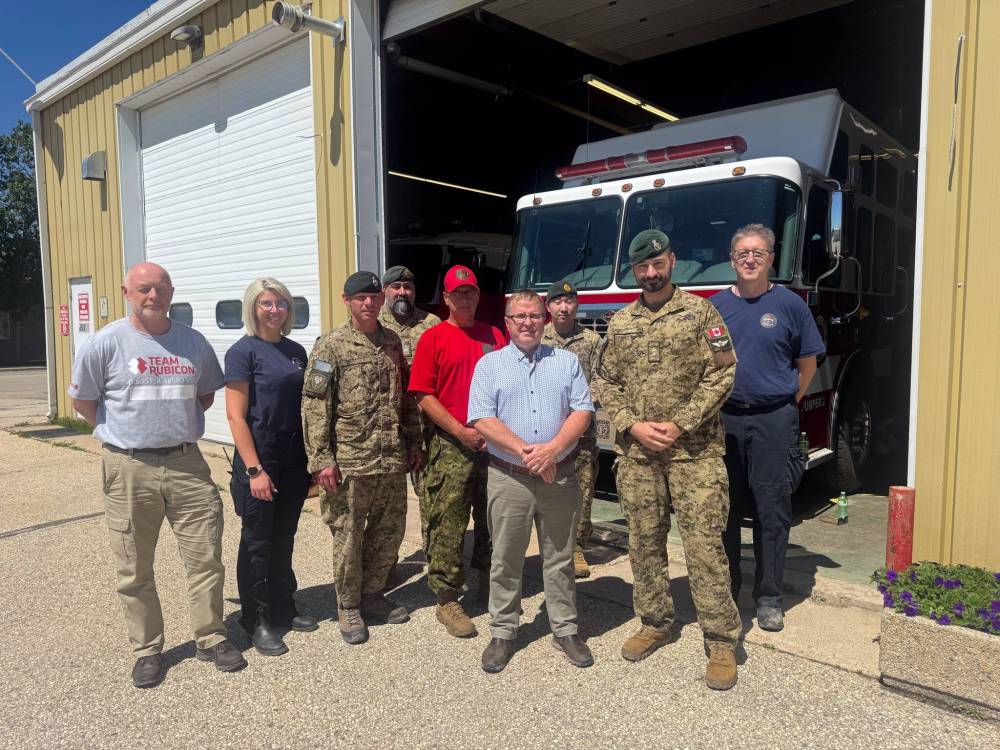
SUPPLIED
Canadian Armed Forces, Team Rubicon Canada and other personnel visited Swan Valley on Sunday to conduct assessments of flooded areas, says Swan River Mayor Lance Jacobson (fourth from right).
Sections of the dike system were raised Monday based on the projected peak.
“There were some areas, particularly in our recreation areas, where it was going to get within that two feet of freeboard,” said Brandon Mayor Jeff Fawcett. “It’s not majorly significant (work), but it’s going to get us back to that two of freeboard.”
Sandbag dikes will be set up around some properties, but no homes were at risk as of Monday, he said.
Brandon was expecting an update from the province to find out if recent rainfall will affect projected peaks in the Assiniboine River basin.

The river level was 358.39 metres in Brandon. The latest projection was a flood peak of 360.3 metres to 360.6 metres. The record peak of 361.28 metres occurred in 2014.
“I think our history of this, hopefully, helps us out significantly. Our goal around here is always get big quick, so we’re doing that again,” Fawcett said.
“Just like in the previous events, it is: what does the weather bring us while this is happening? That’s why we want to have things in place.”
Some Interlake communities continue to deal with flooding. The RM of West Interlake announced the closure of Ashern’s airport through July 31. Flood barriers were set up to protect at-risk homes in Ashern.
chris.kitching@freepress.mb.ca
As a general assignment reporter, Chris covers a little bit of everything for the Free Press.
Our newsroom depends on a growing audience of readers to power our journalism. If you are not a paid reader, please consider becoming a subscriber.
Our newsroom depends on its audience of readers to power our journalism. Thank you for your support.
History
Updated on Monday, July 6, 2026 4:47 PM CDT: Adds details