

It’s not the weather — it’s the climate
Advertisement
Read this article for free:
or
Already have an account? Log in here »
To continue reading, please subscribe:

Digital Subscription
One year of digital access for only $205*
- Enjoy unlimited reading on winnipegfreepress.com
- Read the E-Edition, our digital replica newspaper
- Access News Break, our award-winning app
- Play interactive puzzles
*First annual payment billed as $205.00 + GST for one year. This annual subscription will automatically renew at $233.00 + GST every 52 weeks (10% off the regular annual price of $259.35). Offer available to new and qualified returning subscribers only. Cancel any time.
To continue reading, please subscribe:
Add Free Press access to your Brandon Sun subscription for only an additional
$1 for the first 4 weeks*
- Enjoy unlimited reading on winnipegfreepress.com
- Read the E-Edition, our digital replica newspaper
- Access News Break, our award-winning app
- Play interactive puzzles
*Your next Brandon Sun subscription payment will increase by $1.00 and you will be charged $17.95 plus GST for four weeks. After four weeks, your payment will increase to $24.95 plus GST every four weeks.
Read unlimited articles for free today:
or
Already have an account? Log in here »
Ten days ago it was Europe’s turn, with a slow-moving ‘heat dome’ that gave almost everybody from the United Kingdom to Poland three consecutive days of record-breaking temperatures. In Germany it hit 41 Celsius. That’s 106 Fahrenheit, if you live in the one country that still clings to British Imperial measures. (Hint: it’s not Britain.)
Late last week it was America’s turn, with a similar heat dome inflicting comparable temperatures on almost everywhere east of the Mississippi River. Even central Canada reached temperatures in the mid-to-high 30s C. Meanwhile, the next heat dome has already arrived over Spain and Portugal, heading north and east to envelop the rest of the continent.
It’s not just Europe and North America. Schools in northern India, Bangladesh and Pakistan have been closed much of the time since late April-early May because of extreme heat, with some pupils set to lose six to eight weeks of classes. You’d almost think that there is some sort of global phenomenon driving these widespread, record-breaking heat waves.
THE ASSOCIATED PRESS FILES
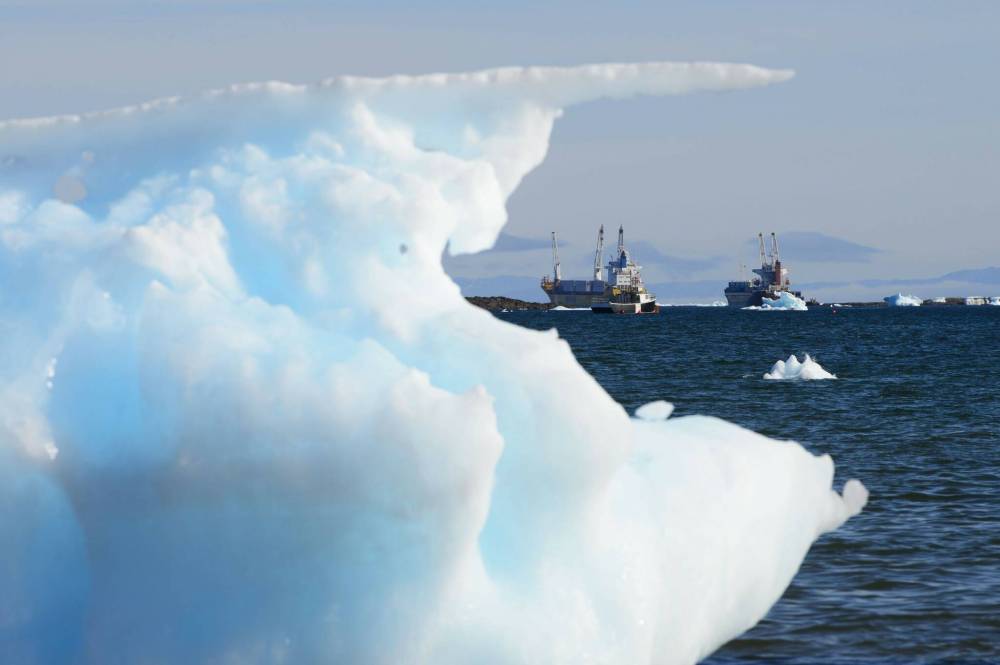
Melting sea ice, pictured near Iqaluit, Nunavut, is one of the ‘feedback’ signs of climate change.
Well, I checked out that possibility, and you’ll be pleased to hear that nothing untoward is happening. It’s just random heat domes wandering past. I looked it up on Fox Weather, and in an 800-word report on the record heat in the eastern United States there wasn’t a single mention of climate change. In fact, the word ‘climate’ did not appear.
Just to be sure, I also checked the coverage in a country whose leader is not the Climate Change Denier-in-Chief. Britain’s Guardian newspaper is pretty reliable (centre-left but evidence-based) and today’s piece on the heat wave in North America did mention climate change — once, in the last paragraph.
There is an almost universal reluctance to engage with the reality of what is happening right now, and what that may portend for the not-very distant future. It’s complicated, it’s a bit frightening, and we all know that dealing with it would change our lives in unwelcome ways. (So would not dealing with it, but that bill arrives a little later.)
But if you want to know the current state of play, from someone who is not a climate scientist but has been heavily engaged with the topic for 15 years (at least a hundred interviews with climate scientists), here it is, almost in bullet form:
Most people understand that we have to reduce global emissions of greenhouse gases fast or we are in deep trouble in the long term (20-30 years). However, that is no longer enough, because the heating is happening much faster than predicted. The average global temperature they were expecting us to reach around 2035 is actually here now.
This accelerated warming risks setting off ‘feedbacks’ that trigger even faster warming. (Some people prefer to talk about ‘tipping points’ — it’s the same phenomenon.) Scientists have a list of the feedbacks that will be triggered at various temperatures, some of which are already quite close — loss of summer sea ice in the Arctic, for example.
But the same scientists now fear that there are feedbacks waiting out there that we don’t know about. They even suspect that most of them will have to do with ocean currents and how they might shift as warming progresses. Indeed, in June 2023 we actually found one — or rather, it found us.
In that one month the average global temperature leapt by almost one-third of a degree Celsius — and it has never fallen back. The new normal is one-and-a-half degrees Celsius ‘above pre-industrial’ (+1.5°C), although we were hoping not to reach that level until between 2035 and 2040.

The safest assumption now is that there are probably other unknown feedbacks out there, waiting to be triggered by some relatively minor increase in temperature. If we can’t cut our emissions that fast (and we can’t), then we will have to hold the heat down artificially in the meantime.
That is still a hugely controversial subject in some quarters, but there is now a strong push to start doing small-scale experiments in the open air. We need to learn quickly if we can safely hold the temperature down by means like reflecting a tiny portion of the incoming sunlight back into space.
The short-term risk now is to avoid setting off a cascade of feedbacks that might quickly deliver us into really bad territory. That can only be achieved by holding the heat down.
In the long run we have to deal with the carbon dioxide and the methane and the various lesser emissions that are actually causing warming, but you can’t get to the long run if you don’t survive the short run.
Gwynne Dyer’s new book is Intervention Earth: Life-Saving Ideas from the World’s Climate Engineers.