

Big decisions put many farmers in same boat

Advertisement
Read this article for free:
or
Already have an account? Log in here »
To continue reading, please subscribe:
Digital Subscription
One year of digital access for only $1.44 a week*
- Enjoy unlimited reading on winnipegfreepress.com
- Read the E-Edition, our digital replica newspaper
- Access News Break, our award-winning app
- Play interactive puzzles
*Billed as $5.77 plus GST every four weeks. After 52 weeks, price increases to the regular rate of $19.95 plus GST every four weeks. Offer available to new and qualified returning subscribers only. Cancel any time.
To continue reading, please subscribe:
Add Free Press access to your Brandon Sun subscription for only an additional
$1 for the first 4 weeks*
- Enjoy unlimited reading on winnipegfreepress.com
- Read the E-Edition, our digital replica newspaper
- Access News Break, our award-winning app
- Play interactive puzzles
*Your next Brandon Sun subscription payment will increase by $1.00 and you will be charged $17.95 plus GST for four weeks. After four weeks, your payment will increase to $24.95 plus GST every four weeks.
Read unlimited articles for free today:
or
Already have an account? Log in here »
There’s a lot of sweating, swatting, squinting — and quite possibly a little swearing — in Manitoba farmyards and fields this summer, as farmers navigate what’s turned into a hellish growing season.
Anyone required to work outdoors in the heat and humidity must also suffer through the relentless swarms of voracious mosquitoes and flies brought on by the recent wet weather. The biting insect populations are unlike anything we’ve seen in recent years and they’re making outside life miserable for humans and livestock alike.
It adds another layer to the frustration in a season when it seems nothing is going well. With each twist and turn, the “so now what?” questions keep piling up.
Laura Rance-Unger
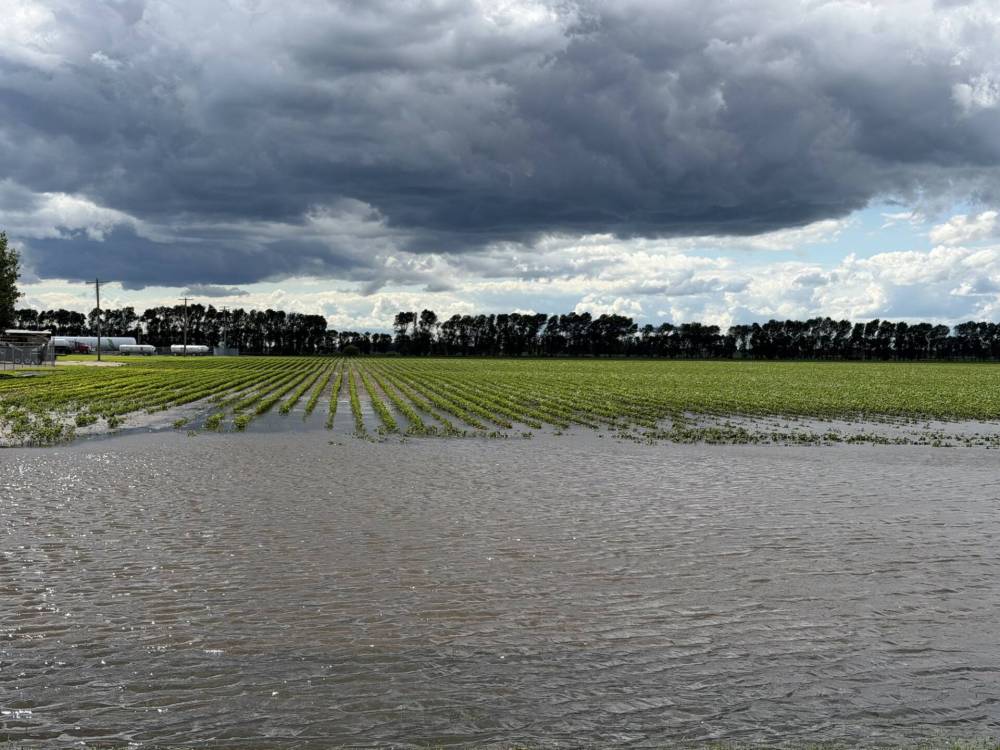
Manitoba farmers must decide how much more to spend protecting this year’s waterlogged crops.
Just getting around the farm or to town for supplies is a chore with roads and bridges washed out in some areas. And the weather alerts just keep coming — warnings of tornadoes, severe thunderstorms and more heavy rain.
Even if fields haven’t been drowned out by the heavy downpours, it’s been difficult, if not impossible, to carry out normal herbicide applications.
If the weeds are too advanced, the herbicides won’t work. If the crops are stressed by excess moisture, their tolerance for the herbicides is weakened and they suffer further setbacks.
Given the age of many Manitoba farmers, many will be pulling out their reading glasses to read the fine print on product labels to see whether the weeds and crops are still at the correct stage for application, how much they can mix with complementary products, and whether these products are approved for application by spray planes and/or drones.
Health Canada granted interim approval in June for the industry to apply herbicides by drone, provided the products being applied are registered for aerial application. However, that’s only one side of the equation.
Farmers must also consider whether the drone they will be using must be registered and whether they must have a drone pilot certificate from Transport Canada.
Plus, there’s still lots to learn about how drone spraying differs from aerial spraying, so it may not deliver the desired payback initially.
With the window for early weed control closing, extension advisers say farmers might be wiser to focus on pre- and post-harvest herbicide applications that set them up for a better year next year.
Manitoba Agriculture farm business specialist Darren Bond urges farmers to consider their next steps with rain-damaged fields with the big picture in mind. It can be paralyzing to try to decide how much to spend on a crop that will likely yield poorly.
“The biggest thing is to make sure that we don’t let this current season’s problems bleed into the next year,” he told the department’s weekly CropTalk webinar. “Simplify, don’t complicate.”
For example, sowing greenfeed, an annual cereal crop harvested for livestock fodder, into a water-soaked field might be a good strategy for producers who have both grain and livestock, but it just adds another layer of complexity for grain farmers if they haven’t already lined up a market.
On the other hand, sowing open land to a cover crop, which is terminated before seeding next spring, is a way to soak up excess water, control weeds and anchor the soil from further wind and water erosion.

“If the decisions that we’re making add stress, add variables, add complexity, I really ask: is that is that the right way to go? Good decisions reduce stress, makes things clear (and) concise,” Bond said.
The best investment farmers can make in a year like this is being kind to themselves and others, he said.
“Going for a walk … texting, calling a neighbour, stopping on the side of the road when you see a neighbour scratching their head, looking at their fields wondering what to do … going to the town fair — that’s all great maintenance for our mental health.”
It not only helps quash one’s own feelings of isolation but it’s a reminder others around are going through the same turmoil. “Everybody has these same pressures, so let’s just remember to be kind with each other when we’re trying to find these solutions,” Bond said.
Laura Rance-Unger is editor emeritus for Glacier FarmMedia. She can be reached at lrance@farmmedia.com
Laura Rance is editorial director at Farm Business Communications.
Our newsroom depends on a growing audience of readers to power our journalism. If you are not a paid reader, please consider becoming a subscriber.
Our newsroom depends on its audience of readers to power our journalism. Thank you for your support.
Laura Rance is editorial director at Farm Business Communications.
Our newsroom depends on a growing audience of readers to power our journalism. If you are not a paid reader, please consider becoming a subscriber.
Our newsroom depends on its audience of readers to power our journalism. Thank you for your support.
Advertisement Advertise With Us
Advertisement Advertise With Us