

‘The water can’t get away’
Drainage maintenance in spotlight as $15M in crop insurance payouts expected this year — before recent flooding

Advertisement
Read this article for free:
or
Already have an account? Log in here »
To continue reading, please subscribe:

Digital Subscription
One year of digital access for only $205*
- Enjoy unlimited reading on winnipegfreepress.com
- Read the E-Edition, our digital replica newspaper
- Access News Break, our award-winning app
- Play interactive puzzles
*First annual payment billed as $205.00 + GST for one year. This annual subscription will automatically renew at $233.00 + GST every 52 weeks (10% off the regular annual price of $259.00). Offer available to new and qualified returning subscribers only. Cancel any time.
To continue reading, please subscribe:
Add Free Press access to your Brandon Sun subscription for only an additional
$1 for the first 4 weeks*
- Enjoy unlimited reading on winnipegfreepress.com
- Read the E-Edition, our digital replica newspaper
- Access News Break, our award-winning app
- Play interactive puzzles
*Your next Brandon Sun subscription payment will increase by $1.00 and you will be charged $17.95 plus GST for four weeks. After four weeks, your payment will increase to $24.95 plus GST every four weeks.
Read unlimited articles for free today:
or
Already have an account? Log in here »
Manitoba crop insurance payouts will likely exceed $15 million this year — before factoring in recent flooding in the Interlake and Parkland regions. Total costs won’t be fully known until year end.
Meantime, as dozens of local communities declare states of emergency, some farmers are calling for greater infrastructure investment, saying damage could’ve been avoided with better drainage maintenance.
“You can do as much ditching as you want in a field, but if it gets to municipality ditches or the provincial ditches and it can’t flow away, it just doesn’t help anything,” said Ryan Elliot.
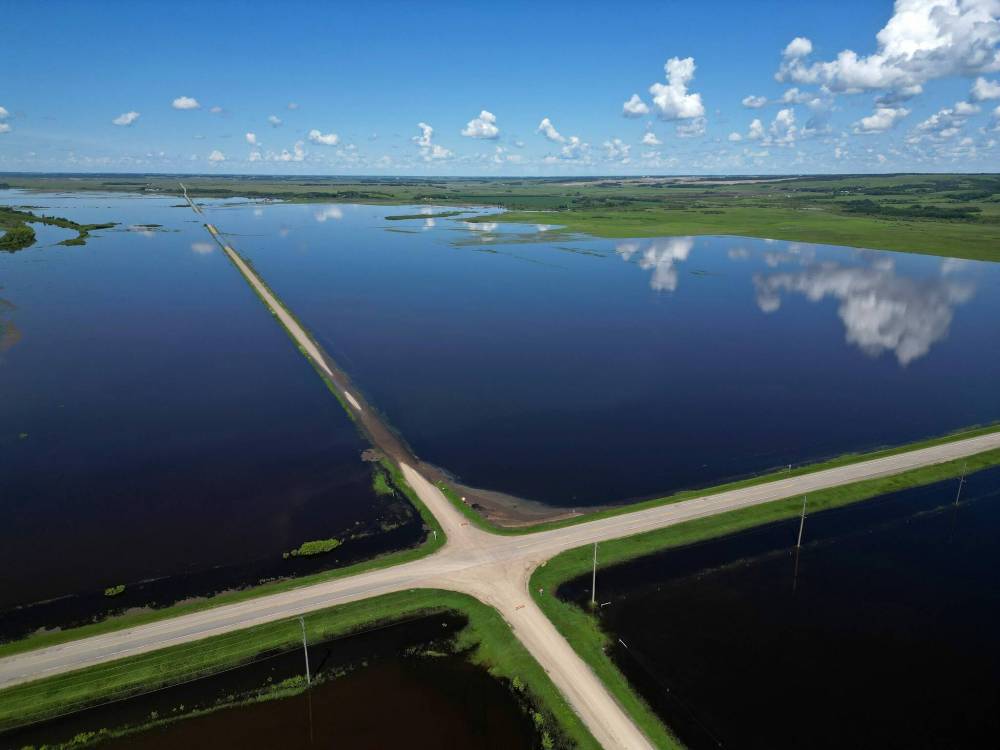
25062026 Flood waters from the swollen Assiniboine River cover farmland and submerge portions of a grid road bisecting Highway 250 north of Alexander on Thursday. (Tim Smith/The Brandon Sun)default
He farms roughly 6,000 acres with his father near Stonewall. About one-third of their crop — wheat, canola — has been completely destroyed by rain, Elliot said. He estimates another third is “heavily damaged.”
There hasn’t been proper care for the infrastructure serving the watershed locals depend upon, Elliot said.
He’s waiting for the Manitoba Agricultural Services Corp. to assess his fields. He tracked roughly 20 inches of rain on his farm from June 10 to 30; 12 inches came in one night.
“A lot of ditches in our area — serious drainage infrastructure — hasn’t been maintained adequately, so that’s causing a lot of the flooding,” Elliot said. “The water can’t get away.”
Twelve inches of rain in one night is an “outlier” event, he added.
Manitoba Agricultural Services assessments won’t happen until water recedes from fields, said David Van Deynze, the Crown corporation’s chief product officer.
Often, staff wait until harvest. They look at farms’ total crop production and compare against the lands’ 10-year averages. Insurance claims are then calculated.
Already, though, the Crown corporation expects to pay farmers at least $15 million in claims of excess moisture not allowing for seeding, and for farmers who were unable to reseed.
More than half of that money — $9 million — comes from excess moisture claims, covering 114,487 damaged acres.
Swan River and surrounding areas, and Dauphin, accounted for most of the claims, Van Deynze said. Reseeding claims haven’t been fully counted.
Jim Kaleta is among those who’ve lost crops in the ground. He saw eight inches of rain at Dauphin Plains Seeds this week.
The Parkland region, which Dauphin is part of, is experiencing widespread flooding.
Kaleta estimates half the crop at Dauphin Plains Seeds is lost. He sells wheat, barley and perennial rye grass seeds, among others, to local farmers.
“Whether we have much seed available (for next year) depends on the outcome of what’s left here,” he said Thursday.
He’s expecting Manitoba farmers to be in financial distress, which could affect sales next spring. Producers may pre-sell to customers; some might not be able to fulfill those orders this year, and they’ll need to buy out the contract.
“Thank God, we’ve got crop insurance,” Kaleta said. “It puts a backstop into what your financial loss will be, but it barely covers your operating costs.”
Fuel, fertilizer and equipment repair prices have climbed in recent years, he continued. Kaleta also called for better infrastructure management to prevent washouts.
Rivers have breached their banks; water near Dauphin Lake is backed up and pooling, Kaleta said.
“I think some of the governments of the day have allocated a lot of resources into issues that don’t deal with necessities,” he said. “Some of those resources should be put back into the infrastructure, in the support of the food production system.

“You lose that, you lose everything.”
Elliot is forecasting a “massive reduction” of food produced in Stonewall.
Soybean growth will be down across the province, affecting exports, said Manitoba Pulse & Soybean Growers production agronomist Wendy MacDonald.
It’s hard to know how many fields are affected until water recedes. MacDonald, who farms in the Parkland region, can’t reach some of her land because there’s no bridge access.
“I have no idea how (the government is) going to go about deciding what to fix first, but that is a huge concern right now — how farmers are going to get to their fields, get to the grain elevators,” MacDonald said.
Semi-trucks are cut off from the Dauphin and Swan River areas, affecting the flow of goods including groceries, according to the Manitoba Trucking Association.
MacDonald hopes to see the provincial government “continuously evaluate” what financial assistance farmers need.
Agriculture Minister Ron Kostyshyn said the province will work with the feds as it gets a “clearer picture” of what’s needed. Manitoba Agricultural Services will assess the damage, he added.
“Agriculture is very important to Manitoba’s economy, and we will respond accordingly,” Kostyshyn told reporters.
The sector contributed $5.46 billion to the provincial GDP last year.
About 90 per cent of Manitoba farmland — or some 9.9 million acres — is covered by crop insurance, Van Deynze said. The Crown corporation set its payout rates based on market values in January 2026.

Grain and oilseed prices were generally higher the week of June 26 than Jan. 16, government reports show.
Grocery prices likely won’t rise in coming months due to the predicted crop loss, said Derek Brewin, a University of Manitoba agricultural economics professor.
“Where it’s wheat and oilseeds, the world has so much of those that the impact on the price … (is) probably pretty low,” he said. “The retail sector in rural Manitoba — where farmers are a big part of the buying population — those retail stores could really suffer, if it’s a large part of their area that lost their crop.”
Upgrading infrastructure is difficult because of regulatory overlap between municipalities and other entities, such as conservation districts, Brewin said.
gabrielle.piche@winnipegfreepress.com
Gabby is a big fan of people, writing and learning. She graduated from Red River College’s Creative Communications program in the spring of 2020.
Our newsroom depends on a growing audience of readers to power our journalism. If you are not a paid reader, please consider becoming a subscriber.
Our newsroom depends on its audience of readers to power our journalism. Thank you for your support.
Gabby is a big fan of people, writing and learning. She graduated from Red River College’s Creative Communications program in the spring of 2020.
Our newsroom depends on a growing audience of readers to power our journalism. If you are not a paid reader, please consider becoming a subscriber.
Our newsroom depends on its audience of readers to power our journalism. Thank you for your support.
Advertisement Advertise With Us
Advertisement Advertise With Us