

Ensuring context accompanies complex history requires courage, strengthens public trust
Advertisement
Read this article for free:
or
Already have an account? Log in here »
To continue reading, please subscribe:

Digital Subscription
One year of digital access for only $205*
- Enjoy unlimited reading on winnipegfreepress.com
- Read the E-Edition, our digital replica newspaper
- Access News Break, our award-winning app
- Play interactive puzzles
*First annual payment billed as $205.00 + GST for one year. This annual subscription will automatically renew at $233.00 + GST every 52 weeks (10% off the regular annual price of $259.35). Offer available to new and qualified returning subscribers only. Cancel any time.
To continue reading, please subscribe:
Add Free Press access to your Brandon Sun subscription for only an additional
$1 for the first 4 weeks*
- Enjoy unlimited reading on winnipegfreepress.com
- Read the E-Edition, our digital replica newspaper
- Access News Break, our award-winning app
- Play interactive puzzles
*Your next Brandon Sun subscription payment will increase by $1.00 and you will be charged $17.95 plus GST for four weeks. After four weeks, your payment will increase to $24.95 plus GST every four weeks.
Read unlimited articles for free today:
or
Already have an account? Log in here »
Museums have never had the capacity to tell every story. Every exhibition is an act of selection. Every gallery is shaped by choices — what to include, what to emphasize and, inevitably, what must remain outside its walls.
After more than three decades working as a museum director, curator and educator, I have learned that these choices are among the profession’s greatest responsibilities. Exhibitions dealing with colonialism, Indigenous histories, war, migration, religion, cultural identity or human rights rarely emerge without disagreement. Curators debate evidence. Scholars debate interpretation. Community members bring lived experience. Boards weigh institutional responsibilities and public expectations. Consensus is uncommon — and it should be.
What matters is not whether museums avoid controversy. It is whether they approach difficult histories with intellectual honesty, scholarly rigour and the humility to acknowledge that the past is rarely simple.
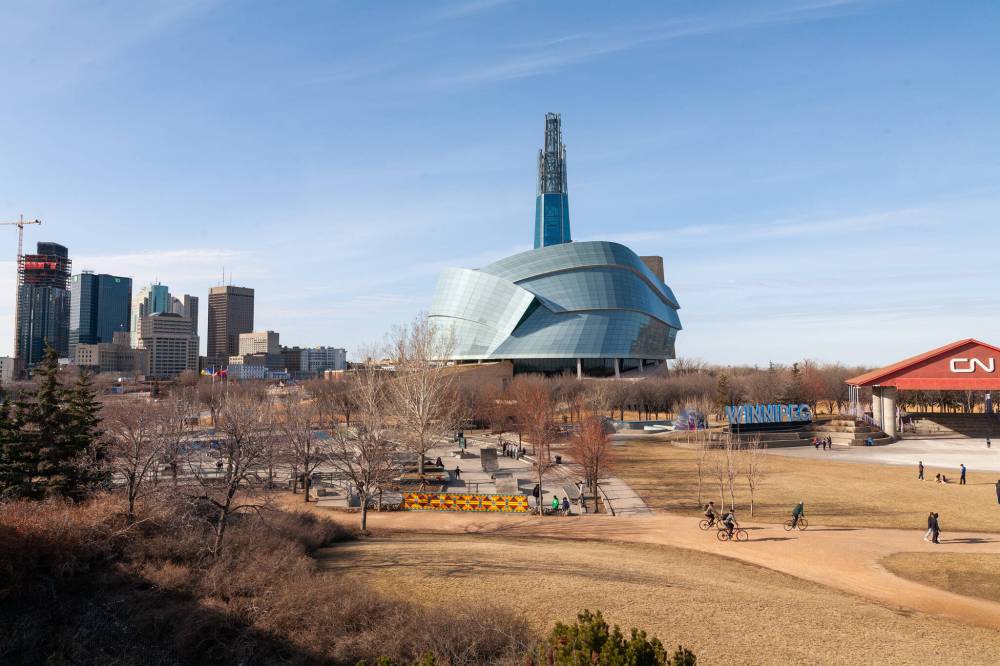
The Canadian Museum for Human Rights (Daniel Crump / Winnipeg Free Press files)
Unlike governments, courts or advocacy organizations, museums are not expected to deliver verdicts. Their authority rests elsewhere. They preserve evidence, steward collections, advance scholarship and invite public reflection. Their role is not to settle political disputes but to deepen public understanding. At their best, museums create spaces where visitors encounter layered histories, wrestle with competing perspectives and, perhaps, leave with more questions than answers.
Today, that responsibility has become considerably more challenging.
Across Canada and around the world, museums are increasingly called upon to interpret histories whose meanings, legacies and public interpretations remain deeply contested. Colonialism, residential schools, slavery, the Holocaust, the Armenian Genocide, the Russian invasion of Ukraine and the ongoing conflict between Israelis and Palestinians all carry profound emotional, political and cultural significance. Every curatorial decision — what to include, what to omit and what to emphasize — will inevitably disappoint someone.
Recent discussion surrounding the Canadian Museum for Human Rights exhibition on the Nakba illustrates this challenge. The exhibition explores the displacement of Palestinians during the 1948 Arab-Israeli war, a defining historical experience for many Palestinians.
That history deserves to be told.
When museums interpret histories that remain deeply contested, however, visitors are best served when exhibitions acknowledge the broader historical landscape in which those events unfolded.
Context is not a concession to one community or another. It is fundamental to good museum practice.
In this case, that broader landscape includes the displacement experienced by both Palestinian and Jewish communities during and after 1948. These experiences are not identical, nor should they be conflated. But neither are they unrelated. Recognizing one history does not diminish another. It enriches our understanding of both.
This is not about creating false equivalencies or suggesting that every exhibition must tell every story. No single exhibition can do that. Every project has a defined scope, limited space and specific interpretive objectives.
But visitors to a national museum devoted to human rights reasonably expect that such histories will be situated within their broader historical context.
Human history is filled with moments when multiple communities experienced profound suffering during the same period. Understanding how those histories intersect often deepens empathy rather than division.
This is where the idea of public trust becomes especially important.
Museums occupy a remarkable place in civic life. At a time when confidence in information is challenged by social media, partisan commentary and fragmented news sources, museums remain among the institutions many people regard as credible stewards of evidence, scholarship and history.
That trust is neither automatic nor permanent. It is earned slowly and can be lost quickly.
Museum director and scholar James Cuno argued museums hold their collections and interpretive authority in trust for the public. That responsibility extends beyond caring for objects. It includes caring for the integrity of historical interpretation. When museums undertake challenging or contested subjects, they have an obligation to demonstrate scholarship, transparency and fairness.
The public does not expect museums to avoid hard conversations. Nor does it expect museums to suspend their scholarly responsibilities or ethical mandates. Human rights, history and art museums all make interpretive choices shaped by their missions, collections and expertise. What visitors do expect is that those choices will be transparent, intellectually rigorous and honest about historical complexity.
Some worry that providing additional context weakens an exhibition’s central narrative. I have never believed that. Greater context rarely dilutes interpretation; it strengthens it. It gives visitors a richer understanding of why events unfolded, how different communities experienced them and why those histories continue to shape our world today.
Context does not diminish suffering. It deepens understanding.
Earlier this year, I wrote about the Art Gallery of Ontario and the difficult intersection of politics, governance and curatorial independence with a contemporary art acquisition. That discussion focused on how museums make difficult decisions. This one asks a different — but closely related — question: how should museums interpret difficult histories? Both ultimately lead to the same place: the public trust.
Institutional credibility is not built by pretending controversy does not exist. Nor is it strengthened by reducing history to a single perspective. Confidence grows when museums demonstrate careful scholarship, balanced interpretation and transparency about the choices they have made.

Museums should challenge assumptions, introduce unfamiliar perspectives and encourage conversations. But they must also resist the pressure — whether political, ideological or institutional — to reduce complicated histories to a single narrative.
Visitors are capable of holding more than one truth at a time. They can recognize the suffering of one people without denying the suffering of another. That willingness to embrace complexity may be one of the museum’s greatest gifts.
In an increasingly polarized world, this may also be one of the museum’s greatest civic responsibilities. Not to tell people what to think, nor to resolve history’s enduring disagreements, but to provide the evidence, scholarship and context that allow them to think more deeply for themselves.
Museums do not earn the public’s confidence by making the past appear uncomplicated. They earn it through evidence, transparency, empathy and the courage to embrace complexity. In the end, having the courage to tell the fullest story possible — honestly, thoughtfully and in context — is among the highest obligations museums owe the public they serve.
Stephen Borys is President and CEO of Civic Muse, an arts and cultural consulting practice based in Winnipeg.