Documentary puts affordable housing centre stage
Winnipeg co-ops among models examined in film
Advertisement
Read this article for free:
or
Already have an account? Log in here »
To continue reading, please subscribe:
Digital Subscription
One year of digital access for only $1.44 a week*
- Enjoy unlimited reading on winnipegfreepress.com
- Read the E-Edition, our digital replica newspaper
- Access News Break, our award-winning app
- Play interactive puzzles
*Billed as $5.77 plus GST every four weeks. After 52 weeks, price increases to the regular rate of $19.95 plus GST every four weeks. Offer available to new and qualified returning subscribers only. Cancel any time.
To continue reading, please subscribe:
Add Free Press access to your Brandon Sun subscription for only an additional
$1 for the first 4 weeks*
- Enjoy unlimited reading on winnipegfreepress.com
- Read the E-Edition, our digital replica newspaper
- Access News Break, our award-winning app
- Play interactive puzzles
*Your next Brandon Sun subscription payment will increase by $1.00 and you will be charged $17.95 plus GST for four weeks. After four weeks, your payment will increase to $24.95 plus GST every four weeks.
Read unlimited articles for free today:
or
Already have an account? Log in here »
We see theatre artist Debbie Patterson making her way toward the Old Grace Housing Co-operative’s entrance in her wheelchair, then settling inside for a steaming cup of tea. The co-op is her home.
“Well, I’ve always loved this neighbourhood and wanted to stay in this neighbourhood. I lived in a big, three-storey Wolseley house and then got MS and couldn’t do the stairs,” she says in a voiceover.
“Having a place I could move into that was completely accessible was just a godsend at a perfect time when I needed to stop living in my house, so I could stay in my neighbourhood and continue to be in a safe place.”
Supplied
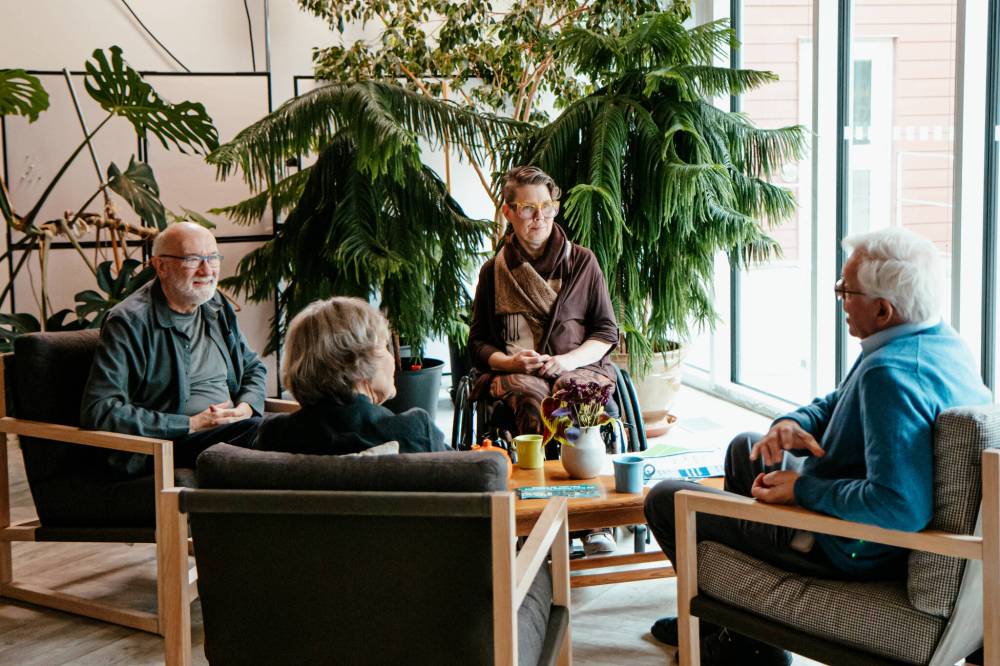
From left: Doug Smith, Sandra Hardy, Debbie Patterson and Greg Selinger discuss co-ops in Meeting a Moment: The Art of Social Architecture, which airs on CBC.
It’s one of the opening scenes of Meeting a Moment: The Art of Social Architecture, directed by Danielle Sturk and produced by Leslie Stafford, which appears on CBC Gem today and airs on CBC TV Saturday.
The 44-minute documentary is a meditation on Winnipeg housing against a backdrop of a countrywide affordability crisis. It’s unapologetically a film with a mission: promoting affordable housing models and developments through the voice of local architects, residents, developers, historians and designers.
“This isn’t a commune, by the way. Very much, you close the door to your unit, it is your life. There’s no one paying attention to you,” says Old Grace resident/treasurer Doug Smith, the author of Property Wrongs.
“But it’s like Cheers: everybody knows your name.”
In the film, Patterson and Smith sit down for tea with Old Grace founding member Sandra Hardy and former NDP Manitoba premier Greg Selinger, who is a board member of La Crèmerie Co-op.
“Some people wonder where co-ops fit on the political spectrum, and the answer is everywhere. They’re used by groups that are looking for solutions, whether they’re Mennonites, Ukrainians or francophones,” Selinger says.
Patterson doesn’t downplay her political affinities: “I love the anti-capitalist model of the co-op — that housing isn’t an investment, it’s a place to live,” she says.
“Land, like people, is not a commodity,” adds Smith.
According to a figure cited in the film, 40 per cent of Canadian households can’t afford today’s average market rents.
Supplied
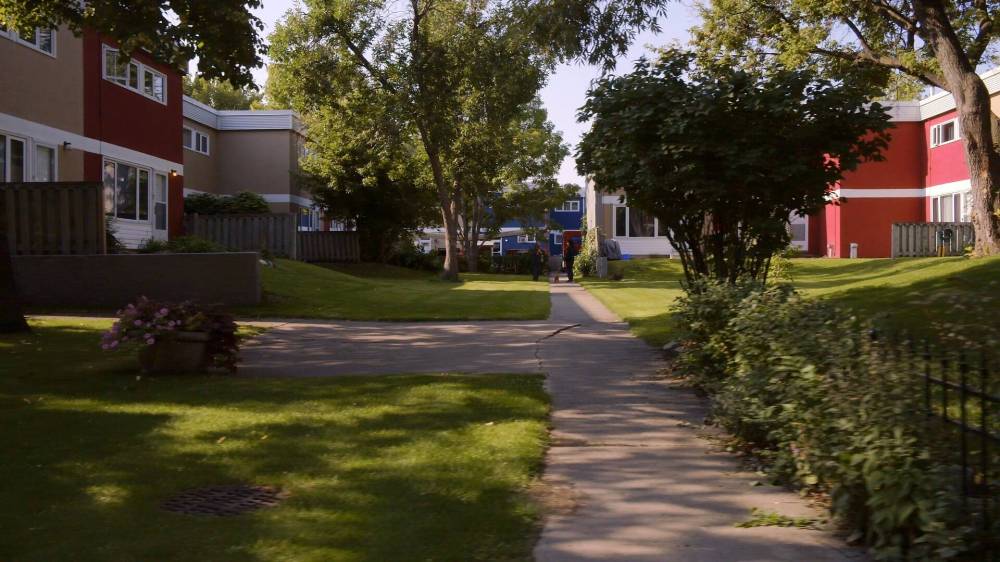
Willow Park Housing Co-operative in Winnipeg was designed during the Great Depression.
This problem is exacerbated by speculation, with investors and developers buying up homes and land not primarily for living, but to profit from surging property values. As non-profits, co-ops are freer from this dynamic since they can’t be flipped for private gain.
During the Great Depression, co-ops took off across Saskatchewan and Manitoba as means for immigrant and rural communities to pool resources.
A carry-over from this co-op heyday is the 200-unit Willow Park Housing Co-operative in northwest Winnipeg, a subject of Meeting A Moment. Designed during the Great Depression by the pioneering Green Blankstein Russell architecture firm, Willow is Canada’s first permanent housing co-op and still stands tall today.
“A huge storm comes, and they’re under tents and the tents are almost going to collapse under the weight of the water,” says Sturk, describing a scene in the doc that unfolds at Willow. “Everybody moved together as a community: old women, young teen boys. All ages, all groups, working together.”
Willow’s waiting list, according to the filmmakers, is currently five years long — highlighting how housing pressures show up in Winnipeg even with comparatively low rents and home prices.
The city has a lower median income than the national average, a sizable unhoused population and an aging non-market housing stock.
The film explores other alternative approaches to this problem apart from co-ops, with examples of non-market, affordable and deeply affordable housing. This is a chance for local developers and architects to don a hardhat or throw up a concept render and show off projects still in development.
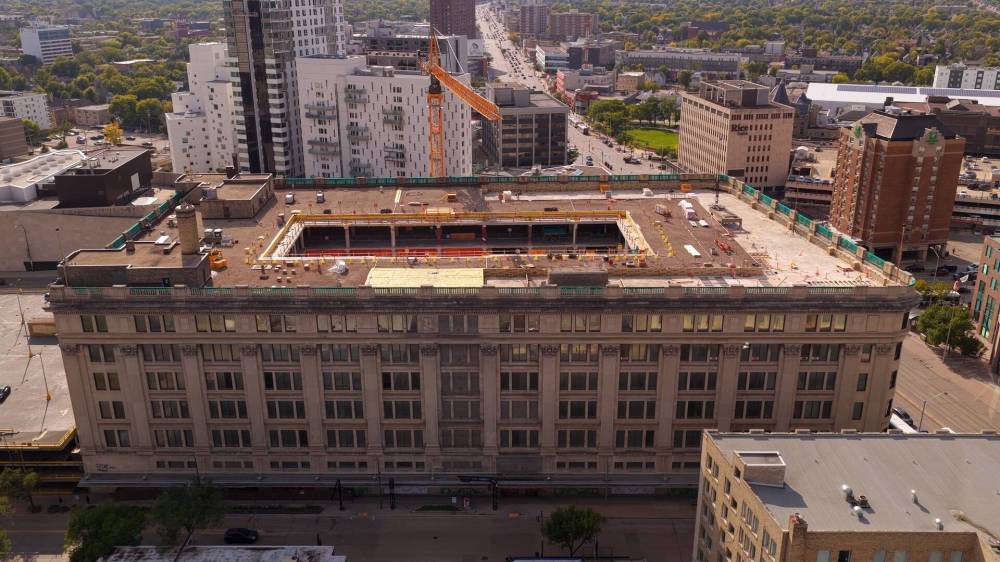
New projects explored include, for instance, Wehwehneh Bahgahkinahgohn, a large-scale transformation of the former Hudson’s Bay department store into a mixed-use Indigenous-led community space with housing and other services.
“It was a real privilege to do the work and to be able to have access to the multiple brains and hearts of folks that are working in this space right now, trying to find solutions,” Sturk says.
Supplied
The Wehwehneh Bahgahkinahgohn will transform the former downtown Bay building into a mixed-use Indigenous-led community space.
The word “community” is often on the lips of the film’s architects and developers, who are the film’s primary protagonists, though some may seem remote from the people actually living in the spaces discussed.

Smith, a co-op resident himself, stresses that a grassroots approach to housing challenges alone is insufficient.
“It’s dangerous to think the housing crisis is going to be resolved by a small group of activists. If it weren’t for the government supplying the land here and a loan, we wouldn’t have happened,” he says.
Meeting a Moment — whose funders include the CBC, Manitoba Film and Music, the City of Winnipeg, the Manitoba government and others — premièred in Winnipeg at the Architecture + Design Film Festival in April.
“(Audiences) felt really positive about Winnipeg, which is not always the case,” says Stafford. “There’s a lot of people doing this work and we don’t know about them, (but) it’s wonderful to know this work is being done.”
winnipegfreepress.com/conradsweatman
Conrad Sweatman is an arts reporter and feature writer. Before joining the Free Press full-time in 2024, he worked in the U.K. and Canadian cultural sectors, freelanced for outlets including The Walrus, VICE and Prairie Fire. Read more about Conrad.
Our newsroom depends on a growing audience of readers to power our journalism. If you are not a paid reader, please consider becoming a subscriber.
Our newsroom depends on its audience of readers to power our journalism. Thank you for your support.