
Big Smoke murders point to bigger picture

Advertisement

Advertise with us

Two murdered teens, a strangled sex worker, corrupt and aggressive cops, a morally bankrupt mayor, undercover real estate deals and a city on edge during a long hot summer — this is the volatile mixture that Don Gillmor concocts in his detective noir novel Cherry Beach.

Read this article for free:


By clicking the button above, an account will be created and you will begin to receive some of our recommended newsletters. You may opt out of any newsletter by visiting your Email and Communication Preferences page or by clicking "unsubscribe" at the bottom of any email.

or

Already have an account? Log in here »

To continue reading, please subscribe:

Subscribe and receive a limited-edition Free Press branded hat or tote.

Digital Subscription

One year of digital access for only $205*

  • Enjoy unlimited reading on winnipegfreepress.com
  • Read the E-Edition, our digital replica newspaper
  • Access News Break, our award-winning app
  • Play interactive puzzles

*First annual payment billed as $205.00 + GST for one year. This annual subscription will automatically renew at $233.00 + GST every 52 weeks (10% off the regular annual price of $259.35). Offer available to new and qualified returning subscribers only. Cancel any time.

To continue reading, please subscribe:

Add Free Press access to your Brandon Sun subscription for only an additional

$1 for the first 4 weeks*

  • Enjoy unlimited reading on winnipegfreepress.com
  • Read the E-Edition, our digital replica newspaper
  • Access News Break, our award-winning app
  • Play interactive puzzles
Start now

*Your next Brandon Sun subscription payment will increase by $1.00 and you will be charged $17.95 plus GST for four weeks. After four weeks, your payment will increase to $24.95 plus GST every four weeks.

Two murdered teens, a strangled sex worker, corrupt and aggressive cops, a morally bankrupt mayor, undercover real estate deals and a city on edge during a long hot summer — this is the volatile mixture that Don Gillmor concocts in his detective noir novel Cherry Beach.

A Toronto writer and editor, Gillmor won the Governor General’s award for non-fiction for his memoir To the River, written in memory of his late brother David. Cherry Beach is his fifth novel; he has also written nine children’s books, has won 12 National Magazine Awards and was senior editor at the Walrus.

In Cherry Beach, Gillmor serves up a tense tale with numerous twists. Toronto Police detective Jamieson Abel is on a mission to solve the three murders while also digging down to reveal dirty dealings linking Toronto politicians, criminals and crooked cops in the city’s high-stakes real estate market.

The book opens with Abel and his partner, Davis, who is the division’s only woman of colour, responding to the call after the teens’ bodies are discovered in an apartment in St. James Town. The two friends were promising athletes and good students, both stabbed to death; the only possible suspect identified is 21-year-old Delroy Staples, the boyfriend of the older girl.

The division’s superintendent, a longtime cop now counting the days until retirement, pairs Abel and Davis with two veteran cops who Abel doesn’t like or trust. He knows the two don’t think twice about using physical force on suspects taken to isolated locations such as Cherry Beach. As public pressure mounts, a city-wide manhunt for Staples begins.

Abel certainly has no friends among his peers. He dropped out of law school to care for his mother when she was dying of cancer. His decision to enter the police force isn’t explained, but he’s come to view his superintendent and fellow officers with disdain. He knows he was purposely partnered with Davis, as the two of them are outliers in their division — Abel goes to work each day expecting to be fired for insubordination.

A loner in his personal life too, Abel’s main hobby is buying high-priced ingredients to prepare elaborate meals paired with the best wines he can afford. Gillmor devotes a lot of ink to detailing his protagonist’s culinary forays.

After the body of Infinity, a transgender sex worker, is found strangled with an expensive silk tie, Abel visits the exclusive suburb of Rosedale to see a former city councillor. Titus Bishop owes him a favour; 12 years earlier, Abel had discovered him stoned in a limo with two sex workers who had been beaten, yet no charges were laid. Upon seeing Bishop again, Abel reckons the elderly man wouldn’t have been physically capable of killing Infinity.

While the crime rate is falling in most parts of the Greater Toronto Area, St. James Town is an anomaly, with the recent three-month rate standing at a level six times higher than a decade prior. With the largest high-rise community in the country, built in the ’60s, St. James Town now houses more than 18,000 residents, about two-thirds of which are immigrants. These residents are economically trapped in their crumbling buildings as rents in more desirable areas skyrocket.

The buildings might be deteriorating, but Abel knows the large chunk of land on which the development is situated holds enormous value. He works to figure out the true ownership of this property and how the murders, and St. James Town’s current crime spree, might all be pieces of a larger picture.

In Cherry Beach, Gillmor draws on his personal knowledge of Toronto’s history and social tensions existing within Canada’s largest and most ethnically diverse metropolitan area. Abel is a flawed character, yet one who wishes to restore some justice to the lives of those citizens who keep the city functioning.

Andrea Geary is a freelance writer in Selkirk.
Report Error Submit a Tip

More Stories

The War to June 6, 1944: Why Normandy?

The Canadian Press 3 minute read Wednesday, Jun. 5, 2019

OTTAWA - THE WAR TO JUNE 6: Allied fortunes had rebounded by 1944 after the massive German conquests of 1940-41. British and American armies had driven the Germans from North Africa and Sicily, forced Italy to surrender and were moving up the Italian boot while Allied bombers were pounding German cities and towns day and night. In the East, the Soviets were on the march to Berlin. And in the Pacific, the Americans were making headway against the Japanese.

WHY INVADE? Military planners recognized Germany could not be defeated by strategic bombing or naval blockade. Instead, they would have to invade to both free occupied Allies and ensure Europe didn't fall into the hands of the Soviet Union.

WHY NORMANDY? The decision was largely dictated by technology and supply problems. Beaches had to be within range of British-based fighter planes and easy striking distance of a port, which would be needed to unload supplies. The Nazis believed the Allies would attack at the Pas de Calais, which was the closest point to Great Britain. Knowing this, the Allies devised an elaborate deception to keep the Nazis focused on this area while actually preparing for Normandy, which had lighter defences, suitable beaches and the requisite proximity to ports.

WHO HAD THE ADVANTAGE? In many ways, the Allies and Germans were well-matched. The Allies had far superior air and sea power; the Germans had troops and tanks available for quick reinforcement. The Germans had better tanks and anti-tank guns while the Allies had more of both. German troops, in many cases, were better trained and superbly led by hardened veterans. The Germans, however, were hampered by shortages of supplies, especially fuel while the Allies had plenty of everything. German generals also faced ham-handed interference by Adolf Hitler; Allied generals were able to unfold their plans without harassment from above.

Musk’s Starship flawed, but useful

Gwynne Dyer 5 minute read Saturday, May. 30, 2026

With a record of five failures and six partial successes in his Starship program, the 12th launch, on May 22, of Elon Musk’s rocket was critical to the success of the whole SpaceX enterprise. Doubts were growing, and the initial public offering was only weeks away.

The IPO, due on June 12, is expected to raise up to $80 billion for the company. Its only currently profitable sector is its telecommunications business, Starlink, but SpaceX’s long-haul potential is a near-monopoly on launches and other space services for American and other players in the burgeoning space business.

Musk does push hard at the boundaries of possibility, however, and with Starship he made two promises that are hard to keep: fully reusable spaceships that deliver 100 tonnes of payload to low earth orbit (LEO). The ‘reusable’ part of the promise is almost done; the ‘heavy lift’ part not so much, because that brings him up against the ‘rocket equation’.

That’s Russian scientist Konstantin Tsiolkovsky’s classic rocket equation of 1903, which states that around 90 per cent of a rocket’s launch weight has to be fuel if you want to put it into Earth orbit. It has not yet been successfully challenged, which is why so many of Starship’s launches failed — and none has yet reached orbit.

MILWAUKEE - Move your hands atop the worn table in the darkened room and it responds with jumbled sounds: a man and woman talking, knives being sharpened, tires screeching, breathing, music.

Walk on the nine-metre-by-six-metre floor piece and its glowing orange, yellow and red shapes that resemble microscopic organisms form "scars" in response to movements. Stand before what seems to be a large abstract painting on the wall, and projected single and multiple lines are mysteriously drawn where you stand or move.

These are works in the "Act/React: Interactive Installation Art," making its world premiere at the Milwaukee Art Museum through Jan. 11, 2009.

Guest Curator George Fifield said previous interactive pieces asked viewers to use a mouse or keyboard, but this is the first exhibition that just allows viewers to move through the space to help create art.

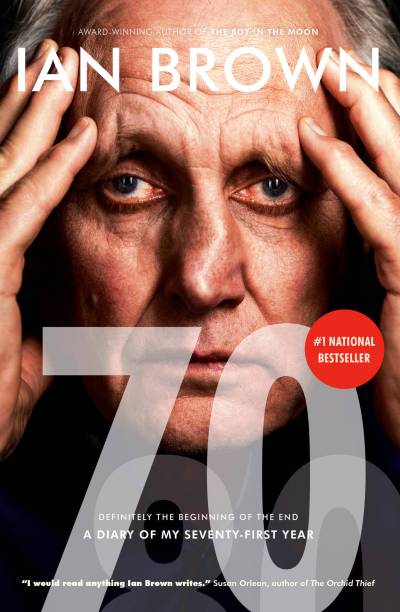
Brown ponders life in his 71st year, warts and all, in thoughtful, fearless prose

Reviewed by Gene Walz 4 minute read Preview

Brown ponders life in his 71st year, warts and all, in thoughtful, fearless prose

Reviewed by Gene Walz 4 minute read Saturday, Sep. 19, 2026

Sequels are rarely as good as their originals. (The movie The Godfather Part II may be the rare exception.) That’s the main shortcoming of Ian Brown’s Seventy, a sequel of sorts to his popular and acclaimed Sixty.

Both works are diaries of pivotal years in his life. And while Seventy has fewer surprises, Brown is still writing at the peak of his powers. Luckily, there are new things to ponder, wonder and worry about from a slightly different perspective.

Brown is the widely respected features reporter for the Globe and Mail. He has several books to his credit, most notably The Boy in the Moon: A Father’s Search for His Disabled Son, the winner of too many awards to list in a short book review. He’s an immensely accomplished writer.

Brown is definitely not a typical septuagenarian. Not yet retired, he travels extensively, has a wide circle of friends with whom he stays in regular contact, bikes to work year-round, swims in the ocean, golfs, plays pickleball, rows and skis. And not just downhill skiing, but heli-skis — helicoptering into remote areas of the B.C. Rockies to blaze new trails.

Read
Saturday, Sep. 19, 2026

Payroll reveal: 18 school staff cleared $200K

Maggie Macintosh 4 minute read Preview

Payroll reveal: 18 school staff cleared $200K

Maggie Macintosh 4 minute read Friday, Jul. 3, 2026

Chief superintendents and a divisional kookum were among 18 public school board employees in Winnipeg who earned more than $200,000 last year.

New salary compensation reports reveal the top-paid teacher in the city was in charge of Manitoba’s most populated school board, while the group of trustees with the largest cumulative paycheque was based in St. Vital.

New salary compensation reports reveal the Winnipeg School Division’s Matt Henderson was the highest-paid chief executive officer of his kind. In 2025, Henderson’s salary was $292,473.

Sandra Herbst, who oversees the River East Transcona School Division, and the Louis Riel School Division’s Christian Michalik each earned $291,203.

Read
Friday, Jul. 3, 2026

Creatures’ comfort key to coping with loss

Maureen Scurfield 5 minute read 2:00 AM CDT

DEAR MISS LONELYHEARTS: Not long ago I lost my husband to illness at far too young an age. My spouse was a great guy, but I do want another one.

I just want to pass on a little tip. When my husband was dying, he encouraged me to bring home warm and loving pets to our acreage just outside the city. They were my saviours when my husband was ill.

Since he has died, they continue to help me keep warm, happy and affectionate. They were my greatest comfort in the later stages when my man was in too much pain to hold me or be held. The cats and the dog would welcome me home from the hospital and transfer their cuddling to me, giving me all the attention I needed, and I always felt so loved.

I have been dating a fair bit for a fairly recent widow because I’m ready to be held and loved, and I feel my husband and the pets saying, “Way to go.”