

More time at work is not always more productive work
Advertisement
Read this article for free:
or
Already have an account? Log in here »
To continue reading, please subscribe:

Digital Subscription
One year of digital access for only $205*
- Enjoy unlimited reading on winnipegfreepress.com
- Read the E-Edition, our digital replica newspaper
- Access News Break, our award-winning app
- Play interactive puzzles
*First annual payment billed as $205.00 + GST for one year. This annual subscription will automatically renew at $233.00 + GST every 52 weeks (10% off the regular annual price of $259.35). Offer available to new and qualified returning subscribers only. Cancel any time.
To continue reading, please subscribe:
Add Free Press access to your Brandon Sun subscription for only an additional
$1 for the first 4 weeks*
- Enjoy unlimited reading on winnipegfreepress.com
- Read the E-Edition, our digital replica newspaper
- Access News Break, our award-winning app
- Play interactive puzzles
*Your next Brandon Sun subscription payment will increase by $1.00 and you will be charged $17.95 plus GST for four weeks. After four weeks, your payment will increase to $24.95 plus GST every four weeks.
Read unlimited articles for free today:
or
Already have an account? Log in here »
There is a quiet assumption built into many workplaces that more time equals more value.
The employee who answers emails late into the evening is seen as committed. The manager who skips lunch and powers through 12-hour days is admired for their work ethic. The team that keeps stretching to absorb one more vacancy, one more project, one more urgent ask is praised for stepping up.
It feels productive. It looks productive. But often, it is not.
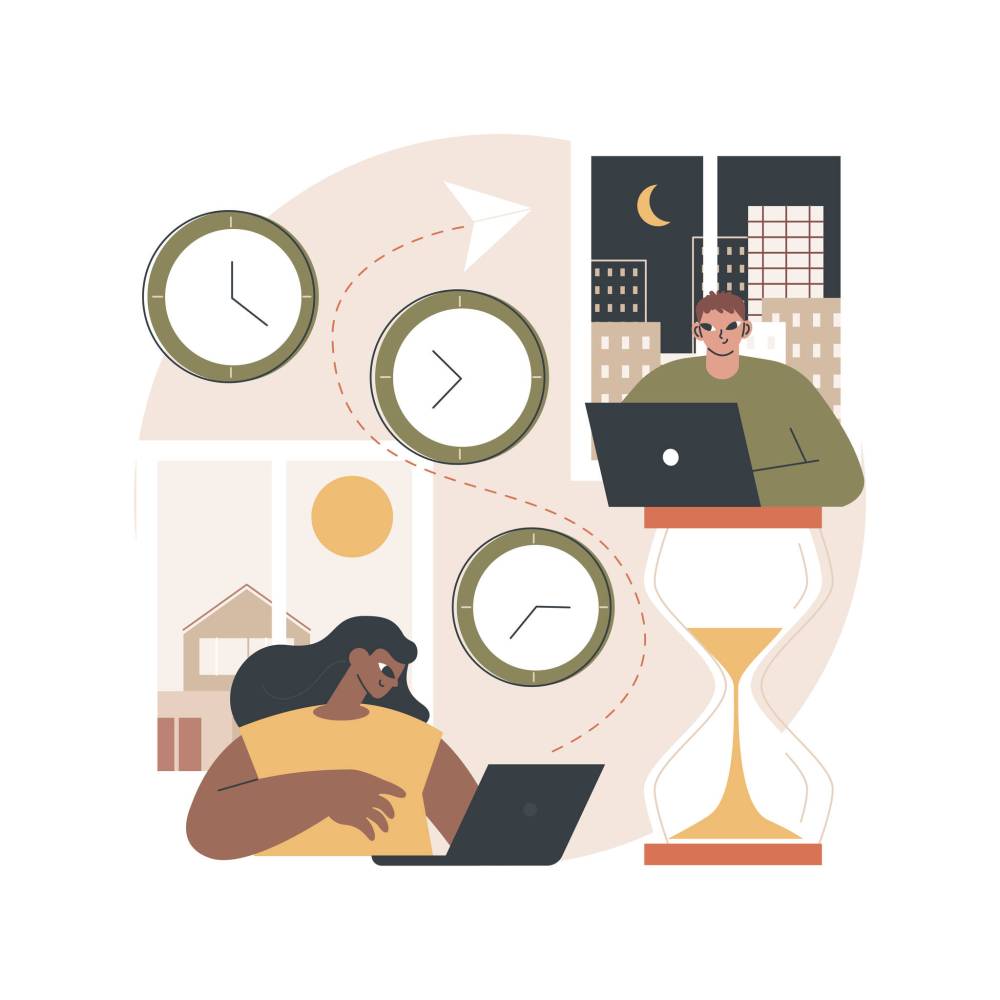
Magnifico
Time zones abstract concept vector illustration. Time standard, international business coordination, meeting management, utc converter, gmt, world clock calculator, jet lag abstract metaphor.
Canada’s productivity conversation has increasingly focused on a simple but important measure: output per hour worked. In other words, what are we actually producing for the time we are putting in?
Statistics Canada measures labour productivity as real GDP per hour worked, which is a reminder that productivity is not about how long people work, it is about what gets accomplished during that time.
That distinction matters because Canadian data tells an interesting story.
In the third quarter of 2025, labour productivity in Canadian businesses rose by 0.9 per cent, even while hours worked declined slightly. Output increased, but hours dipped. More was produced with less time. On the flip side, in periods where hours worked have grown faster than output, productivity has fallen. Simply adding hours does not automatically create better results.
For employers, that should be a moment of pause.
Longer hours can sometimes be necessary. Harvest season does not wait. Hospitals cannot simply close their doors at 5 p.m. Construction timelines are affected by weather, supply chains and potentially short building seasons.
Manitoba employers in manufacturing, agriculture, transportation, health care and public service know work often comes in waves. There are seasons when everyone pulls harder. The problem is when temporary intensity becomes permanent operating style.
That is where productivity begins to quietly erode.
Fatigue changes how people work. Tired employees make more mistakes. They solve problems more slowly. They become reactive rather than thoughtful. Their patience shortens. Collaboration gets rougher around the edges. Creativity narrows because there is no mental room left for ideas, only task completion. The workday becomes about clearing what is urgent, not improving what matters.
Eventually, people are physically present but mentally depleted. That has a cost.
A national survey from Canada Life found nearly 39 per cent of Canadian employees reported feeling burned out, and for an organization with 500 employees, burnout-related productivity losses and salary costs can exceed $3.4 million annually.
Burnout is often discussed as a wellness issue, but it is equally an operational issue. It affects output, decision making, attendance, retention and service quality.
This is especially relevant in Manitoba.
Manitoba employers are carrying a unique mix of pressure. The province currently has labour shortages in skilled trades, health care, education and specialized professional roles. Many organizations are operating lean, either because they cannot find talent or because economic uncertainty has made hiring decisions cautious. Existing employees are often covering gaps, taking on broader roles or doing work once shared across larger teams.
That creates a dangerous temptation: stretch the good people.
Most organizations know exactly who their dependable employees are. They are the people who say yes, who stay late, who fix things quietly, who pick up extra work without complaint. They become the organizational shock absorbers.
But when workplaces continually lean on their most capable people without redesigning workload, adding support or adjusting expectations, those employees do not become more productive — they become exhausted.
Exhausted talent eventually leaves, disengages or stays while giving much less than they once could.
The Manitoba answer is not to work less, it is to work smarter and more intentionally. That starts by asking practical questions.
Are meetings necessary or are they crowding out productive work time? Are reporting processes useful or are employees spending hours completing reports no one meaningfully uses? Are strong employees carrying weak systems? Are managers solving workload issues by redistributing work instead of redesigning work? Are teams rewarded for visible busyness rather than measurable outcomes?
These are culture questions as much as operational ones.
Healthy workplace culture does not celebrate burnout as commitment. It values focus, clarity, efficiency and sustainability. It recognizes people are not machines with endless capacity. It understands recovery is part of performance.
Athletes know this. Muscles rebuild during rest, not strain. Work is no different. People need room to think, recover and return sharp.
Manitoba has an advantage here. Its business community is relationship-driven. Its organizations are often more community-minded. Leaders are closer to their people. There is an opportunity to build workplaces where productivity is defined not by how late the parking lot is full but by whether employees have what they need to do meaningful work well.

Because at the end of the day, hours are easy to count. Value is harder — but value is what matters.
The workplaces that will thrive in the years ahead will not be the ones that simply ask people for more time. They will be the ones that make better use of the time people already give.
Tory McNally, CPHR, BSc., vice-president, professional services
at TIPI Legacy HR+ (formerly Legacy Bowes), is a
human resource consultant, relationship builder and problem solver. She can be reached at tmcnally@tipipartners.com