

Seeding clock ticks loudly on Prairie fields

Advertisement
Read this article for free:
or
Already have an account? Log in here »
To continue reading, please subscribe:
Monthly Digital Subscription
$1 per week for 24 weeks*
- Enjoy unlimited reading on winnipegfreepress.com
- Read the E-Edition, our digital replica newspaper
- Access News Break, our award-winning app
- Play interactive puzzles
*Billed as $4.00 plus GST every four weeks. After 24 weeks, price increases to the regular rate of $19.95 plus GST every four weeks. Offer available to new and qualified returning subscribers only. Cancel any time.
Monthly Digital Subscription
$4.99/week*
- Enjoy unlimited reading on winnipegfreepress.com
- Read the E-Edition, our digital replica newspaper
- Access News Break, our award-winning app
- Play interactive puzzles
*Billed as $19.95 plus GST every four weeks. Cancel any time.
To continue reading, please subscribe:
Add Free Press access to your Brandon Sun subscription for only an additional
$1 for the first 4 weeks*
- Enjoy unlimited reading on winnipegfreepress.com
- Read the E-Edition, our digital replica newspaper
- Access News Break, our award-winning app
- Play interactive puzzles
*Your next Brandon Sun subscription payment will increase by $1.00 and you will be charged $17.95 plus GST for four weeks. After four weeks, your payment will increase to $24.95 plus GST every four weeks.
Read unlimited articles for free today:
or
Already have an account? Log in here »
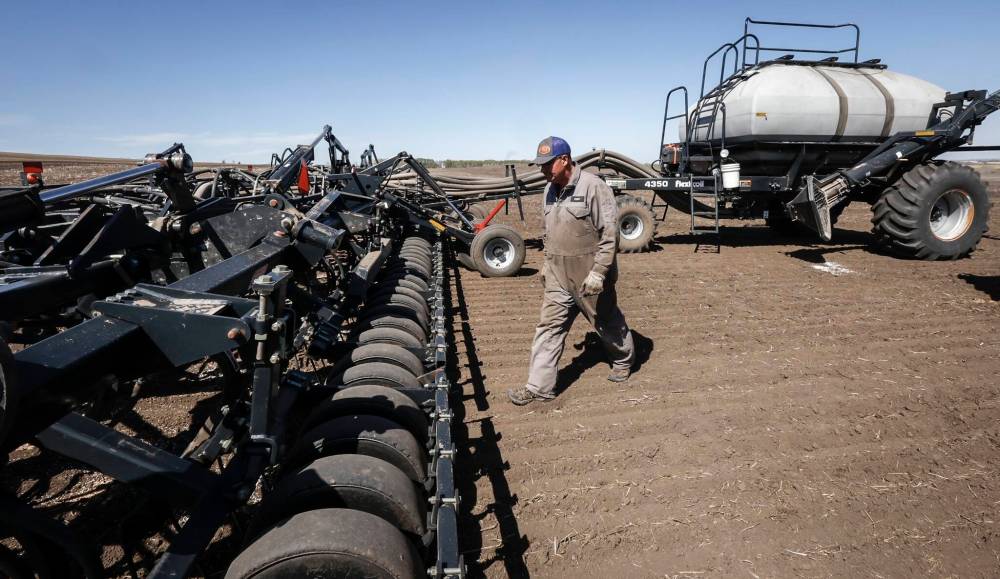
If the forecast holds, Manitoba fields will be crawling with equipment this week, as the race to seed this year’s crop begins.
An early-May start to seeding is right on track by historical standards, but still feels late this year, partly because it’s been so cold. Seeding dates have been edging earlier over time, especially for crops such as wheat, as farmers discover they can get away with super-early seeding under the right circumstances.
Due to the compressed growing season characteristic to this part of the world, it’s well-documented the later the crop is seeded, the lower it yields. However, seed too early and there’s a risk that a late-spring frost will force farmers to reseed some fields.
For most, it’s a gamble worth taking.
They’re monitoring soil moisture and temperature for when to start the seeding clock, instead of the calendar. Thanks to some late-season storms that have moved across the Prairies over the past month, soil moisture conditions have improved.
Soil temperatures, however, remain cool, which makes other management decisions, such as how to manage fertilizer applications, more complicated than usual. It’s tempting to simply apply less fertilizer in this year of high prices, but extension agronomists advise farmers to weigh those decisions carefully.
Phosphorus, which along with nitrogen and sulphur, is subject to tightening supplies and soaring costs because of war in the Middle East, is crucial for early plant root development. While farmers are unlikely to cut back on nitrogen because of how well it correlates with higher yields, it’s a case where a farmer might borrow against their soil bank equity for phosphorus in a year like this.
A starter dose of phosphorus, preferably placed into the soil near the seed, is pretty well non-negotiable if they want to maintain yields. Phosphorus enables the plant to do a better job of connecting with the nutrients it needs for vigorous growth.
“With the cool temperatures, this is when, if you have that starter phosphorus down, you will actually see a big benefit to the crop … being a bit more vigorous in the early-season growth,” Manitoba Agriculture soil fertility specialist Marla Riekman told a webinar this week.
But then it becomes a dance of sorts, depending on the crop and whether farmers want to jig for short-term results or waltz with their long-term nutrient balance.
Some crops, such as canola, like being spoon-fed. Give it easy access to soil-placed phosphorus and it will gobble it up. Others, such as flax or soybeans, prefer foraging. They are more apt to draw their needs from residual phosphorus in the soil than annual applications.
Several crops absorb phosphorus by forming symbiotic relationships with mycorrhizal fungi in the soil, exchanging sugars to feed the fungi for help converting soil phosphorus into a usable form. Those fungi populations stick around to support the other crops that follow.
However, canola, the second- largest crop by acreage on the Prairies, breaks that cycle. It takes phosphorus in, but doesn’t support the mycorrhizae. So, the crops that follow can suffer if the farmer doesn’t account for that in their nutrient plan. Corn is rarely grown after canola in the crop rotation for that reason.

Riekman said the recommended strategy is for farmers to apply a little more phosphorus than their crops will remove for several years until their soil bank registers medium-to-high phosphorus levels. While it is possible to have too much, most Manitoba soils have below-optimum levels.
Building reserves up over time gives farmers flexibility in a year like this one to use only starter P and draw down residual levels until price and availability improves. But that only buys time. If prices remain high next year, as many anticipate, they’ll have to consider reinvesting.
However, a drawdown of residual reserves may be impractical for farmers who haven’t had time to build up their phosphorus bank, or who are farming rented land or nearing retirement.
Either path they choose, they’re under pressure to secure the supplies they need early to avoid potential shortages or supply chain hiccups.
Laura Rance-Unger is editor emeritus for Glacier FarmMedia. She can be reached at lrance@farmmedia.com
Laura Rance is editorial director at Farm Business Communications.
Our newsroom depends on a growing audience of readers to power our journalism. If you are not a paid reader, please consider becoming a subscriber.
Our newsroom depends on its audience of readers to power our journalism. Thank you for your support.
Laura Rance is editorial director at Farm Business Communications.
Our newsroom depends on a growing audience of readers to power our journalism. If you are not a paid reader, please consider becoming a subscriber.
Our newsroom depends on its audience of readers to power our journalism. Thank you for your support.
Advertisement Advertise With Us
Advertisement Advertise With Us