

A Sanctuary for the City — and Its Future
Advertisement
Read this article for free:
or
Already have an account? Log in here »
To continue reading, please subscribe:
Monthly Digital Subscription
$1 per week for 24 weeks*
- Enjoy unlimited reading on winnipegfreepress.com
- Read the E-Edition, our digital replica newspaper
- Access News Break, our award-winning app
- Play interactive puzzles
*Billed as $4.00 plus GST every four weeks. After 24 weeks, price increases to the regular rate of $19.95 plus GST every four weeks. Offer available to new and qualified returning subscribers only. Cancel any time.
Monthly Digital Subscription
$4.99/week*
- Enjoy unlimited reading on winnipegfreepress.com
- Read the E-Edition, our digital replica newspaper
- Access News Break, our award-winning app
- Play interactive puzzles
*Billed as $19.95 plus GST every four weeks. Cancel any time.
To continue reading, please subscribe:
Add Free Press access to your Brandon Sun subscription for only an additional
$1 for the first 4 weeks*
*Your next subscription payment will increase by $1.00 and you will be charged $16.99 plus GST for four weeks. After four weeks, your payment will increase to $23.99 plus GST every four weeks.
Read unlimited articles for free today:
or
Already have an account? Log in here »
On Saturday mornings during my Grade 12 year, I would head downtown to the Eaton’s department store on Portage Avenue.
I was part of the Eaton’s Junior Executive program, which brought together students from high schools across Winnipeg to host events and represent Eaton’s at community gatherings.
I also had a part-time job in the store’s sporting goods department.
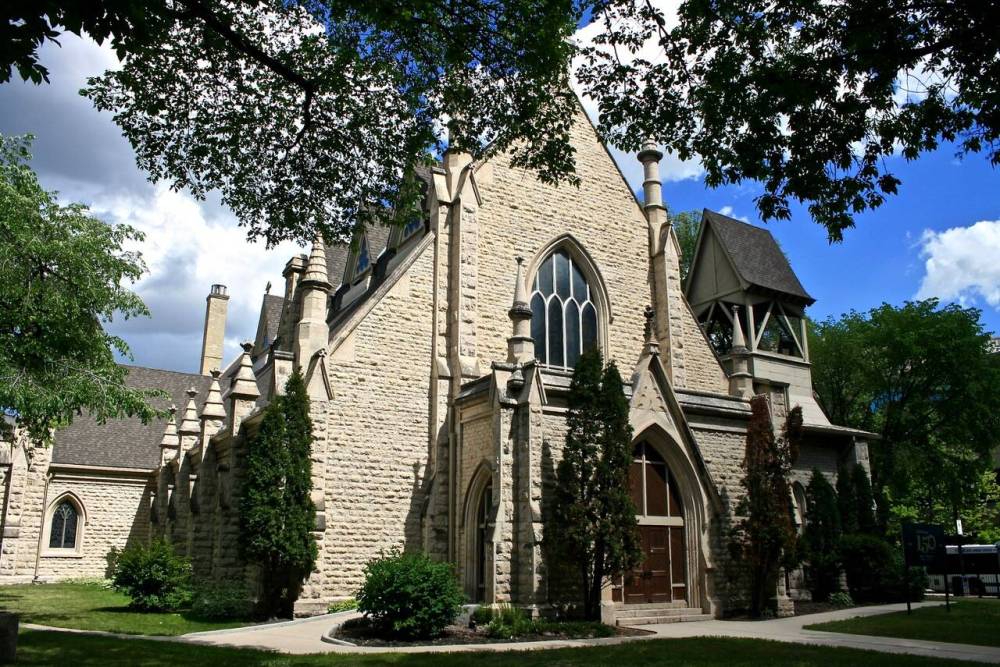
Submitted/Winnipeg Architecture Foundation
Holy Trinity Church
Downtown Winnipeg in those days felt like the centre of my universe. Eaton’s — now the site of Canada Life Centre — was a bustling hub, and on my lunch breaks I would wander outside to explore the neighbourhood.
Across the street stood Holy Trinity Church.
In the heat of summer, I stepped inside. The thick limestone walls and breezes from the clerestory windows made the interior wonderfully cool — long before central air conditioning. The noise of Portage and Graham faded away. The church offered something rare in the heart of the city: stillness.
My mother used to call it “the Eaton’s church.” During her high school days she worked part-time in the Eaton’s mail order building next door, and for many downtown workers Holy Trinity was part of the rhythm of daily life.
As a graduate art history student at the University of Toronto, one of my final papers focused on 19th-century churches in Canada designed in the Gothic Revival style, with Holy Trinity among the notable examples.
This week, many years later, that memory came full circle. Through my consulting firm, I have been asked to serve as the building project manager for Holy Trinity’s redevelopment initiative.
The church, designed by Charles H. Wheeler, stands at the corner of Graham Avenue and Donald Street — an unmistakable presence amid the towers and arenas of downtown Winnipeg. Built in 1883–84, it remains one of Winnipeg’s most remarkable historic buildings — a National Historic Site and one of the oldest houses of worship in the downtown core.
In the century and a half since, the surrounding neighbourhood has changed repeatedly as buildings rose, disappeared, and districts transformed.
Holy Trinity is one of the rare downtown structures that has remained constant.
Its first purpose has always been as a parish church — a place of worship, pastoral care and Christian service in the heart of the city. For generations it has also been known as a “Sanctuary for the City,” welcoming people for worship, music, lectures, workshops, and quiet reflection amid the rhythms of urban life. Today its outreach programs include preparing and serving more than 400 free meals each week.
Now the church faces an important stewardship challenge. Engineering assessments have identified foundation issues that require attention and long-term planning. With support from CentreVenture and Monteyne Architecture, a comprehensive architectural and engineering report outlines the work ahead.
The question facing the parish and the Diocese of Rupert’s Land is not simply how to repair a historic structure — which can and will be done.
The deeper question is what Holy Trinity should become in the decades ahead.
Across Canada, roughly 10,000 historic places of worship will likely close in the coming decade as congregations age and maintenance costs rise. In the United States, the number may exceed 150,000 buildings.
The challenge is not simply preservation. It is imagination.
How can these spaces continue to serve the public good — as places of gathering, culture, housing, learning, refuge, and civic life — while honouring their spiritual and architectural history?
I have encountered that question before.
My family lives in a historic church complex that we transformed through an adaptive reuse project. What had once been a 1904 brick and stone church and mid-century modern hall has been restored and reimagined as private residences and gardens, preserving the architectural footprint and character of the buildings while giving them new life.
Projects like this are becoming increasingly common across North America. They are not about erasing history. They are about extending it.
Holy Trinity now stands at a similar threshold moment.
Over the coming months, working alongside the Reverend Canon Donna Joy and the parish, one of my highest priorities will be community consultation and stakeholder engagement. Parish and diocesan members, neighbours, and partners will be invited to share their perspectives as we consider Holy Trinity’s future.
The goal is not to rush toward conclusions, but to listen carefully and identify viable pathways forward — ones that respect the church’s architectural heritage while allowing it to continue serving the needs of a changing city.
The Diocese of Rupert’s Land has also outlined guiding principles for any future redevelopment: maintaining worship space in the city’s core; considering the needs of Holy Trinity’s community partners and tenants; respecting treaty obligations and reconciliation; and ensuring the church continues to serve the broader downtown community.
What has been remarkable in recent years is the extraordinary level of public support the church has received. Media coverage and community conversations have consistently emphasized one thing: Holy Trinity matters.
Not just to Anglicans.
To Winnipeg.
It is seen as a place of dignity, welcome and moral presence in the heart of the city — a building that embodies both the history and the civic spirit of downtown.
The question, therefore, is not whether Holy Trinity should exist in the future.
The question is what it can become.
At the close of Archdeacon Octave Fortin’s farewell sermon at Holy Trinity on Nov. 25, 1917, in the dark years of the First World War, he spoke about the church’s role in the life of the city:
“I commend unto you the various avenues of service which we have developed within our borders. Here is ample scope for your energies. Let it be your aim to abound in your service… Winnipeg will be a great city. Holy Trinity must have a great future. It must be a beacon of light for future generations.”

More than a century later, those words feel less like history than a challenge.
The future of Holy Trinity will emerge through careful listening, thoughtful planning, and the shared imagination of the community around it.
In many ways, that has always been the story of Holy Trinity — a place shaped by the people of Winnipeg and their hopes for the city.
And I am honoured to play a part in that journey.
Stephen Borys is president and CEO of Civic Muse, and former Director and CEO of the Winnipeg Art Gallery–Qaumajuq.