

Canada’s university funding system is broken
Advertisement
Read this article for free:
or
Already have an account? Log in here »
To continue reading, please subscribe:
Monthly Digital Subscription
$1 per week for 24 weeks*
- Enjoy unlimited reading on winnipegfreepress.com
- Read the E-Edition, our digital replica newspaper
- Access News Break, our award-winning app
- Play interactive puzzles
*Billed as $4.00 plus GST every four weeks. After 24 weeks, price increases to the regular rate of $19.95 plus GST every four weeks. Offer available to new and qualified returning subscribers only. Cancel any time.
Monthly Digital Subscription
$4.99/week*
- Enjoy unlimited reading on winnipegfreepress.com
- Read the E-Edition, our digital replica newspaper
- Access News Break, our award-winning app
- Play interactive puzzles
*Billed as $19.95 plus GST every four weeks. Cancel any time.
To continue reading, please subscribe:
Add Free Press access to your Brandon Sun subscription for only an additional
$1 for the first 4 weeks*
*Your next subscription payment will increase by $1.00 and you will be charged $16.99 plus GST for four weeks. After four weeks, your payment will increase to $23.99 plus GST every four weeks.
Read unlimited articles for free today:
or
Already have an account? Log in here »
For decades, Canadian universities have delivered a world-class education at a remarkably accessible cost. Nationally, Manitoba has among the lowest tuition fees in the country.
However, like many universities across Canada, the University of Manitoba is facing a new reality that can no longer be ignored.
According to Statistics Canada, average tuition in Manitoba is 22.5 per cent below the national average and 39 per cent below Saskatchewan’s. As the Globe and Mail editorial board recently observed, Canadian students today are paying — after inflation — roughly what they paid in 2013.
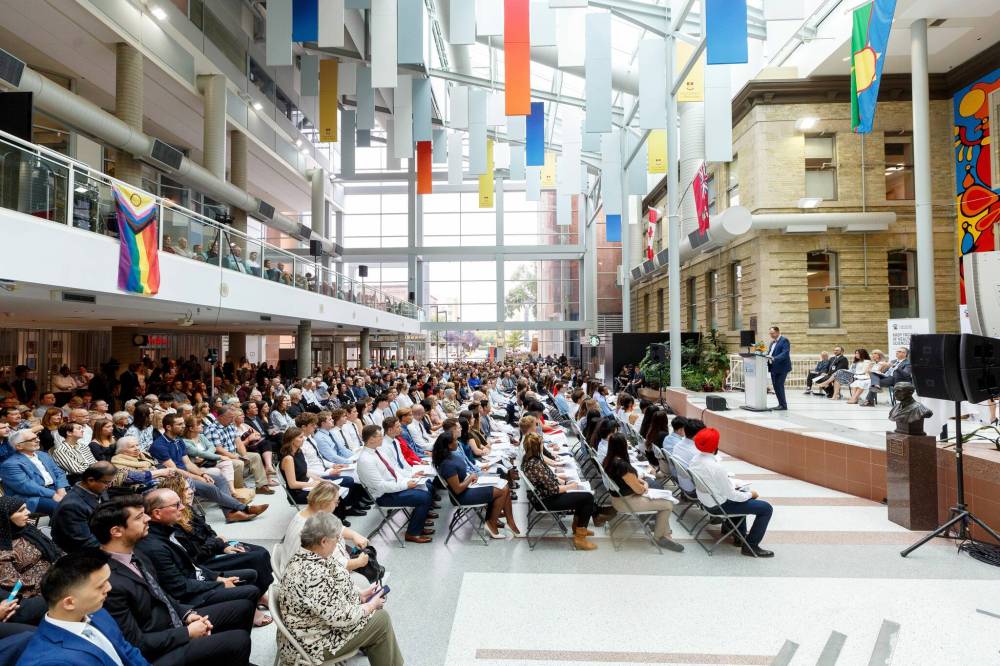
MIKE DEAL / WINNIPEG FREE PRESS
The fiscal equation is changing for Canadian universities like the University of Manitoba, and Canadian students are going to have to pay higher tuition as a result.
The problem is that the cost of running a university in 2026 bears no resemblance to the cost of running one in 2013.
That affordability did not happen by accident. Nor was it fully supported by public funding. Instead, it has been sustained through years of constrained spending and — critically — through growing reliance on international student tuition. At most universities, international students pay three to five times the domestic rate, effectively subsidizing the education of Canadian students.
This model worked because Canada offered something uniquely attractive: a globally respected post-secondary system within an open, stable, and welcoming society. International students chose Canada not just to study, but to live, work, and, in many cases, build their futures. Canada, in turn, benefited enormously — from cultural exchange to research capacity to long-term economic growth.
That model is now broken.
In 2024, the federal government of the day moved to sharply limit international student admissions in response to housing pressures concentrated mostly in southern Ontario and British Columbia. Rather than tailoring policy to regional realities, a blunt, uniform cap was applied across the country. The impact has been severe. The government has since doubled down, aiming to reduce Canada’s temporary population, including international students, further over the next three years.
The consequences are already visible. Universities and colleges across Canada are cutting programs, eliminating staff, and scaling back ambitions.
Although Manitoba’s post-secondary institutions have always taken a measured approach to international recruitment and have connected the talent of international students to vital gaps in our economy, Manitoba is also no exception. The Manitoba Institute of Trades and Technology recently announced it is closing its doors, citing the collapse in international student enrolment.
As Advanced Education and Training Minister Renée Cable acknowledged on Jan. 9, the province experienced a 40 per cent reduction in international students, with what she rightly described as “massive cuts” creating “unnecessary hardship for the education system.”
Compounding the problem, federal signals have fundamentally altered how Canada is perceived abroad. Applications from international students are falling, not simply because of caps, but because Canada no longer appears to be the welcoming destination it once was.
Canadian universities are now confronting a hard truth: we are facing a financial reckoning because we can no longer rely on international tuition revenue to subsidize domestic tuition.
If we want to preserve the quality Canadians rightly expect — to educate future leaders, drive innovation, and sustain research excellence — then domestic tuition rates must increase. Not dramatically. Not in an American-style spiral. But meaningfully, and honestly, and closer to the true cost of delivering a university education.
This does not mean closing doors or abandoning accessibility. A fair tuition system must be paired with robust financial aid so that students with talent and ambition are not excluded because of income. Equity and affordability matter — but they must be built on a foundation that is financially sustainable.
How large an adjustment is needed depends, in part, on provincial choices. In Canada, provinces fund university operations, and increases in provincial grants can reduce pressure on tuition.
The reality, however, is stark. For more than a decade, provincial funding has declined in real terms. According to Higher Education Strategy Associates’ State of Postsecondary Education in Canada 2025 report, provincial funding fell three per cent nationally over the past five years, and four per cent in Manitoba between 2019 and 2024.
At the University of Manitoba, our operating grant is not tied to enrolment. As we welcome record numbers of domestic students, we do so with less provincial funding per student than before. If current trends continue, by 2028 we will be educating over 1,400 more domestic students than we did in 2024, without commensurate revenue to support them.
You do not need to be an accountant to see that this math does not work. A 40 per cent drop in international enrolment, combined with rising domestic enrolment, leads inevitably to declining revenue per student. While Manitoba’s current provincial government has recognized the need and provided modest funding increases — and the federal government has invested significantly in research — these measures do not compensate for past cuts or the scale of the international enrolment collapse.

As political scientist Jonathan Malloy wrote recently in the Globe and Mail, “universities are not a commodity in which quality holds steady regardless of price.” Starve the system long enough, and a race to the bottom becomes unavoidable.
Universities exist to serve the public good: expanding opportunity, advancing knowledge, and strengthening democracy.
That mission depends on stable, sustainable investment. For years, Canada’s universities have worked to keep tuition fees disproportionately low for domestic students. With fewer international students this is no longer possible — the era of international student tuition subsidizing domestic fees is ending. Adjusting domestic tuition gradually now helps maintain affordability and avoids sharper changes later, while enabling universities to deliver the learning experiences and spaces students need.
If we fail to respond now — honestly, pragmatically, and with courage — we risk weakening Canada’s most powerful engines of growth, innovation, and social mobility.
Michael Benarroch is the president and vice-chancellor of the University of Manitoba, Western Canada’s oldest post-secondary and one of the top research universities in the country.