Ducks were once a conservation bright spot. Now they’re declining in the US, new report shows

Advertisement

Advertise with us

WASHINGTON (AP) — At least 112 North American bird species have lost more than half their populations in the past 50 years, according to a new report published Thursday.

Read this article for free:


or

Already have an account? Log in here »

To continue reading, please subscribe:

Subscribe and receive a limited-edition Free Press branded hat or tote.

Digital Subscription

One year of digital access for only $205*

  • Enjoy unlimited reading on winnipegfreepress.com
  • Read the E-Edition, our digital replica newspaper
  • Access News Break, our award-winning app
  • Play interactive puzzles

*First annual payment billed as $205.00 + GST for one year. This annual subscription will automatically renew at $233.00 + GST every 52 weeks (10% off the regular annual price of $259.35). Offer available to new and qualified returning subscribers only. Cancel any time.

To continue reading, please subscribe:

Add Free Press access to your Brandon Sun subscription for only an additional

$1 for the first 4 weeks*

  • Enjoy unlimited reading on winnipegfreepress.com
  • Read the E-Edition, our digital replica newspaper
  • Access News Break, our award-winning app
  • Play interactive puzzles
Start now

*Your next Brandon Sun subscription payment will increase by $1.00 and you will be charged $17.95 plus GST for four weeks. After four weeks, your payment will increase to $24.95 plus GST every four weeks.

Hey there, time traveller!
This article was published 13/03/2025 (558 days ago), so information in it may no longer be current.

WASHINGTON (AP) — At least 112 North American bird species have lost more than half their populations in the past 50 years, according to a new report published Thursday.

Among the birds showing the steepest declines are Allen’s hummingbirds, Florida scrub jays, golden-cheeked warblers, tricolored blackbirds and yellow-billed magpies.

“These are the very real consequences if we are unable to conserve and protect the crucial habitats that birds need,” said study co-author Mike Brasher, a senior scientist at the nonprofit Ducks Unlimited.
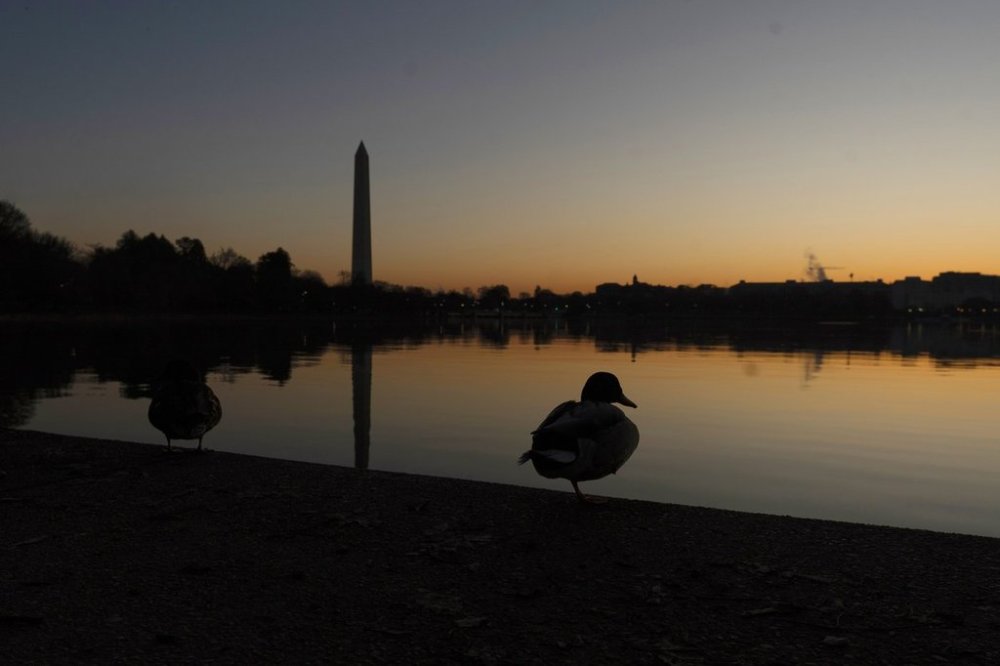
FILE - A mallard duck rests on the edge of a path around the Tidal Basin as the sun rises in Washington, Sunday, March 5, 2023, with the Washington Monument in the background. (AP Photo/Manuel Balce Ceneta, File)

For several decades, waterfowl stood out as a conservation bright spot with duck populations growing nationwide even as many other groups of birds declined in the U.S. But that trend has reversed, the new data shows.

The total number of dabbling and diving ducks is down about 30% from 2017, said Brasher. Loss of grasslands habitat and a prolonged drought affecting the wetlands of the Great Plains’ prairie pothole region have taken a toll. Among all waterfowl, numbers are down 20% since 2014, the report found.

The latest report is a collaboration between several groups including Cornell University, Ducks Unlimited, American Bird Conservancy, National Audubon Society and the American Ornithological Society.

The work draws on survey data from the U.S. Geological Survey, U.S. Fish and Wildlife Service and citizen projects such as Cornell’s eBird. There are some 2,000 bird species in North America. A third of the species examined are rated as high or moderate concern for conservation due to declining numbers, habitat loss or other threats.

These birds “need urgent conservation attention,” said Amanda Rodewald, a study co-author from Cornell, adding that bird survey trends also reveal the health of their habitats.

The report focuses on birds that must breed and feed in specific habitats such as forests, grasslands and coastal regions. Grassland birds including the Bobolink are most at risk.

“For each species that we’re in danger of losing, it’s like pulling an individual thread out of the complex tapestry of life,” said Georgetown University biologist Peter Marra, who was not involved in the new report.

Marra pointed to key past conservation successes in the U.S. – such as the comebacks of bald eagles, egrets and osprey.

“We know that we can bend the curve back with targeted conservation plans. But we can’t just close our eyes and hope,” he said.

___

The Associated Press Health and Science Department receives support from the Howard Hughes Medical Institute’s Science and Educational Media Group and the Robert Wood Johnson Foundation. The AP is solely responsible for all content.

Report Error Submit a Tip

More Stories

McKeever wins historic 16th Paralympic gold medal

The Canadian Press 2 minute read Preview

McKeever wins historic 16th Paralympic gold medal

The Canadian Press 2 minute read Friday, Mar. 11, 2022

BEIJING - Brian McKeever of Canmore, Alta., along with guide Graham Nishikawa, has won gold in the men's para cross-country middle distance vision impaired race at the 2022 Winter Paralympics.

The victory was McKeever's 16th gold medal and tied him with Gerd Schoenfelder of Germany for the most titles by a male winter Paralympian.

McKeever beat out Sweden's Zebastian Modin and Ukraine's Dmytro Suiarko in a time of 33 minutes, 6.6 seconds to win his historic gold.

The 42-year-old has won 20 Paralympic medals over the course of his career.

Read
Friday, Mar. 11, 2022

Hot topic: mayor considers max temp for rental properties

Joyanne Pursaga 3 minute read Preview

Hot topic: mayor considers max temp for rental properties

Joyanne Pursaga 3 minute read Tuesday, Jul. 14, 2026

Mayor Scott Gillingham says he’s open to exploring a call to set a maximum temperature for indoor rental units.

“I think we should be looking at that, as far as what the specifics would be … (In) our overall body of work, recently, we have been addressing the heat and making sure people have places to get out from under the heat,” said Gillingham.

Tenant and environmental groups have called for a maximum indoor rental unit heat limit that doesn’t exceed 26 C. A city bylaw does require landlords to maintain a minimum daytime temperature of 21 C during cold weather.

Gillingham noted the city has added 24-7 safe spaces, extended spray pad hours, opened libraries as cooling spaces and added drinking water stations to provide relief on very hot days.

Read
Tuesday, Jul. 14, 2026

Severe weather preparedness not one-time exercise for businesses

Abiola Odutola 3 minute read Yesterday at 2:00 AM CDT

BRANDON — Local business owners should prepare for the possibility that severe weather could disrupt their operations — even when their facilities escape major damage, a climate resilience expert told the Brandon Chamber of Commerce last week.

Emilia Cameron of the Institute for Catastrophic Loss Reduction told attendees at a September luncheon the recent flooding and heavy rainfall across southern Manitoba affected several businesses.

“Businesses need to prepare not just for direct damages to buildings, but for wide disruptions that can prevent them from operating,” she said. “Road closures, power outages, damaged infrastructure, internet failures and employees being unable to reach work can all bring operations to a standstill.”

Supply chains can also be affected when suppliers cannot reach their customers, she said.

Assiniboine Park has long provided visitors the chance to commune with nature

Alison Gillmor 8 minute read Preview

Assiniboine Park has long provided visitors the chance to commune with nature

Alison Gillmor 8 minute read Monday, Apr. 12, 2021

Here’s what I observed on a perfect spring day in Assiniboine Park last week: I saw people biking, jogging and walking their dogs (so many good dogs).

I saw the Assiniboine River at low ebb and perennial plantings in the English Garden pushing up toward the April sun.

I saw birdwatchers with binoculars, a group of 20-somethings playing cards, a man tossing bread to some chipper little ground squirrels, and a guy on a tricked-out three-wheeled cycle with a speaker blasting Don’t Stop Believing. This being Winnipeg, I also ran into my husband’s aunt’s best friend.

During the last year of COVID-19, as so many indoor places where Winnipeggers would normally gather were shut down, outdoor public spaces became crucial for mental and physical health. When time seems to have stopped, it helps to see the natural world continue its cycles. When life feels isolated, it’s reassuring to realize you’re still part of a larger community.

Read
Monday, Apr. 12, 2021

Colourful history of Neepawa's cemetery draws visitors from all over

By Bill Redekop 12 minute read Preview

Colourful history of Neepawa's cemetery draws visitors from all over

By Bill Redekop 12 minute read Monday, Sep. 28, 2015

NEEPAWA — Headstones can make for interesting reading.

Take this rhyme from the headstone of John James Black, b. Apr. 4, 1860; d. Dec. 9, 1934, in Neepawa’s Riverside Cemetery.

“Reader behold as you pass by,

As you are now, so once was I.

Read
Monday, Sep. 28, 2015

From footnote to martyr: execution altered Scott’s place in history

Tom Brodbeck 5 minute read Preview

From footnote to martyr: execution altered Scott’s place in history

Tom Brodbeck 5 minute read Friday, Feb. 14, 2020

When Thomas Scott was marched outside the walls of Upper Fort Garry and executed by firing squad, it forever changed how history would treat Louis Riel and the Red River Resistance. The killing of Scott, whether a misguided error by Riel or an unavoidable step to prevent further bloodshed, would turn out to be one of the most pivotal events of the resistance.

Only a month after the Irish-born Canadian was condemned to death in March 1870, Riel opponents in Ontario used Scott’s execution to whip up anti-Métis sentiment in an effort to sabotage negotiations between Ottawa and the Red River Settlement. It nearly worked. Two of three Red River delegates sent to Ottawa to negotiate the terms of Manitoba’s entry into confederation were arrested on arrival (but later released) for Scott’s death. At the same time, Prime Minister John A. Macdonald was under increasing political pressure to send military troops to quell the resistance in Red River, rather than engage in peaceful negotiations.

Scott’s death didn’t just complicate matters for the Red River delegates. It undermined their efforts to bargain with Ottawa.

Scott was tried and convicted by a “military council” on March 3 for rebelling against the provisional government and attacking a Métis guard at Upper Fort Garry, where he and other political prisoners were held. The trial wasn’t conducted under normal court rules, even by 1870 Red River standards. Scott had no defence counsel and wasn’t present for much of the proceedings, which were conducted in French (a language he didn’t understand). Riel, one of the chief witnesses in the case, had to act as translator. The military council was not unanimous in its decision to sentence Scott to death. Some felt the penalty was too harsh.

Read
Friday, Feb. 14, 2020