Satellite launched to map the world’s oceans, lakes, rivers

Advertisement

Advertise with us

A U.S.-French satellite that will map almost all of the world’s oceans, lakes and rivers rocketed into orbit Friday.

Read this article for free:


By clicking the button above, an account will be created and you will begin to receive some of our recommended newsletters. You may opt out of any newsletter by visiting your Email and Communication Preferences page or by clicking "unsubscribe" at the bottom of any email.

or

Already have an account? Log in here »

To continue reading, please subscribe:

Digital Subscription

One year of digital access for only $1.44 a week*

  • Enjoy unlimited reading on winnipegfreepress.com
  • Read the E-Edition, our digital replica newspaper
  • Access News Break, our award-winning app
  • Play interactive puzzles

*Billed as $5.77 plus GST every four weeks. After 52 weeks, price increases to the regular rate of $19.95 plus GST every four weeks. Offer available to new and qualified returning subscribers only. Cancel any time.

To continue reading, please subscribe:

Add Free Press access to your Brandon Sun subscription for only an additional

$1 for the first 4 weeks*

  • Enjoy unlimited reading on winnipegfreepress.com
  • Read the E-Edition, our digital replica newspaper
  • Access News Break, our award-winning app
  • Play interactive puzzles
Start now

*Your next Brandon Sun subscription payment will increase by $1.00 and you will be charged $17.95 plus GST for four weeks. After four weeks, your payment will increase to $24.95 plus GST every four weeks.

Hey there, time traveller!
This article was published 16/12/2022 (1420 days ago), so information in it may no longer be current.

A U.S.-French satellite that will map almost all of the world’s oceans, lakes and rivers rocketed into orbit Friday.

The predawn launch aboard a SpaceX rocket from Vandenberg Space Force Base in California capped a highly successful year for NASA.

Nicknamed SWOT — short for Surface Water and Ocean Topography — the satellite is needed more than ever as climate change worsens droughts, flooding and coastal erosion, according to scientists. Cheers erupted at control centers in California and France as the spacecraft started its mission.
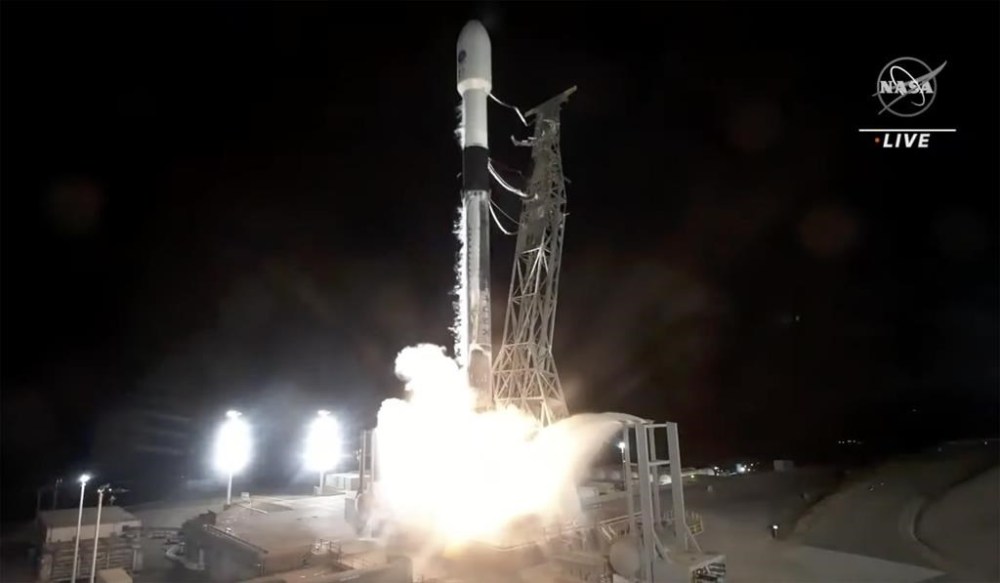
In this image made from video provided by NASA, a SpaceX rocket carrying the Surface Water and Ocean Topography satellite lifts off from Vandenberg Space Force Base in California, Friday, Dec. 16, 2022. (NASA via AP)

“It is a pivotal moment, and I’m very excited about it,” said NASA program manager Nadya Vinogradova-Shiffer. “We’re going to see Earth’s water like we’ve never before.”

About the size of a SUV, the satellite will measure the height of water on more than 90% of Earth’s surface, allowing scientists to track the flow and identify potential high-risk areas. It will also survey millions of lakes as well as 1.3 million miles (2.1 million kilometers) of rivers, from headwater to mouth.

The satellite will shoot radar pulses at Earth, with the signals bouncing back to be received by a pair of antennas, one on each end of a 33-foot (10-meter) boom.

It should be able to make out currents and eddies less than 13 miles (21 kilometers) across, as well as areas of the ocean where water masses of varying temperatures merge.

NASA’s current fleet of nearly 30 Earth-observing satellites cannot make out such slight features. And while these older satellites can map the extent of lakes and rivers, their measurements are not as detailed, said the University of North Carolina’s Tamlin Pavelsky, who is part of the mission.

Perhaps most importantly, the satellite will reveal the location and speed of rising sea levels and the shift of coastlines, key to saving lives and property. It will cover the globe between the Arctic and Antarctica at least once every three weeks, as it orbits more than 550 miles (890 kilometers) high. The mission is expected to last three years.

Laurie Leshin, the director of NASA’s Jet Propulsion Laboratory in Pasadena, California, noted that while the agency is known for its Mars rovers and space telescopes, “this is the planet we care most about.”

“We’ve got a lot of eyes on Earth,” with even more globe-surveying missions planned in the next few years, she added.
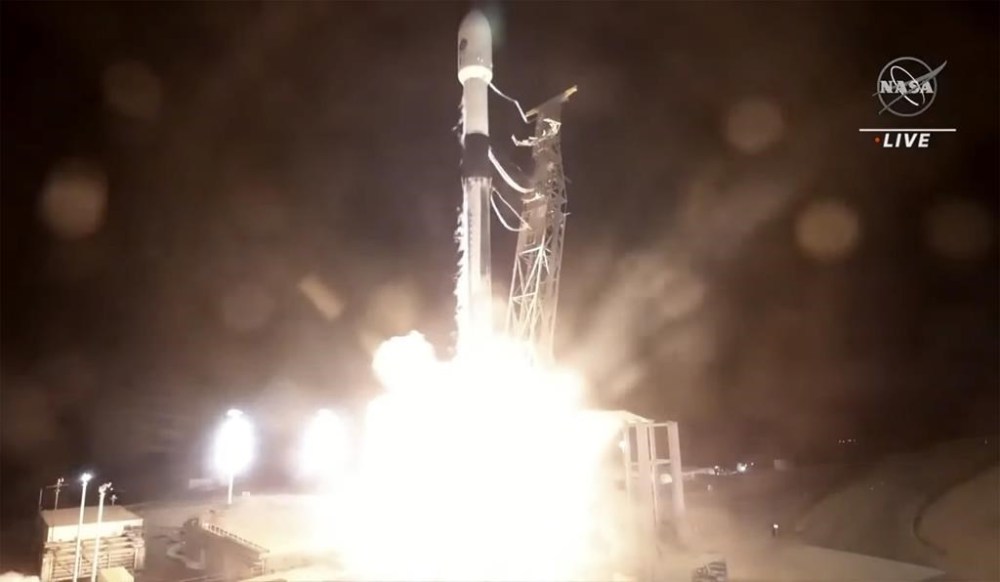
In this image made from video provided by NASA, a SpaceX rocket carrying the Surface Water and Ocean Topography satellite lifts off from Vandenberg Space Force Base in California, Friday, Dec. 16, 2022. (NASA via AP)

NASA and the French Space Agency collaborated on the $1.2 billion SWOT project — some 20 years in the making — with Britain and Canada chipping in.

Already recycled, the first-stage booster returned to Vandenberg eight minutes after liftoff to fly again one day. When the double sonic booms sounded, “Everybody jumped out of their skin, and it was exhilarating. What a morning,” said Taryn Tomlinson, an Earth science director at the Canadian Space Agency.

It’s the latest milestone this year for NASA. Among the other highlights: glamour shots of the universe from the new Webb Space Telescope; the Dart spacecraft’s dead-on slam into an asteroid in the first planetary defense test; and the Orion capsule’s recent return from the moon following a test flight.

___

The Associated Press Health and Science Department receives support from the Howard Hughes Medical Institute’s Science and Educational Media Group. The AP is solely responsible for all content.

Report Error Submit a Tip

More Stories

Leader of Indigenous chamber steps down

Free Press staff 2 minute read 2:01 AM EST

The chief executive of the Indigenous Chamber of Commerce is stepping down.

Shelly Bulycz, who was appointed CEO in April, said she’s accepted a new job in The Pas.

She made the announcement in a message to chamber members on Tuesday: “I am grateful for the opportunity to have served the organization and worked alongside so many dedicated individuals who share a commitment to Indigenous business, entrepreneurship and economic reconciliation.”

In the message, board chair Adam Nepon thanked Bulycz and wished her well.

They say a man's home is his castle; grand old Queen Anne house takes the adage literally

Ben Waldman  9 minute read Preview

They say a man's home is his castle; grand old Queen Anne house takes the adage literally

Ben Waldman  9 minute read Monday, Apr. 26, 2021

To call the house at 494 College Ave. anything other than a castle would seem wrong, so we’ll call it the Castle. It’s three storeys tall but seems taller, 115 years old but seems older, and it is right smack in the middle of a neighbourhood, right in the middle of a city, where its turreted existence inspires confusion, bewilderment and a touch of awe. It’s a place both out of time and out of place, but somehow, it feels like it’s exactly where it belongs.

“It definitely stands out around here,” says Ryan Lavallee, a 33-year-old man who lives two doors down, on the second floor of a house without turrets of its own. “Kids are always stopping to look at it. Even adults do. I have.”

In 2015, Vanh Thiep Hoang looked at it, and couldn’t stop. Hoang had come to Winnipeg with his family from Vietnam, where he worked as a surgeon. He marvelled at the Queen Anne-style castle — its gabled roof, its orange bricks, its ten-foot ceilings, and its playful disregard of convention and defiance of expectation. It cast a bit of a spell.

“It reminded me of palaces I’d seen where I was from,” and of buildings in Ukraine, where he studied, says the 63-year-old Hoang, who emerges from the castle’s front door wearing board shorts and metal-rimmed glasses, his thick head of hair as attention-grabbing as the castle he calls home.

Read
Monday, Apr. 26, 2021

Satellite launched to map the world’s oceans, lakes, rivers

Marcia Dunn, The Associated Press 4 minute read Preview

Satellite launched to map the world’s oceans, lakes, rivers

Marcia Dunn, The Associated Press 4 minute read Friday, Dec. 16, 2022

A U.S.-French satellite that will map almost all of the world’s oceans, lakes and rivers rocketed into orbit Friday.

The predawn launch aboard a SpaceX rocket from Vandenberg Space Force Base in California capped a highly successful year for NASA.

Nicknamed SWOT — short for Surface Water and Ocean Topography — the satellite is needed more than ever as climate change worsens droughts, flooding and coastal erosion, according to scientists. Cheers erupted at control centers in California and France as the spacecraft started its mission.

“It is a pivotal moment, and I’m very excited about it," said NASA program manager Nadya Vinogradova-Shiffer. "We're going to see Earth's water like we've never before."

Read
Friday, Dec. 16, 2022

Esteban Jaramillo

0 minute read Preview

Esteban Jaramillo

0 minute read Thursday, Aug. 6, 2026

Read
Thursday, Aug. 6, 2026

Digital media an illusion of democracy

Rod Lastra 5 minute read Preview

Digital media an illusion of democracy

Rod Lastra 5 minute read 2:01 AM EST

I recently finished reading The Obsolescence of the Human (Die Antiquiertheit des Menschen) by Günther Anders, a German philosopher and critical theorist known for his critique of technology and modern society.

First published in German in 1956, the book appeared in English for the first time only in 2025. It is an unsettling work. Writing in the age of television, industrial automation and the atomic bomb, Anders worried that humanity was becoming more technologically capable without becoming better able to understand, much less control, what it had created.

Seven decades later, his observations seem remarkably prescient. Quoting a tale set in his fictional land of Molussia, Anders writes: “The less people have a voice, the more they are given to look at and see.”

Anders was describing a world in which images brought distant events into people’s living rooms while decisions shaping those events remained beyond their influence. The world appeared increasingly accessible, but accessibility was not agency. He warned that images could become “stultification-devices”: representations that reveal fragments of reality while obscuring the relationships needed to understand and judge them. One could watch history unfold without having much say in its direction.

Read
2:01 AM EST

Judge rules girl’s testimony inconsistent

Tessa Adamski 4 minute read 2:01 AM EST

BRANDON — A Manitoba judge has acquitted a father of sexually touching his daughter over a 10-month period after ruling the girl’s testimony was inconsistent.

“While I do not believe the accused’s denials and generally prefer the complainant’s evidence where their accounts conflict, I am unable to conclude with the requisite certainty what, if anything, happened,” provincial court Judge Shauna Hewitt-Michta said in a written decision delivered in Virden last month.

The accused, who can’t be identified owing to a publication ban, was charged with sexual interference arising from allegations he touched his daughter inappropriately on multiple occasions between September 2023 and July 2024.

During that time frame, the girl, who is now 11, was alternating between living at her mother and father’s homes as a result of a shared custody arrangement.