Hospitalizations signal rising COVID-19 risk for US seniors
Advertisement
Read this article for free:
or
Already have an account? Log in here »
To continue reading, please subscribe:
Digital Subscription
One year of digital access for only $1.44 a week*
- Enjoy unlimited reading on winnipegfreepress.com
- Read the E-Edition, our digital replica newspaper
- Access News Break, our award-winning app
- Play interactive puzzles
*Billed as $5.77 plus GST every four weeks. After 52 weeks, price increases to the regular rate of $19.95 plus GST every four weeks. Offer available to new and qualified returning subscribers only. Cancel any time.
To continue reading, please subscribe:
Add Free Press access to your Brandon Sun subscription for only an additional
$1 for the first 4 weeks*
- Enjoy unlimited reading on winnipegfreepress.com
- Read the E-Edition, our digital replica newspaper
- Access News Break, our award-winning app
- Play interactive puzzles
*Your next Brandon Sun subscription payment will increase by $1.00 and you will be charged $17.95 plus GST for four weeks. After four weeks, your payment will increase to $24.95 plus GST every four weeks.
Read unlimited articles for free today:
or
Already have an account? Log in here »
Hey there, time traveller!
This article was published 11/12/2022 (1420 days ago), so information in it may no longer be current.
Coronavirus-related hospital admissions are climbing again in the United States, with older adults a growing share of U.S. deaths and less than half of nursing home residents up to date on COVID-19 vaccinations.
These alarming signs portend a difficult winter for seniors, which worries 81-year-old nursing home resident Bartley O’Hara, who said he is “vaccinated up to the eyeballs” and tracks coronavirus hospital trends as they “zoom up” for older adults, but remain flat for younger folks.
“The sense of urgency is not universal,” said O’Hara of Washington, D.C. But “if you’re 21, you probably should worry about your granny. We’re all in this together.”
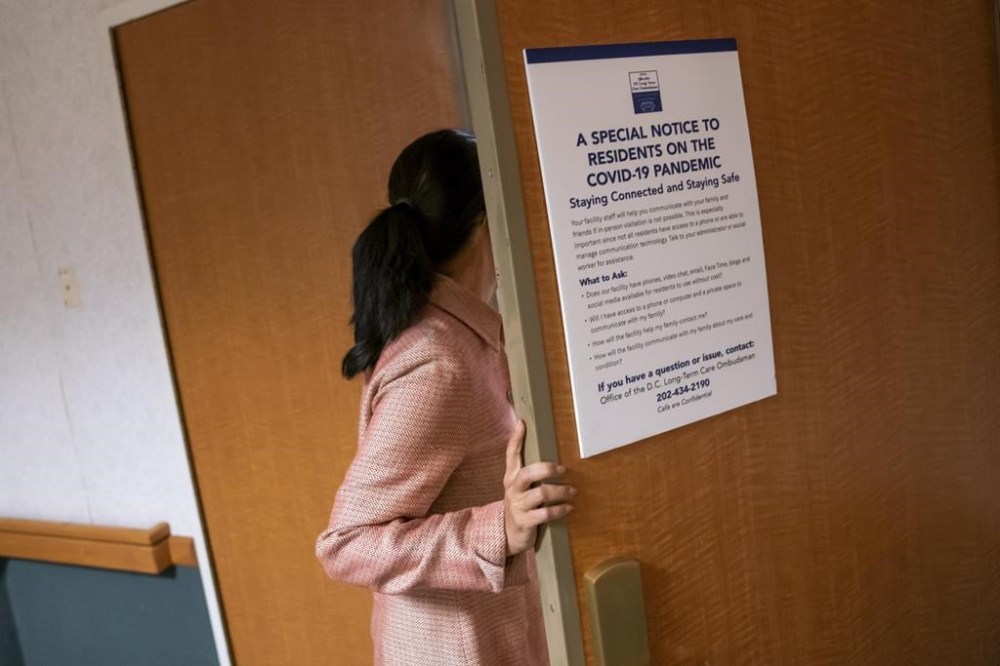
One troubling indicator for seniors: Hospitalizations for people with COVID-19 rose by more than 30% in two weeks. Much of the increase is driven by older people and those with existing health problems, said Dr. Rochelle Walensky, director of the Centers for Disease Control and Prevention. The numbers include everyone testing positive, no matter why they are admitted.
When it comes to protecting seniors, “we’re doing a terrible job of that in this country,” said Dr. Eric Topol, head of Scripps Research Translational Institute.
As nursing home leaders redouble efforts to get staff and residents boosted with the new vaccine version, now recommended for those 6 months and older, they face complacency, misinformation and COVID-19 fatigue. They are calling on the White House for help with an “all hands on deck” approach.
Clear messages about what the vaccine can do — and what it can’t — are needed, said Katie Smith Sloan, president of LeadingAge, which represents nonprofit nursing homes.
Breakthrough infections do not mean the vaccine has failed, she said, but that false perception has been hard to fight.
“We need to change our messaging to be accurate about what it does, which is prevent serious illness and hospitalization and death,” Sloan said. “This virus is insidious, and it just keeps popping up everywhere. We just need to be real about that.”
Problems include unwarranted hesitance to prescribe the antiviral pill Paxlovid quickly in the elderly, which prompted five major medical societies to hold a web-based educational session for doctors, “Vax & Pax: How to Keep Your Patients Safe This Winter.”
Easing restrictions, broader immunity in the general population and mixed messages about whether the pandemic is over have softened the sense of threat felt by younger adults. That may be a welcome development for most, but the attitude has seeped into nursing homes in troubling ways.
Getting family consent for vaccinating nursing home residents has become more difficult, nursing home leaders say. Some residents who can give their own consent are declining the shots. Only 23% of nursing home staff are up to date on COVID-19 vaccinations.
Cissy Sanders of Austin, Texas, met multiple obstacles trying to get a booster for her 73-year-old mother, who is in a nursing home. No booster clinic was scheduled. The facility told her they couldn’t find a vaccinator. So she made plans to take her mom to Walgreens later this month.
“I’m concerned about the uptick in hospitalizations and deaths among seniors, and concerned about the lack of urgency at my mother’s nursing home in getting the residents and staff vaccinated” with the latest booster, she said.
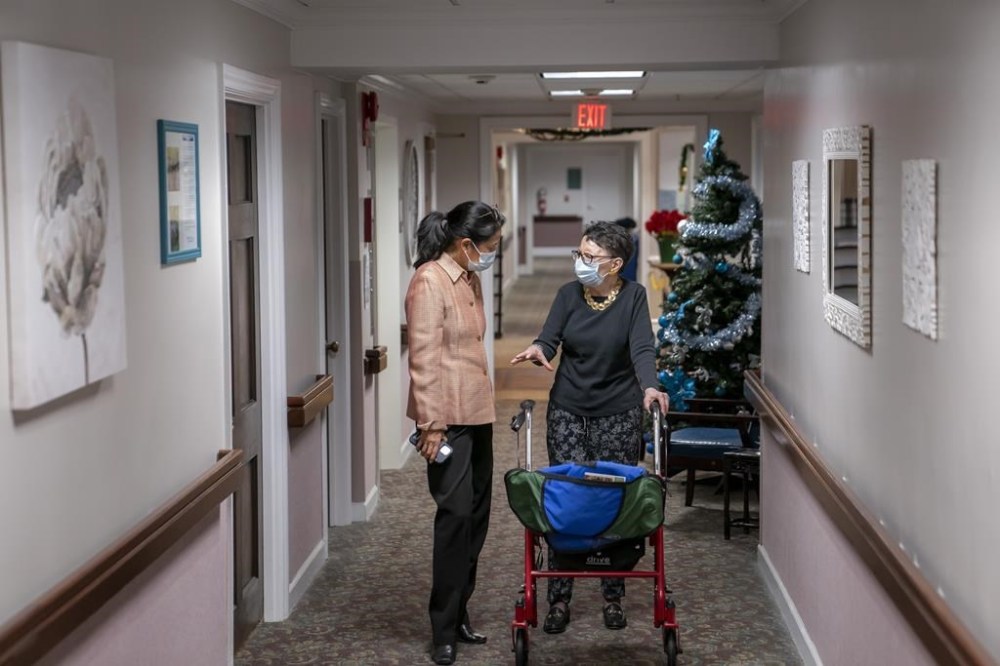
Staff and visitors are potential entry points to nursing homes for the virus. The best facilities use a multi-layered approach, protecting residents with masks, screening questions, temperature checks and enhanced infection control.
“What we’ve learned during COVID is that the rate of spread is dependent on the community rate of spread,” said Tina Sandri, CEO of Forest Hills of D.C., a nursing home in the nation’s capital. “I feel safer in my building than anywhere else, including the grocery store.”
Meanwhile, hospitals across the country are seeing an influx of senior patients that Topol calls “pretty alarming.” Nationally, the rate of daily hospital admissions for those 70 and older with confirmed or suspected COVID-19 rose from 8.8 per 100,000 people on Nov. 15, to 12.1 per 100,000 people on Dec. 6, according to statistics from the Department of Health and Human Services. In California and New York, Topol said, hospitalizations for seniors with COVID-19 have already surpassed those during spring and summer omicron waves.
At NYU Langone Health, chief hospital epidemiologist Dr. Michael Phillips said a growing number of seniors are being admitted to his hospital with COVID-19. But the biggest increase he’s seen is in the emergency department, “which is very, very busy” with COVID-19, as well as flu patients.
Dr. Wesley Long, a pathologist at Houston Methodist in Texas, said his hospital has also seen an increase in COVID-19 admissions over the last couple of weeks — and many of the patients are seniors with other health problems. Some are admitted for different illnesses and test positive for COVID-19 in the hospital. The good news? “We haven’t seen an increase in ICU admissions,” he said.
The new combination booster shot, which targets both omicron and the original coronavirus, provides protection against one of the main omicron variants pushing up cases lately: BQ.1.1, which is especially adept at escaping immunity.
“But our booster rates among seniors are pathetically low,” Topol said, with only about a third getting the shot.
Long said health care providers at Houston Methodist promote the booster “every chance we get.” But they don’t administer it to people hospitalized with COVID-19, who are generally told to wait three months after being infected to get it.
Phillips also urges people to get their boosters, especially if they are at risk of serious illness or planning to spend time with someone who is. He said they see many more hospitalizations among people who are unvaccinated.
Deaths, like hospitalizations, are now rising.
The ultimate worry is that more seniors will die. Last spring and summer, death rates declined overall as more people gained protection from vaccination and prior infection. But the share of COVID-19–related deaths for the oldest old — adults 85 and older, who make up 2% of the population — grew to 40%.
Over the course of the pandemic, 1 in 5 COVID-19 deaths was among those who were in a long-term care facility.
Dr. Walid Michelen, chief medical officer for seven nonprofit nursing homes operated by the Archdiocese of New York, said Americans need to continue taking the pandemic seriously.

“It’s not going away. It’s here to stay,” he said. “We’re going to get a new variant, and who knows how aggressive that variant is going to be? That keeps me up at night.”
___
Associated Press writer Nicky Forster contributed from New York.
___
The Associated Press Health and Science Department receives support from the Howard Hughes Medical Institute’s Science and Educational Media Group. The AP is solely responsible for all content.