Facing COVID surge, China expanding hospitals, ICUs

Advertisement

Advertise with us

BEIJING (AP) — Facing a surge in COVID-19 cases, China is setting up more intensive care facilities and trying to strengthen hospitals as it rolls back anti-virus controls that confined millions of people to their homes, crushed economic growth and set off protests.

Read this article for free:


By clicking the button above, an account will be created and you will begin to receive some of our recommended newsletters. You may opt out of any newsletter by visiting your Email and Communication Preferences page or by clicking "unsubscribe" at the bottom of any email.

or

Already have an account? Log in here »

To continue reading, please subscribe:

Digital Subscription

One year of digital access for only $1.44 a week*

  • Enjoy unlimited reading on winnipegfreepress.com
  • Read the E-Edition, our digital replica newspaper
  • Access News Break, our award-winning app
  • Play interactive puzzles

*Billed as $5.77 plus GST every four weeks. After 52 weeks, price increases to the regular rate of $19.95 plus GST every four weeks. Offer available to new and qualified returning subscribers only. Cancel any time.

To continue reading, please subscribe:

Add Free Press access to your Brandon Sun subscription for only an additional

$1 for the first 4 weeks*

  • Enjoy unlimited reading on winnipegfreepress.com
  • Read the E-Edition, our digital replica newspaper
  • Access News Break, our award-winning app
  • Play interactive puzzles
Start now

*Your next Brandon Sun subscription payment will increase by $1.00 and you will be charged $17.95 plus GST for four weeks. After four weeks, your payment will increase to $24.95 plus GST every four weeks.

Hey there, time traveller!
This article was published 10/12/2022 (1420 days ago), so information in it may no longer be current.

BEIJING (AP) — Facing a surge in COVID-19 cases, China is setting up more intensive care facilities and trying to strengthen hospitals as it rolls back anti-virus controls that confined millions of people to their homes, crushed economic growth and set off protests.

President Xi Jinping’s government is officially committed to stopping virus transmission, the last major country to try. But the latest moves suggest the ruling Communist Party will tolerate more cases without quarantines or shutting down travel or businesses as it winds down its “zero-COVID” strategy.

A Cabinet meeting called Thursday for “full mobilization” of hospitals including adding staff to ensure their “combat effectiveness” and increasing drug supplies, according to state media. Officials were told to keep track of the health of everyone in their area aged 65 and older.
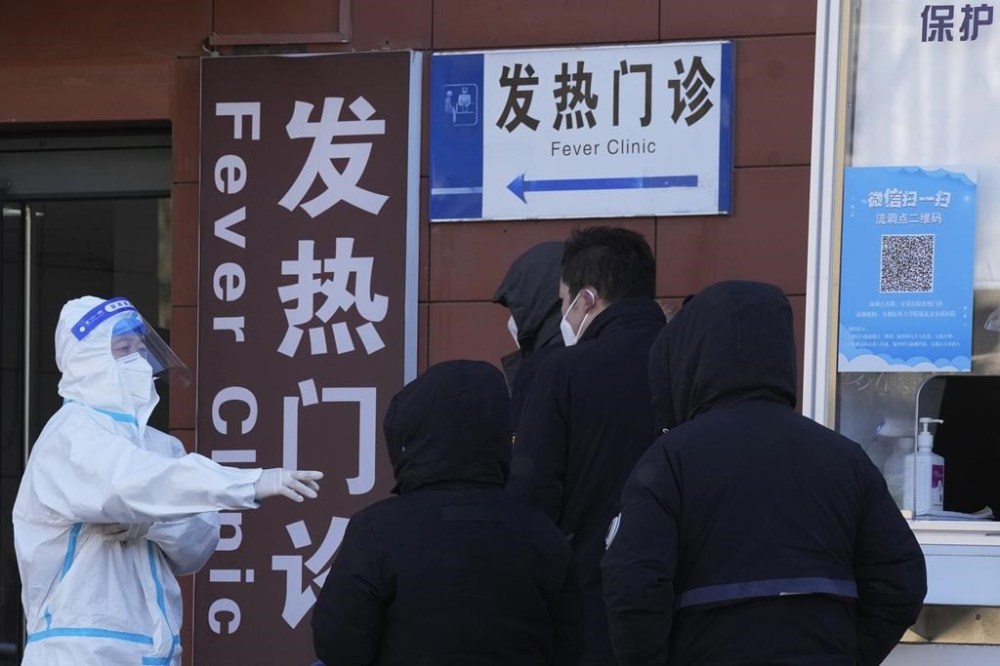
A worker in protective overalls controls the line outside the fever clinic at a hospital in Beijing, Saturday, Dec. 10, 2022. A rash of COVID-19 cases in schools and businesses were reported Friday in areas across China after the ruling Communist Party loosened anti-virus rules as it tries to reverse a deepening economic slump. (AP Photo/Ng Han Guan)

It isn’t clear how much infection numbers have increased since Beijing last week ended mandatory testing as often as once a day in many areas. But interviews and social media accounts say there are outbreaks in businesses and schools across the country. Some restaurants and other businesses have closed because too many employees are sick.

The virus testing site in Beijing’s Runfeng Shuishang neighborhood shut down because all its employees were infected, the neighborhood government said Saturday on its social media account. “Please be patient,” it said.

Official case numbers are falling, but those no longer cover large parts of the population after mandatory testing ended Wednesday in many areas. That was part of dramatic changes that confirmed Beijing was trying gradually to join the United States and other governments that ended travel and other restrictions and are trying to live with the virus.

On Sunday, the government reported 10,815 new cases, including 8,477 without symptoms. That was barely one-quarter of the previous week’s daily peak above 40,000 but only represents people who are tested after being admitted to hospitals or for jobs in schools and other higher-risk sites.

Shaanxi province in the west has set aside 22,000 hospital beds for COVID-19 and is ready to increase its intensive care capacity 20% by converting other beds, the Shanghai news outlet The Paper reported, citing Yun Chunfu, an official of the provincial health commission. Yun said cities are “accelerating the upgrading” of hospitals for “critically ill patients.”

“Each city is required to designate a hospital with strong comprehensive strength and high treatment level” for COVID-19 cases, Yu was cited as saying at a news conference.
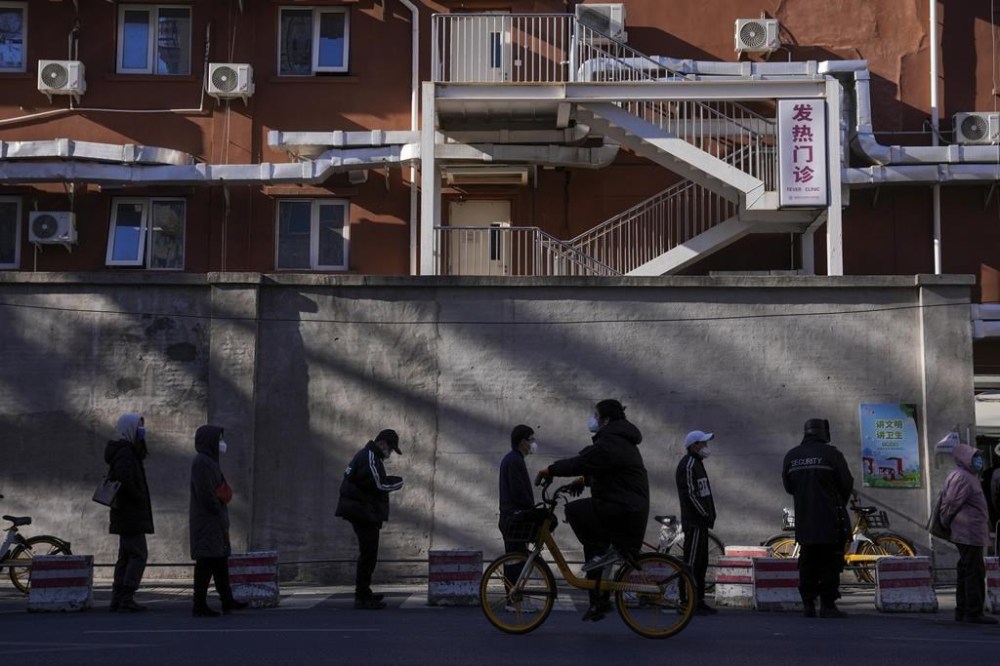
A cyclist passes by residents lining up outside the fever clinic of a hospital in Beijing, Sunday, Dec. 11, 2022. Facing a surge in COVID-19 cases, China is setting up more intensive care facilities and trying to strengthen hospitals as Beijing rolls back anti-virus controls that confined millions of people to their homes, crushed economic growth and set off protests. (AP Photo/Andy Wong)

China has 138,000 intensive care beds, the general director of Bureau of Medical Administration of the National Health Commission, Jiao Yahui, said at a news conference Friday. That is less than one for every 10,000 people.

Health resources are distributed unevenly. Hospital beds are concentrated in Beijing, Shanghai and other cities on the prosperous east coast. Thursday’s Cabinet statement told officials to make sure rural areas have “fair access” to treatment and drugs.

China’s controls kept its infection rate low but crushed already weak economic growth and prompted complaints about the rising human cost. The official death toll is 5,235, compared with 1.1 million for the United States.

China’s official total case count of 363,072 is up nearly 50% from the Oct. 1 level after a rash of outbreaks across the country.

Protests erupted Nov. 25 after 10 people died in a fire in Urumqi in the northwest. Internet users asked whether firefighters or people trying to escape were blocked by locked doors or other anti-virus measures. Authorities denied that, but the disaster became a focus for public anger.

Xi’s government promised to reduce the cost and disruption after the economy shrank by 2.6% from the previous quarter in the three months ending in June. That was after Shanghai and other industrial centers shut down for up to two months to fight outbreaks.
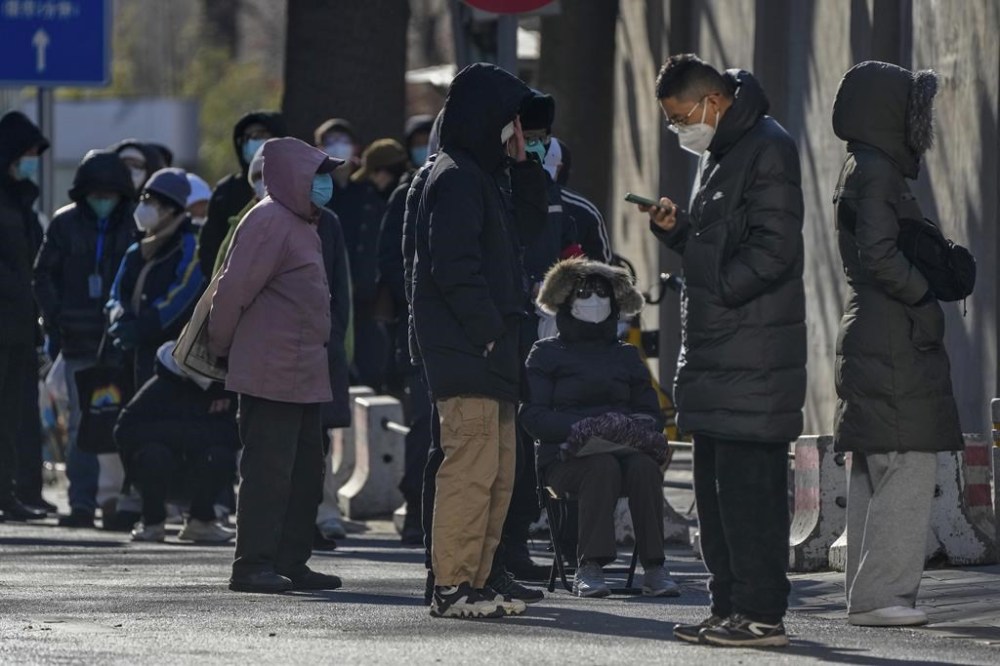
A woman sits on a foldable chair as she and residents wait in line to enter the fever clinic of a hospital in Beijing, Sunday, Dec. 11, 2022. Facing a surge in COVID-19 cases, China is setting up more intensive care facilities and trying to strengthen hospitals as Beijing rolls back anti-virus controls that confined millions of people to their homes, crushed economic growth and set off protests. (AP Photo/Andy Wong)

Forecasters say the economy probably is shrinking in the current quarter. Imports tumbled 10.9% from a year ago in November in a sign of weak demand. Some forecasters have cut their outlook for annual growth to below 3%, less than half of last year’s robust 8.1% expansion.

It isn’t clear whether any of the changes were a response to the protests.

In a show of official confidence, the No. 2 leader, Premier Li Keqiang, was shown by state media meeting with leaders of the International Monetary Fund and other financial institutions without masks last week in the eastern city of Huangshan. Earlier, Xi skipped a photo-taking session with Russian and Central Asian leaders during a summit in Uzbekistan in September at which the others wore no masks.

Still, health experts and economists say “zero COVID” is likely to stay in place at least through mid-2023 because millions of elderly people need to be vaccinated before restrictions that keep most visitors out of China be lifted. The government launched a campaign last week to vaccinate the elderly, a process that might take months.

Experts warn there still is a chance the ruling party might reverse course and reimpose restrictions if it worries hospitals might be overwhelmed.

Meanwhile, experts cited by state media called on the public to reduce the strain on hospitals by treating mild COVID-19 cases at home and putting off treatment for less serious problems.
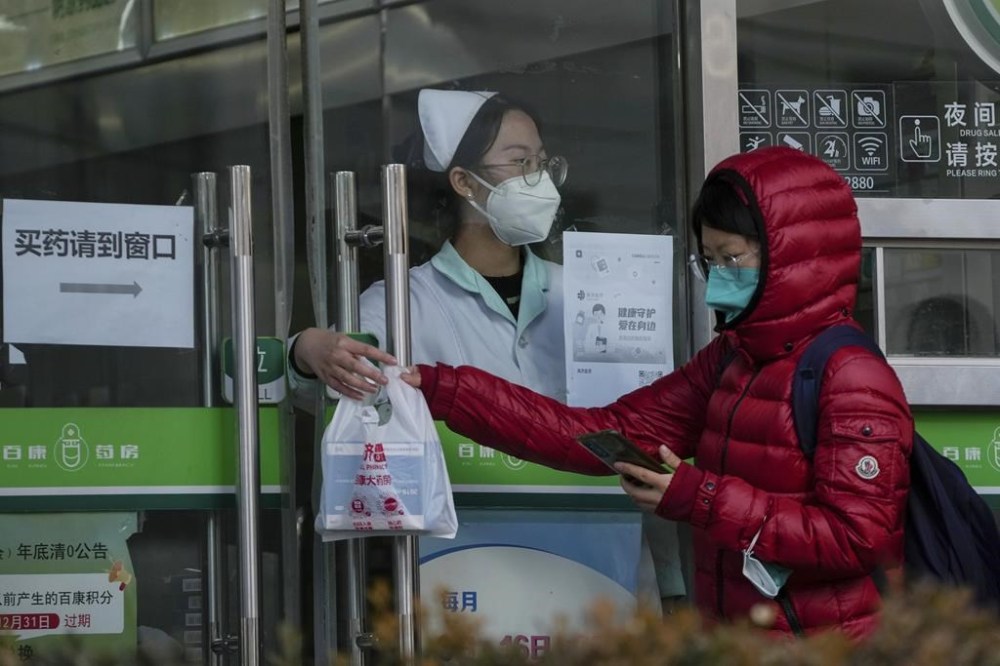
A woman collects COVID-19 antigen kits from a worker at a pharmacy in Beijing, Sunday, Dec. 11, 2022. Facing a surge in COVID-19 cases, China is setting up more intensive care facilities and trying to strengthen hospitals as Beijing rolls back anti-virus controls that confined millions of people to their homes, crushed economic growth and set off protests. (AP Photo/Andy Wong)

Patients are standing in line for up to six hours to get into fever clinics. Accounts on social media say some hospitals turn away patients with problems deemed not serious enough to need urgent treatment.

“Blindly going to the hospital” is depleting resources and might delay treatment for serious cases, “resulting in serious risk,” the vice president of Ruijin Hospital in Shanghai, Chen Erzhen, told The Paper.

“We recommend trying to manage health at home,” Chen said. “Leave medical resources for people who really need treatment.”


Report Error Submit a Tip

More Stories

No Christmas trees, no Christmas trees — the lots are empty as can be

Doug Speirs  3 minute read Preview

No Christmas trees, no Christmas trees — the lots are empty as can be

Doug Speirs  3 minute read Monday, Dec. 7, 2020

It might take a Christmas miracle to get your hands on even a scraggly Charlie Brown-style tree this holiday season.

Winnipeg garden centre owners interviewed Monday morning said they are totally sold out and they’ve never seen stock vanish this quickly in all their years in the business.

They likened it to the holiday version of panicked shoppers binge-buying toilet paper when the COVID-19 pandemic first arrived in the province back in March.

“I’m sold out,” declared Ray DuBois, owner of Ron Paul Garden Centre on St. Mary’s Road. “I could see it coming back in August. When we placed our order, I bumped it up by 10 per cent.”

Read
Monday, Dec. 7, 2020

Hellebuyck’s numbers down, but problems go beyond crease

Andrew Berkshire 6 minute read Preview

Hellebuyck’s numbers down, but problems go beyond crease

Andrew Berkshire 6 minute read Friday, Dec. 7, 2018

After hitting a bit of a skid in the last couple weeks of November when they lost four of six games, the Jets have turned it around to win four straight heading into Friday’s matchup against the St. Louis Blues, averaging over four goals per game in the process.

They’ve needed that goal support because, outside of Tuesday’s win over the Islanders, they have allowed three or more against in seven of their last nine games. As it is any time a team allows a lot of goals over a short stretch, many are looking straight at Connor Hellebuyck and expecting him to shut the door, going forward.

Goaltending isn’t that simple, and as I mentioned in mid-November, there were signs this season that Hellebuyck’s performance so far this season was as good and in some ways superior to last season, despite the drop in save percentage.

Things change as time goes on though, and because Hellebuyck’s save percentage since then is an unimpressive 87.8 per cent, it’s probably worthwhile to look at his overall numbers to see what’s going on.

Read
Friday, Dec. 7, 2018

Two government bills left on table as NDP ends third year of term

Carol Sanders 4 minute read Preview

Two government bills left on table as NDP ends third year of term

Carol Sanders 4 minute read 6:59 PM CDT

Year 3 of the NDP government’s four-year mandate ended Thursday with more than 50 bills expected to become law and two that didn’t make it to the finish line.

“We’re on the final stages of passing 52 amazing bills,” government house leader Nahanni Fontaine said after the final question period of the 43rd legislature.

Most were passed before the house rose for the summer break, including getting rid of the provincial sales tax on pop, chips and packaged foods that took effect July 1. A handful of health-care bills that aim to restrict mandatory overtime, create a patient safety charter, establish nurse-to-patient ratios and do away with sick-note requirements for employees — unless they miss more than seven consecutive days or 10 in a year — were also passed.

Under rules of the legislature, the Progressive Conservatives held back three government bills until the fall session to allow for further debate before passage by the NDP majority Thursday. The most contentious was Bill 13, the Residential Tenancies Amendment Act, that aims to strengthen renter protections and increase maximum fines for landlords in breach of the act.

Read
6:59 PM CDT

Moving past the Indian Act will take time and trust

Niigaan Sinclair 5 minute read Preview

Moving past the Indian Act will take time and trust

Niigaan Sinclair 5 minute read 4:52 PM CDT

If I had a dime for every time a politician has called for the “abolishment”of the Indian Act, I’d be a rich man.

OK, maybe I’d have enough coins to jingle loudly in my pocket.

My point: a Canadian leader calling for the end of the race-based law passed in 1867 that is designed to give the federal government broad and brutal control over First Nations governments, membership, and reserve land is nothing new.

Premier Wab Kinew became the latest to advocate for this, during the First Nations-first ministers meeting in Ottawa this week.

Read
4:52 PM CDT

Brian Bowman wins mayoral battle

Aldo Santin and Mary Agnes Welch 6 minute read Preview

Brian Bowman wins mayoral battle

Aldo Santin and Mary Agnes Welch 6 minute read Thursday, Oct. 23, 2014

In the end, it wasn’t even close.

A mayoral race that was supposed to be a head-to-head battle between privacy lawyer Brian Bowman and former NDP MP and MLA Judy Wasylycia-Leis turned into a rout on election night. Wasylycia-Leis, the experienced politician, had held what looked like an unassailable lead for months, but Bowman, the outsider who promised Winnipeggers a better, prosperous future, chipped doggedly away at it.

“I’m excited to tell you that positive change is coming to city hall,” Bowman told roaring supporters at the Inn At The Forks after making his way into the small ballroom accompanied by his wife and two young sons.

He said he hadn’t expecting such a landslide victory, but had believed that the campaign was building momentum.

Read
Thursday, Oct. 23, 2014

Railways report more accidents with dangerous goods

Dylan Robertson 6 minute read Preview

Railways report more accidents with dangerous goods

Dylan Robertson 6 minute read Monday, Jan. 20, 2020

OTTAWA — The number of rail accidents involving dangerous goods more than doubled in Canada in 2018.

There were 25 accidents involving dangerous goods in 2018, involving one death, according to Transport Canada data published Monday.

There were 11 accidents recorded a year prior, and five in 2016.

These accidents involve dangerous goods — flammable or corrosive substances — that either exploded or leaked.

Read
Monday, Jan. 20, 2020