Developed countries called on to provide meaningful financial support at COP15

Advertisement

Advertise with us

MONTREAL - Hard talks on hard targets for saving the world's biodiversity began Wednesday at an international conference in Montreal, with calls for rich nations to pony up to save functioning ecosystems where most of them exist — in poor nations.

Read this article for free:


or

Already have an account? Log in here »

To continue reading, please subscribe:

Subscribe and receive a limited-edition Free Press branded hat or tote.

Digital Subscription

One year of digital access for only $205*

  • Enjoy unlimited reading on winnipegfreepress.com
  • Read the E-Edition, our digital replica newspaper
  • Access News Break, our award-winning app
  • Play interactive puzzles

*First annual payment billed as $205.00 + GST for one year. This annual subscription will automatically renew at $233.00 + GST every 52 weeks (10% off the regular annual price of $259.35). Offer available to new and qualified returning subscribers only. Cancel any time.

To continue reading, please subscribe:

Add Free Press access to your Brandon Sun subscription for only an additional

$1 for the first 4 weeks*

  • Enjoy unlimited reading on winnipegfreepress.com
  • Read the E-Edition, our digital replica newspaper
  • Access News Break, our award-winning app
  • Play interactive puzzles
Start now

*Your next Brandon Sun subscription payment will increase by $1.00 and you will be charged $17.95 plus GST for four weeks. After four weeks, your payment will increase to $24.95 plus GST every four weeks.

Hey there, time traveller!
This article was published 07/12/2022 (1392 days ago), so information in it may no longer be current.

MONTREAL – Hard talks on hard targets for saving the world’s biodiversity began Wednesday at an international conference in Montreal, with calls for rich nations to pony up to save functioning ecosystems where most of them exist — in poor nations.

“We need developed countries to provide meaningful financial support for the countries of the global south as custodians of the world’s natural wealth following centuries of exploitation and loss,” said United Nations Secretary-General Antonio Guterres as the COP15 conference began.

Delegates from more than 190 countries will try over the next two weeks to thrash out what they call a framework for preserving biodiversity with timed, measurable targets.
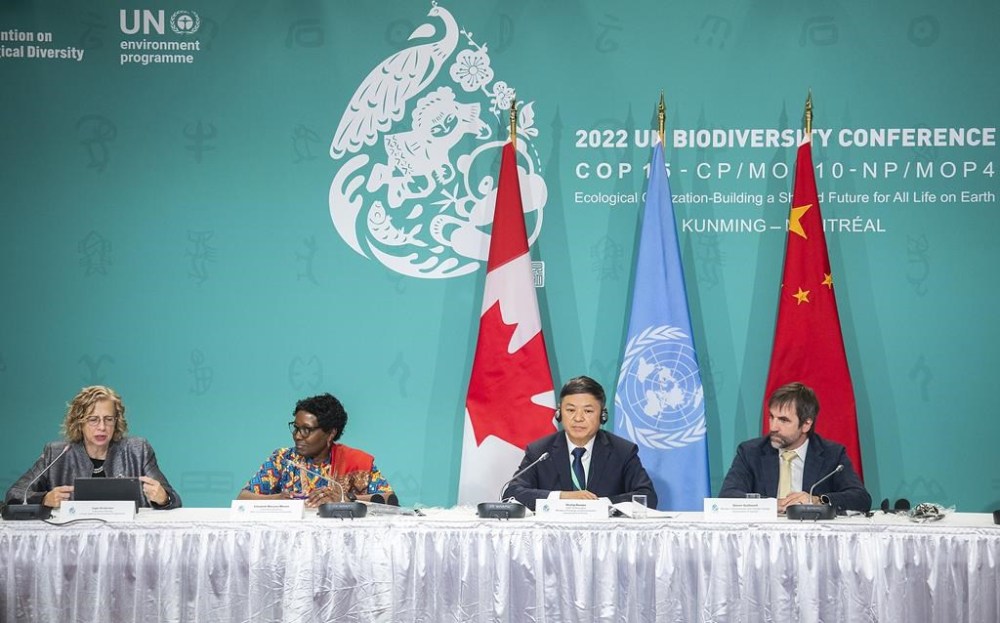
From left, Inger Andersen, Executive Director, UN Environment Programme, Elizabeth Maruma Mrema, Executive Secretary, UN Convention on Biological Diversity, Huang Runqiu, President, COP15 and Minister of Ecology and Environment of China and Steven Guilbeault, Minister of Environment and Climate Change, Canada, attend the opening news conference of COP15 the UN Biodiversity Conference in Montreal, Tuesday, Dec. 6, 2022. THE CANADIAN PRESS/Graham Hughes

Prominent among them is a proposal that nearly a third of Earth’s land and water should be protected by 2030. Advocates say more than 100 countries support the idea, but the draft text on conservation targets still has more brackets in it than agreed wording.

“We’ve made some progress,” said Stephen Woodley of the International Union for Conservation of Nature, a high-profile group of governments and civil society organizations advising conference delegates. “It’s tough sledding.”

But funding — known in COP-speak as “mobilization of resources” — is considered just as central to success.

The rationale is simple. Most remaining biodiversity is in the developing nations of the global south, while most of the money — much of which has been generated at the expense of that biodiversity — is in the rich countries of the north.

That’s where the simplicity ends.

“It is one of the tricky issues of this process,” said Eddy Perez of Climate Action Network Canada.

Estimates of the possible tab vary wildly.

Perez said a group of African countries is looking for about $100 billion a year. The International Union for Conservation of Nature — an influential group of scientists and non-governmental organizations — says the figure should be twice that.

“The total need is very difficult to assess,” said Florian Titze of the World Wildlife Fund. “The only thing they have in common is it’s in the hundreds of billions.”

Negotiators haven’t even agreed on how the tab should be tallied.

There’s money for biodiversity from governments, spent both internationally and domestically. There’s money from private finance that does the same.

And there’s funding from public and private sources that works against it. The UN says in 2019 major investment banks provided an estimated $2.6 trillion to sectors that governments and scientists agree are driving ecosystem destruction.

On Tuesday, Canada announced it would earmark an additional $350 million for biodiversity projects in developing countries. On Wednesday, the European Union sounded skeptical about upping its contribution from its pledge of $7 billion by 2025.

Hugo-Maria Schally, the European Commission’s Directorate General for the Environment, told the conference that the current amounts being discussed are “not realistic.”

Dollar amounts aren’t even the whole story.

“It is capacity building,” said Perez. “It is technology transfer.

“It can’t just be a number issue.”

As well, mobilization of resources must be accompanied by disclosure standards, so both investors and voters can assess how their money is being used.

“That is one of the important elements of reform of the financial system,” Titze said. “We don’t even have the data that tells us, for example, how a financial institution is contributing to the destruction of nature.”

Both he and Perez agree that talks on the financial side of preserving biodiversity aren’t as advanced as those on conservation areas.

The conservation side has a defined target. Finance has a 10-point plan signed on to by a scant 16 countries.

But one can’t move forward without the other, said Titze.

“If we’re not setting the right ambition for the (conservation) measures that need to be taken, it’s almost impossible to set the level of ambition in finance. One side of the room is waiting for the other.”

Titze said one thing is certain.

“Now is the time to make progress.”

This report by The Canadian Press was first published Dec. 7, 2020.

— By Bob Weber in Edmonton and Jacob Serebrin in Montreal
Report Error Submit a Tip

More Stories

Developed countries called on to provide meaningful financial support at COP15

The Canadian Press 4 minute read Preview

Developed countries called on to provide meaningful financial support at COP15

The Canadian Press 4 minute read Wednesday, Dec. 7, 2022

MONTREAL - Hard talks on hard targets for saving the world's biodiversity began Wednesday at an international conference in Montreal, with calls for rich nations to pony up to save functioning ecosystems where most of them exist — in poor nations.

"We need developed countries to provide meaningful financial support for the countries of the global south as custodians of the world’s natural wealth following centuries of exploitation and loss," said United Nations Secretary-General Antonio Guterres as the COP15 conference began.

Delegates from more than 190 countries will try over the next two weeks to thrash out what they call a framework for preserving biodiversity with timed, measurable targets.

Prominent among them is a proposal that nearly a third of Earth's land and water should be protected by 2030. Advocates say more than 100 countries support the idea, but the draft text on conservation targets still has more brackets in it than agreed wording.

Read
Wednesday, Dec. 7, 2022

Oka crisis informs powerful coming-of-age story

Randall King 3 minute read Preview

Oka crisis informs powerful coming-of-age story

Randall King 3 minute read Friday, Jul. 23, 2021

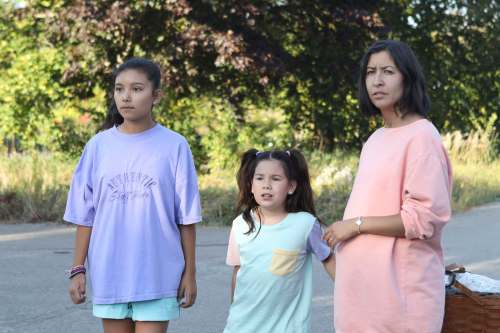
The title of the movie, Beans, is a cute nickname for a cute 12-year-old Mohawk girl with a considerably more dignified traditional name: Tekehentahkhwa.

As with the movie, the name is disarming. By these stealthy means, it allows some tough material — both personal and historical — and very strong emotions into the movie experience.

It’s a first dramatic feature for director/co-writer Tracey Deer, whose past work has been in the field of TV comedy (the APTN series Mohawk Girls). For this film, Deer excavated some of her own experiences, coming of age during the so-called Oka crisis of 1990, a 78-day armed standoff between Mohawk protesters and an escalating opposing force including the Quebec police, the Royal Canadian Mounted Police and ultimately the Canadian Army.

The crux of the conflict was a few acres of land desired by the Oka community to transform its nine-hole golf course to 18 holes. For that purpose, they needed to level an ancient forest, known on the adjacent Kanesatake Mohawk reserve as “the Pines.”

Read
Friday, Jul. 23, 2021

Manitoba PC leader Khan survives confidence vote

Free Press staff 3 minute read Preview

Manitoba PC leader Khan survives confidence vote

Free Press staff 3 minute read Updated: 12:54 PM CDT

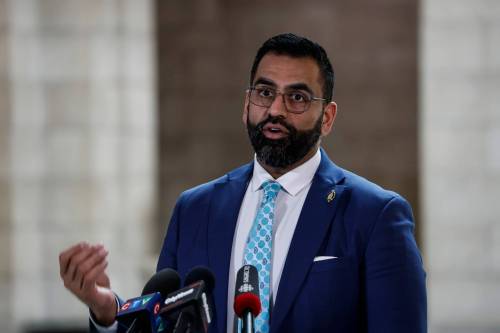
Manitoba Progressive Conservative Leader Obby Khan survived a confidence vote last week.

Caucus communications director Alison Sutherland confirmed the vote was held Friday and that Khan still has “the full confidence” of the PC caucus.

She did not provide further details.

The party under Khan’s leadership is floundering, a recent poll suggests.

Read
Updated: 12:54 PM CDT

Nobel laureate Toni Morrison dead at 88

Hillel Italie, The Associated Press 18 minute read Preview

Nobel laureate Toni Morrison dead at 88

Hillel Italie, The Associated Press 18 minute read Tuesday, Aug. 6, 2019

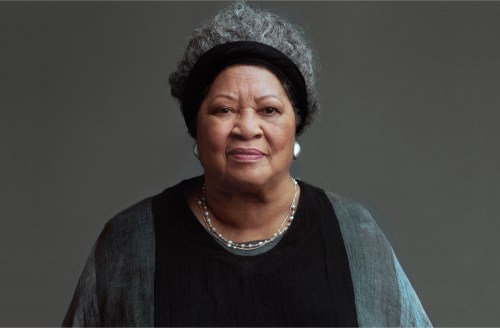
NEW YORK - Nobel laureate Toni Morrison, a pioneer and reigning giant of modern literature whose imaginative power in "Beloved," ''Song of Solomon" and other works transformed American letters by dramatizing the pursuit of freedom within the boundaries of race, has died at age 88.

Publisher Alfred A. Knopf announced that Morrison died Monday night at Montefiore Medical Center in New York. Morrison's family issued a statement through Knopf saying she died after a brief illness.

"Toni Morrison passed away peacefully last night surrounded by family and friends," the family announced. "The consummate writer who treasured the written word, whether her own, her students or others, she read voraciously and was most at home when writing."

Few authors rose in such rapid, spectacular style. She was nearly 40 when her first novel, "The Bluest Eye," was published. By her early 60s, after just six novels, she had become the first black woman to receive the Nobel literature prize, praised in 1993 by the Swedish academy for her "visionary force" and for her delving into "language itself, a language she wants to liberate" from categories of black and white. In 2012, Barack Obama awarded her a Presidential Medal of Freedom.

Read
Tuesday, Aug. 6, 2019

New tour firm seeks to display ‘hidden gem’

Aaron Epp 5 minute read Preview

New tour firm seeks to display ‘hidden gem’

Aaron Epp 5 minute read 7:36 PM CDT

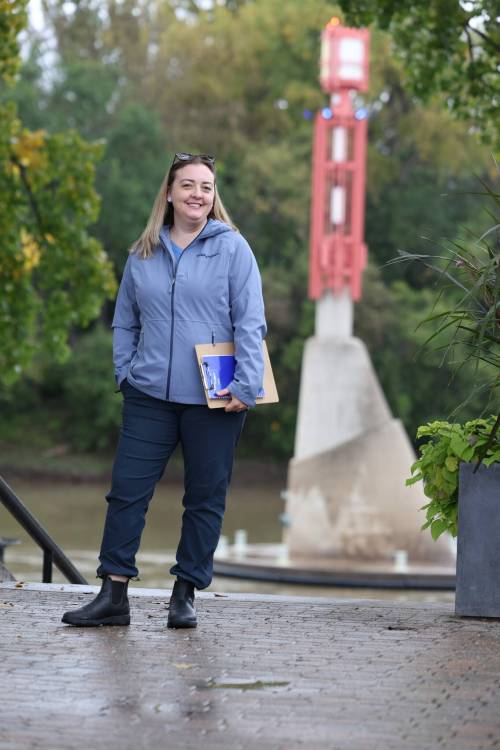
Desiree Rantala has serious Manitoba bona fides.

The 34-year-old grew up in two northern First Nations communities and has lived in Gimli and Dauphin. She’s worked in marketing roles at the Manitoba Museum, Downtown Winnipeg Business Improvement Zone and Travel Manitoba, and she’s travelled to New York and Vancouver to promote the province.

Now, Rantala has launched a tour company called Toba Tripper.

“We’re a hidden gem that has so much to offer,” the Winnipeg resident said. “We have so much to see and I really hope that people leave my tours appreciating the beauty of Manitoba a little bit more.”

Read
7:36 PM CDT

Today’s horoscope

Georgia Nicols 4 minute read Preview

Today’s horoscope

Georgia Nicols 4 minute read Sunday, Aug. 16, 2026

MOON ALERT: There are no restrictions to shopping or important decisions today. The moon is in Libra.

ARIES (March 21-April 19)

The day is a mixed bag. For the most part, it’s romantic, friendly, congenial and a great time to socialize with others and enjoy playful activities with kids. Nevertheless, you might meet a real sourpuss or someone who is a wet blanket. Keep things light!

TAURUS (April 20-May 20)

Read
Sunday, Aug. 16, 2026