Mi’kmaq First Nation, environmental group work on creating zero-emission lobster boat

Advertisement

Advertise with us

HALIFAX - An environmental charity and the Membertou First Nation in Cape Breton are partnering to create electric lobster boats on the East Coast, saying it's the way of the future if Canada is to meet its zero-emission targets.

Read this article for free:


By clicking the button above, an account will be created and you will begin to receive some of our recommended newsletters. You may opt out of any newsletter by visiting your Email and Communication Preferences page or by clicking "unsubscribe" at the bottom of any email.

or

Already have an account? Log in here »

To continue reading, please subscribe:

Digital Subscription

One year of digital access for only $1.44 a week*

  • Enjoy unlimited reading on winnipegfreepress.com
  • Read the E-Edition, our digital replica newspaper
  • Access News Break, our award-winning app
  • Play interactive puzzles

*Billed as $5.77 plus GST every four weeks. After 52 weeks, price increases to the regular rate of $19.95 plus GST every four weeks. Offer available to new and qualified returning subscribers only. Cancel any time.

To continue reading, please subscribe:

Add Free Press access to your Brandon Sun subscription for only an additional

$1 for the first 4 weeks*

  • Enjoy unlimited reading on winnipegfreepress.com
  • Read the E-Edition, our digital replica newspaper
  • Access News Break, our award-winning app
  • Play interactive puzzles
Start now

*Your next Brandon Sun subscription payment will increase by $1.00 and you will be charged $17.95 plus GST for four weeks. After four weeks, your payment will increase to $24.95 plus GST every four weeks.

Hey there, time traveller!
This article was published 02/12/2022 (1434 days ago), so information in it may no longer be current.

HALIFAX – An environmental charity and the Membertou First Nation in Cape Breton are partnering to create electric lobster boats on the East Coast, saying it’s the way of the future if Canada is to meet its zero-emission targets.

Oceans North announced Thursday it is working on the project with the Mi’kmaq community’s fisheries and boatbuilding corporations, based in Sydney, N.S.

Hubert Nicholas, the director of fisheries at Membertou, said in an interview the new boats will likely be costlier than diesel-powered vessels at first, but he said it’s expected there will be savings in maintenance and fuel costs.
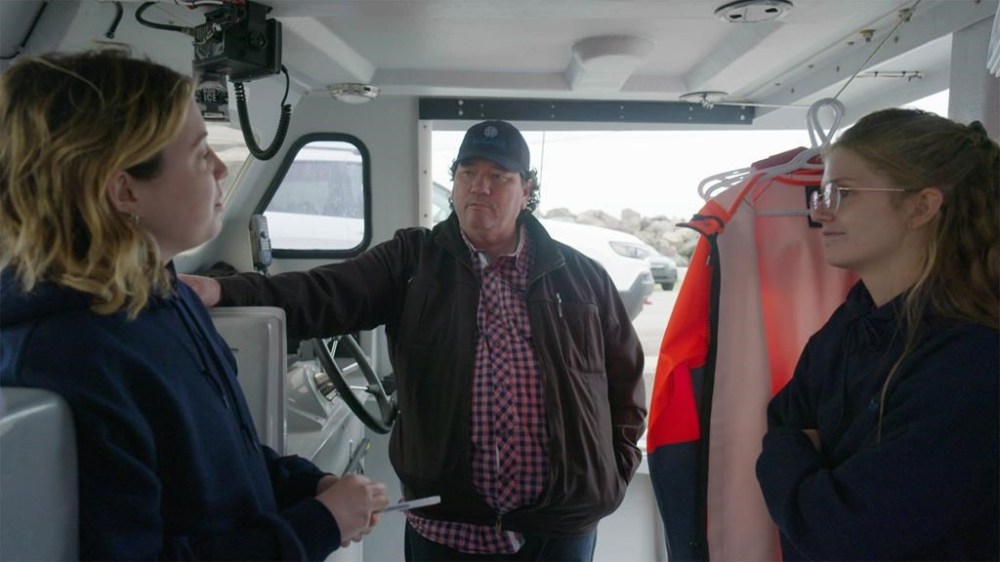
Hubert Nicholas, director of Fisheries at Membertou First Nation speaks with engineers Erica Pineo, left, and Marissa Campbell in a 2022 handout photo. An environmental charity and Membertou First Nation in Nova Scotia are partnering to develop the first generation of electric lobster fishing boats on Canada's east coast. THE CANADIAN PRESS/HO-Ocean North, *MANDATORY CREDIT*

“Right now, the cost is high … but we anticipate that as battery-powered boats become more accepted and more are built, the price will drop dramatically,” he said.

Nicholas estimated the cost of lobster boats is about $600,000 to $700,000, adding that an electrical boat would have higher, yet-to-be-determined costs for its engine and other components.

However, Nicholas said that the band’s boat-building firm sees it as the way forward, and he said he believes the industry will soon follow the pattern of car and truck industries in a shift away from emission-belching diesel motors.

“We’re seeing this as an opportunity to be ahead of the game. We want to be pioneers in this area,” he said.

The federal government has set a goal that one in five automobiles sold in the country by 2026 will be zero-emissions and 60 per cent of them will be by 2030. By 2035 Canada intends to ban the sale of new internal-combustion engines in passenger vehicles.

Brent Dancey, director of marine climate action at Oceans North, said the fishing sector also needs alternatives to fossil fuels, as society shifts toward zero-emission targets. In 2020, the federal government announced that Canada has the goal of cutting net carbon emissions to zero by 2050.

Dancey said the inshore fleet is an obvious first area for electrification in the marine sector. The project estimated that 70 per cent of the inshore lobster fleet travels within 20 kilometres from shore and can be powered by battery electric systems. As well, he said his team estimates the decarbonization of the inshore lobster fleet could displace 82 million kilograms of carbon dioxide — the equivalent of 20,000 cars.

Nicholas said he’s already seeing the potential for increased safety because fuel cells and electric engines are established technologies with fewer breakdowns than aging diesel engines, which are based on “100-year-old technologies.”

Rimot Inc. — a Halifax-based technology firm specializing in marine electrification — provided assistance to Membertou in the early stage of the project, studying how a conventional lobster boat uses energy in the course of a typical fishing trip. This data has been gathered as a baseline that naval architects and other experts can use in the next stage of the project, as hull designs are chosen, fuel cells are sourced, and electrical engine sizes are specified.

The first stage of the project has received $750,000 in funding, with $500,000 contributed by Google.org, the search engine’s philanthropic division, and about $250,000 from RBC.

Dancey said that after the feasibility study is complete, the project team will seek further funding to finish the design and construct the first boat at Membertou’s boatyard. He suggested he would look to governments for part of that funding.

“There are electric ferries working around the world. So, we want to take this technology that’s working in a bunch of vehicles and put it into a lobster vessel,” he said during an interview.

Nicholas estimated it will take two to three years to build the first electric vessel.

Andrew Boswell, the chief executive of Rimot Inc., said in an interview Thursday that one of the related areas of study involves how to set up in harbours charging systems to power boats and allow vessels to transfer unused energy back into the grid.

“You’ll start to see chargers on wharfs across the province. … And if we go at it in an unintelligent way, we’ll load up the grid at times of greatest need,” he said.

“But if we apply intelligence to this, we’ll help the grid in its efforts to achieve net zero by tapping into the storage of energy on the vessels at key times.”

This report by The Canadian Press was first published Dec. 2, 2022.
Report Error Submit a Tip

More Stories

Fact Check

1 minute read Thursday, Nov. 30, 2023

Fact Check

Having problems with the form?Contact Us Directly |

Poilievre’s remarks on tariffs prove he’s not ready for prime time

Tom Brodbeck 5 minute read Preview

Poilievre’s remarks on tariffs prove he’s not ready for prime time

Tom Brodbeck 5 minute read 12:39 PM EST

If Pierre Poilievre thinks a Democratic takeover of the U.S. Congress suddenly gives Canada the upper hand in negotiating a tariff-free trade deal with Donald Trump, he might want to spend a little more time understanding how American politics actually works before aspiring to run this country.

The leader of the Conservative Party of Canada’s reaction to the Democrats’ stunning midterm election victory this week is another example of why he continues to look more like a campaign politician than a prime minister in waiting.

American voters delivered a humiliating rebuke to Trump and his economic policies, including his damaging tariff regime. Democrats have taken control of both the Senate and House of Representatives. That’s a significant political development and it could eventually create new opportunities for Canada.

But it doesn’t suddenly change the balance of power in Canada’s trade negotiations with Washington.

Read
12:39 PM EST

Today’s horoscope

Georgia Nicols 4 minute read Preview

Today’s horoscope

Georgia Nicols 4 minute read 2:00 AM EST

MOON ALERT: After 9 a.m. there are no restrictions to shopping or important decisions. The moon is in Libra.

ARIES (March 21-April 19)

You might be confused about your relationships with partners, spouses and friends. Perhaps something unusual will trigger some kind of epiphany within you about your relations with those who are closest to you. You might suddenly see things in a new light.

TAURUS (April 20-May 20)

Read
2:00 AM EST

Dark mornings fuel school safety fears

Maggie Macintosh 5 minute read Preview

Dark mornings fuel school safety fears

Maggie Macintosh 5 minute read Updated: 9:07 AM EST

School officials are fielding complaints about Manitoba’s decision to abandon biannual clock changes as they urge children to wear bright clothing and take other safety precautions to commute to class in the dark.

The St. James-Assiniboia School Division board office has received two formal complaints related to the province’s new year-round time zone — Manitoba Standard Time (MBT).

“Both were concerned about student safety in the dark and one questioned if we would be changing the start times of all our schools,” said Tara Smith, chairperson of the board of trustees.

Smith said in an email that the division, encompassing Deer Lodge, Westwood and surrounding areas, has no plans to adjust schedules at any of its kindergarten-to-Grade 12 buildings.

Read
Updated: 9:07 AM EST

Two-hour waits for ambulances in Winnipeg

Gabrielle Piché 3 minute read Preview

Two-hour waits for ambulances in Winnipeg

Gabrielle Piché 3 minute read Sunday, Sep. 19, 2021

Staffing is so stretched and resources are so taxed that some Winnipeggers are forced to wait hours for an ambulance and hospitals have no option but to turn away ambulances.

"We have seen wait times for lower-acuity patients of up to two hours, sometimes longer," Christian Schmidt, chief of the Winnipeg Fire Paramedic Service, told the protection committee Thursday.

The consolidation of Winnipeg's emergency departments from six to three has increased transportation times, Schmidt said. The city is growing and substance abuse in increasing, he added — yet, there hasn't been net new ambulance resources in a decade.

"We've had instances recently where... because of the pressures of the system, the crews have actually been advised on arrival at the hospital, the hospital cannot accept the patient, and the crew is asked to transport elsewhere," Schmidt said.

Read
Sunday, Sep. 19, 2021

4/20 party organizers lose their mellow

Solomon Israel 3 minute read Preview

4/20 party organizers lose their mellow

Solomon Israel 3 minute read Thursday, Apr. 18, 2019

The organizing committee behind the subdued 4/20 cannabis celebration expected at the Manitoba Legislative Building this Saturday has been torn apart by internal political rifts over the past year, as former participants accuse head organizer Steven Stairs of embezzling money meant to fund the event — allegations Stairs vigorously denies.

Tracey Cecchini, who identified herself to the Free Press as a member of the Winnipeg 420 Organizing Committee, said other committee members and event sponsors "all pitched in money" to help fund the event last year.

"Unfortunately the money was never put into the treasury, the money was mishandled," said Cecchini.

"He was using it to throw parties at his house, he was paying his rent, he wasn't putting it back into the 420 (Organizing Committee) for our permits, and (for) what we were going to do for this year."

Read
Thursday, Apr. 18, 2019