Words on bronze hand may rewrite past of Basque language

Advertisement

Advertise with us

BARCELONA, Spain (AP) — The discovery of five words inscribed on a 2,000-year-old bronze hand may help rewrite the history of the Basque language, one of Europe's most mysterious tongues.

Read this article for free:


or

Already have an account? Log in here »

To continue reading, please subscribe:

Subscribe and receive a limited-edition Free Press branded hat or tote.

Digital Subscription

One year of digital access for only $205*

  • Enjoy unlimited reading on winnipegfreepress.com
  • Read the E-Edition, our digital replica newspaper
  • Access News Break, our award-winning app
  • Play interactive puzzles

*First annual payment billed as $205.00 + GST for one year. This annual subscription will automatically renew at $233.00 + GST every 52 weeks (10% off the regular annual price of $259.35). Offer available to new and qualified returning subscribers only. Cancel any time.

To continue reading, please subscribe:

Add Free Press access to your Brandon Sun subscription for only an additional

$1 for the first 4 weeks*

  • Enjoy unlimited reading on winnipegfreepress.com
  • Read the E-Edition, our digital replica newspaper
  • Access News Break, our award-winning app
  • Play interactive puzzles
Start now

*Your next Brandon Sun subscription payment will increase by $1.00 and you will be charged $17.95 plus GST for four weeks. After four weeks, your payment will increase to $24.95 plus GST every four weeks.

Hey there, time traveller!
This article was published 16/11/2022 (1365 days ago), so information in it may no longer be current.

BARCELONA, Spain (AP) — The discovery of five words inscribed on a 2,000-year-old bronze hand may help rewrite the history of the Basque language, one of Europe’s most mysterious tongues.

Investigators in northern Spain said this week they discovered what they believe to be the oldest written record of a precursor to modern Basque, pushing back its earliest evidence to the first century B.C.

The Aranzadi Science Society, a Basque research institute, said the inscription was found on a flat piece of bronze shaped like a human hand that archaeologists unearthed last year. Researchers think it is the earliest known evidence of a written Vasconic language, a precursor to the Basque still spoken in parts of northern Spain and southwest France.
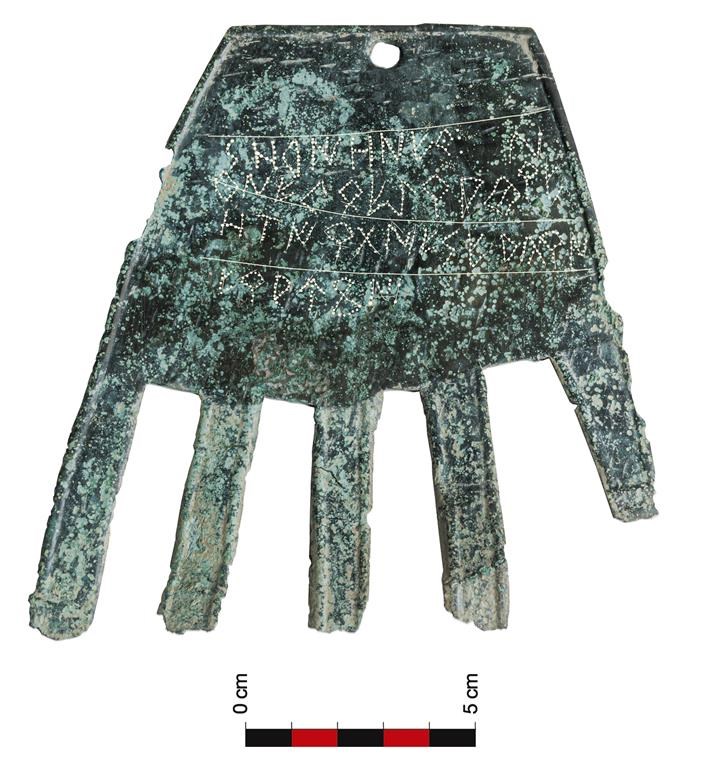
In this undated photo provided by Sociedad de Ciencias Aranzadi, a flat piece of bronze shaped like a human handis displayed in the Navarra region. Investigators in northern Spain believe they have discovered the oldest written record of a precursor of the Basque language, pushing back its earliest evidence to the first century B.C. The Aranzadi Science Society revealed the inscription found on a flat piece of bronze shaped like a human hand that archaeologists unearthed last year. Investigators believe it is the earliest known evidence of a written Vasconic language, the precursor of modern Basque, a minority language still spoken in parts of northern Spain and southwest France. It challenges the wide-held belief the Vascones started writing in their language after the introduction of the Latin script by Roman invaders. (Sociedad de Ciencias Aranzadi via AP)

The discovery could challenge linguists’ wide-held belief that the Vascones, an Iron Age tribe centered on territory that makes up Spain’s modern Navarra region, only started writing in their language after the introduction of the Latin script by Roman invaders.

“This piece completely changes what we thought until now about the Vascones and their writing,” said Joaquín Gorrochategui, professor of Indo-European Linguistics at the University of the Basque Country. “We were convinced that the Vascones didn’t know how to read or write in antiquity and only used script for minting coins.”

Archaeologists believe the hand, which they call “the hand of Irulegi” after the site where it was found at the foot of a medieval castle, was designed to hang on a door, likely as a amulet of protection.

So far, linguists have been able to translate only one of the words inscribed on it: “sorioneku,” which corresponds to the Basque word “zorioneku,” or “fortunate.”

Basque has survived for centuries despite ceding ground to Spanish and French. Several hundred thousand people are estimated to speak the language, also known as Euskara, mostly in the Spanish Basque Country and Navarra regions and across the Pyrenees in a small area of France.

It is considered by linguists to be a “language isolate,” meaning it has no known roots in other language groups.
Report Error Submit a Tip

More Stories

South Korea protests penalties assessed in short track

The Associated Press 3 minute read Preview

South Korea protests penalties assessed in short track

The Associated Press 3 minute read Tuesday, Feb. 8, 2022

Quebec City MP Joël Lightbound said Tuesday that governments shouldn’t dismiss the concerns of people who want health measures to be lifted.

Read
Tuesday, Feb. 8, 2022

WHO team in Wuhan departs quarantine for COVID origins study

Emily Wang Fujiyama, The Associated Press 5 minute read Preview

WHO team in Wuhan departs quarantine for COVID origins study

Emily Wang Fujiyama, The Associated Press 5 minute read Thursday, Jan. 28, 2021

WUHAN, China - A World Health Organization team emerged from quarantine in the Chinese city of Wuhan on Thursday to start field work in a fact-finding mission on the origins of the virus that caused the COVID-19 pandemic.

The researchers, who were required to isolate for 14 days after arriving in China, left their quarantine hotel with their luggage — including at least four yoga mats — in the midafternoon and headed to another hotel.

The mission has become politically charged, as China seeks to avoid blame for alleged missteps in its early response to the outbreak. A major question is where the Chinese side will allow the researchers to go and whom they will be able to talk to.

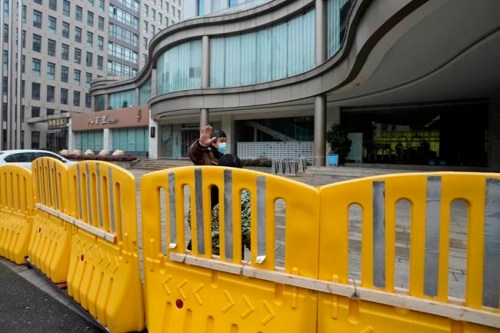
Yellow barriers blocked the entrance to the hotel, keeping the media at a distance. Before the researchers boarded their bus, workers wearing protective outfits and face shields could be seen loading their luggage, including two musical instruments and a dumbbell.

Read
Thursday, Jan. 28, 2021

Winnipeg Jets’ Hellebuyck wins Vezina Trophy

Mike McIntyre 7 minute read Preview

Winnipeg Jets’ Hellebuyck wins Vezina Trophy

Mike McIntyre 7 minute read Monday, Sep. 21, 2020

EDMONTON — There was no red carpet for Connor Hellebuyck to walk, no glitzy awards ceremony on the Vegas strip as is typically the case. Just a quiet steak dinner with family at his Michigan home Monday evening followed by a virtual announcement that his spectacular season had ended with a Vezina Trophy.

It may not have been as he dreamed it, thanks to COVID-19, but it didn’t dull the occasion one bit. The Winnipeg Jets star was named the NHL’s best goaltender in a ceremony prior to Game 2 of the Stanley Cup final.

“It was just one of those moments where I couldn’t believe that it actually happened. Everyone had a big smile on their face and they were all clapping. It was just a proud moment,” Hellebuyck said on a Zoom conference call shortly after the announcement was made.

It’s the first time a Jets netminder — from either the 1.0 or 2.0 eras — has won the award, and the first major individual trophy for any Jet since Teemu Selanne won the Calder for rookie of the year way back in 1993.

Read
Monday, Sep. 21, 2020

Gridlock by design: no excuses for bed backlog

Jason M. Sutherland 5 minute read 2:00 AM CDT

Imagine waking up in a hospital bed and being told by a doctor that you are well enough to leave, only to discover you cannot. Not because you want to stay, but because there is nowhere safe for you to go. No home-care support, no rehabilitation space, no long-term care bed.

This is unfortunately the daily reality for thousands of Canadians.

Being stuck in a hospital bed is a crisis from coast to coast. Our acute care hospitals are functioning as wildly expensive beds for vulnerable citizens awaiting a more suitable place to take them in.

A decade ago, policymakers fretted over this exact issue. Today, despite an aging population with increasingly complex needs and higher demand for hospital beds, the crisis has only deepened.

Surgery backlog, St. Boniface ER big-ticket items in health budget

Danielle Da Silva 5 minute read Preview

Surgery backlog, St. Boniface ER big-ticket items in health budget

Danielle Da Silva 5 minute read Tuesday, Apr. 12, 2022

The provincial government will spend more than $200 million this year to tackle the massive backlog of surgeries and expand emergency room capacity, while slashing its COVID-19 response budget.

Finance Minister Cameron Friesen said his government will spend a combined $7.2 billion to deliver health care, mental health and addictions services, a new seniors strategy and deliver promised improvements to long term care in 2022-23, representing a 2.5 per cent spending increase over last year.

The provincial budget, unveiled Tuesday, includes $9 million to fund 28 new critical care beds provincewide; $100 million for the redevelopment of the St. Boniface Hospital emergency department; and $110 million to expedite an estimated 167,000 surgical and diagnostic cases that were delayed due to the pandemic.

“Our government is very serious about driving down these times that were elongated as a consequence of a global pandemic,” Friesen said. “That’s why we’re putting a very significant effort into combating that.”

Read
Tuesday, Apr. 12, 2022

Netherlands Canada's top source for illicit meth shipments in 2018

Dylan Robertson 6 minute read Preview

Netherlands Canada's top source for illicit meth shipments in 2018

Dylan Robertson 6 minute read Monday, Mar. 9, 2020

OTTAWA — While Winnipeg was in the midst of its ongoing meth crisis in 2018, quantities of the drug were coming from an unexpected country, and through Canadians' most common mode of delivery.

According to documents obtained by the Free Press, there was an increase in "inbound seizures destined to Winnipeg addresses," of postal mail containing meth in 2018 from a year prior. "However, such shipments are likely for personal consumption,” as they were under 35 grams.

And though Canadian officials have called out meth smugglers in China and Mexico, the mailed drugs came from Europe.

"The Netherlands is the top transit country by number of seizures (of meth), while Mexico is the main transit country by quantity,” reads an internal Canada Border Services Agency report from mid-2018.

Read
Monday, Mar. 9, 2020