WHO plans to rename monkeypox over stigmatization concerns

Advertisement

Advertise with us

LONDON (AP) — The World Health Organization says it's holding an open forum to rename the disease monkeypox, after some critics raised concerns the name could be derogatory or have racist connotations.

Read this article for free:


or

Already have an account? Log in here »

To continue reading, please subscribe:

Subscribe and receive a limited-edition Free Press branded hat or tote.

Digital Subscription

One year of digital access for only $205*

  • Enjoy unlimited reading on winnipegfreepress.com
  • Read the E-Edition, our digital replica newspaper
  • Access News Break, our award-winning app
  • Play interactive puzzles

*First annual payment billed as $205.00 + GST for one year. This annual subscription will automatically renew at $233.00 + GST every 52 weeks (10% off the regular annual price of $259.35). Offer available to new and qualified returning subscribers only. Cancel any time.

To continue reading, please subscribe:

Add Free Press access to your Brandon Sun subscription for only an additional

$1 for the first 4 weeks*

  • Enjoy unlimited reading on winnipegfreepress.com
  • Read the E-Edition, our digital replica newspaper
  • Access News Break, our award-winning app
  • Play interactive puzzles
Start now

*Your next Brandon Sun subscription payment will increase by $1.00 and you will be charged $17.95 plus GST for four weeks. After four weeks, your payment will increase to $24.95 plus GST every four weeks.

Hey there, time traveller!
This article was published 12/08/2022 (1466 days ago), so information in it may no longer be current.

LONDON (AP) — The World Health Organization says it’s holding an open forum to rename the disease monkeypox, after some critics raised concerns the name could be derogatory or have racist connotations.

In a statement Friday, the U.N. health agency said it has also renamed two families, or clades, of the virus, using Roman numerals instead of geographic areas, to avoid stigmatization. The version of the disease formerly known as the Congo Basin will now be known as Clade one or I and the West Africa clade will be known as Clade two or II.

WHO said the decision was made following a meeting of scientists this week and in line with current best practices for naming diseases, which aims to “avoid causing offense to any cultural, social, national, regional, professional, or ethnic groups, and minimize any negative impact on trade, travel, tourism or animal welfare.”
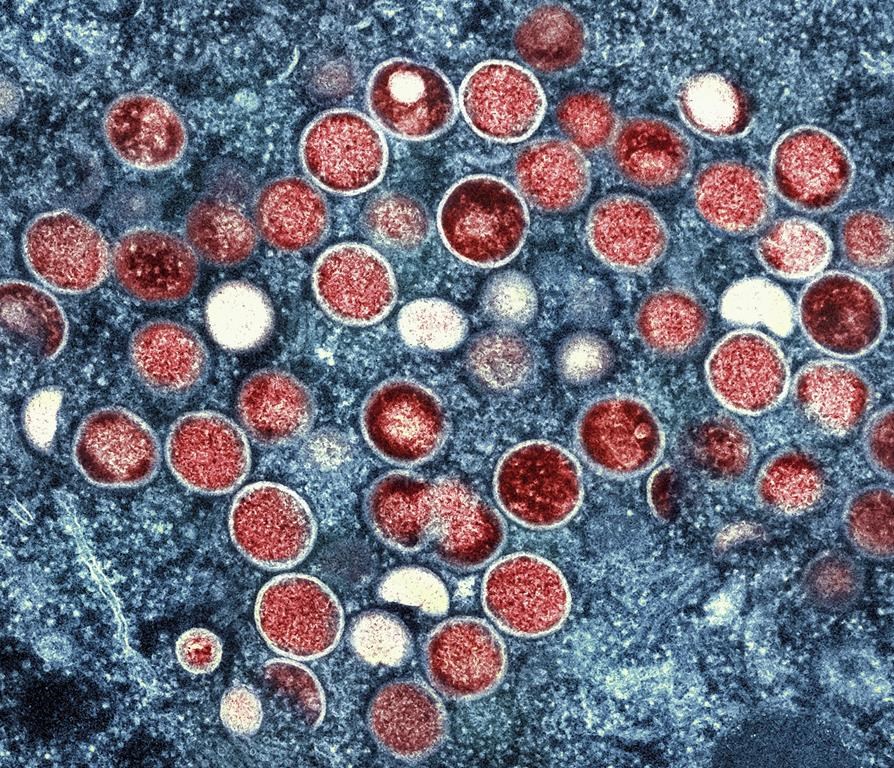
FILE - This image provided by the National Institute of Allergy and Infectious Diseases (NIAID) shows a colorized transmission electron micrograph of monkeypox particles (red) found within an infected cell (blue), cultured in the laboratory that was captured and color-enhanced at the NIAID Integrated Research Facility (IRF) in Fort Detrick, Md. On Friday, Aug. 12, 2022, The Associated Press reported on stories circulating online incorrectly claiming that monkeypox hasn't been detected in Georgia drinking water. The July 26 Atlanta-area news broadcast broadcast is being mischaracterized online to push the false claim that monkeypox has been found in residents’ tap water. (NIAID via AP)

Numerous other diseases, including Japanese encephalitis, Marburg virus, Spanish influenza and Middle Eastern Respiratory Syndrome have been named after the geographic areas where they first arose or were identified. WHO has not publicly suggested changing any of those names.

Monkeypox was first named in 1958 when research monkeys in Denmark were observed to have a “pox-like” disease, although they are not thought to be the animal reservoir.

WHO said it was also opening a way for the public to suggest new names for monkeypox, but did not say when any new name would be announced.

To date, there have been more than 31,000 cases of monkeypox identified globally since May, with the majority of those beyond Africa. Monkeypox has been endemic in parts of central and west Africa for decades and was not known to trigger large outbreaks beyond the continent until May.

WHO declared the global spread of monkeypox to be an international emergency in July and the U.S. declared its own epidemic to be a national emergency earlier this month.

Outside of Africa, 98% of cases are in men who have sex with men. With only a limited global supply of vaccines, authorities are racing to stop monkeypox before it becomes entrenched as a new disease.

Report Error Submit a Tip

More Stories

Must-see Folk Fest workshops

16 minute read Preview

Must-see Folk Fest workshops

16 minute read Thursday, Jul. 5, 2018

Workshops have always been an integral part of the Winnipeg Folk Festival.

They are magic-moment makers; a curated group of musicians — sometimes friends, sometimes strangers — on one stage playing together, supporting each other, creating something that will only exist for an hour or two. No one knows what will come out of the collaboration, but usually it’s something special.

When the Free Press spoke to Winnipeg Folk Festival artistic director Chris Frayer ahead of the lineup release in early March, he noted he would be paying some extra attention to workshops this year, as some of the special projects occurring during the past couple of festivals had pulled some of his attention away.

And with 37 workshops on the books, it would seem he followed through on his promise.

Read
Thursday, Jul. 5, 2018

MGEU resorts to arbitration for 12,000 civil servants

Dan Lett 6 minute read Preview

MGEU resorts to arbitration for 12,000 civil servants

Dan Lett 6 minute read Friday, Jul. 26, 2019

The Manitoba Government and General Employees’ Union filed for arbitration this week, alleging provincial negotiators have refused to make a definitive offer on wages or discuss any non-monetary issues.

Read
Friday, Jul. 26, 2019

WRHA directs three care homes to accommodate surge of hospital patients

Malak Abas 5 minute read Preview

WRHA directs three care homes to accommodate surge of hospital patients

Malak Abas 5 minute read Friday, Aug. 14, 2026

The Winnipeg Regional Health Authority has directed three long-term care centres to make space for hospital patients, citing “exceptionally high demand for care across the health-care system.”

“Riverview Health Centre, Deer Lodge Centre and Misericordia Health Centre have been asked to identify additional temporary capacity for patients who no longer require an acute-care hospital bed but continue to need an appropriate level of care before they can transition to their next care setting,” a WRHA spokesperson told the Free Press Thursday.

“This whole-of-system response will help create additional capacity in acute-care hospitals, supporting patient flow and timely access to emergency departments and other hospital services.”

The spokesperson described the measures as part of “standard surge protocol,” atypical and temporary, but did not provide a timeline of how long patients would be staying at the health-care centres.

Read
Friday, Aug. 14, 2026

Former MLA Kevin Chief opens up about his 18 years of sobriety

Katie May 14 minute read Preview

Former MLA Kevin Chief opens up about his 18 years of sobriety

Katie May 14 minute read Saturday, May. 30, 2020

Every day starts and ends with a prayer.

In the morning, Kevin Chief asks for the strength and courage to stay sober. At night, he thanks the Creator for another day of sobriety. It’s been 18 years since his last drink. Staying sober is still the most important thing to him.

“You’d have to be pretty close to me to know. And there are people today who know me very well that don’t know,” the 45-year-old father of three says.

“I never meant it to be like that. The anonymity was important to me because I honestly thought I wouldn’t make it, and I thought it’d be embarrassing when I slipped again. So I thought it was better for me to not let people know. And then my sponsor told me, ‘Look, you’ll know when the time’s right. You don’t need to force it.’”

Read
Saturday, May. 30, 2020

A voice from within the shelter

Melissa Martin 8 minute read Preview

A voice from within the shelter

Melissa Martin 8 minute read Thursday, Jun. 23, 2022

On a sticky-hot evening, the bus shacks of Winnipeg sit mostly empty, void both of people waiting for the bus and of people who find under their roofs a sheltered, if not entirely comfortable, place to stay. For all the words about the latter groups that have spackled the news as of late, there are few out tonight. Not on Regent, or Pembina, or Osborne, or North Main. 

There is one person. In a shelter at the awkward intersection where Marion Street and St. Mary’s Road meet, Samantha Thomas sits on the bench, arranging containers of soup. Soon, she’ll pack her cart with all her things — a tent, some blankets, a thrift store Bible — and head south to find a quieter shack to bunk in for the night. 

“I do this every day, back and forth,” she says. “When nighttime comes, I’ll go sleep in St. Vital. It’s actually scary over there, because I’m all alone in the bus shelter and everybody’s gone. I can’t believe I stay out there by myself, but when you’re tired, you’re tired.” 

This bus shelter is already in bad condition. Two of the wall panels have been smashed out; Thomas, 27, was sleeping when it happened. She didn’t even know that it had been busted until the cops came, and she woke up to find the shack inundated by rain.

Read
Thursday, Jun. 23, 2022

Truck driver blew stop sign in Broncos crash

Chris Purdy and Bill Graveland, The Canadian Press 5 minute read Preview

Truck driver blew stop sign in Broncos crash

Chris Purdy and Bill Graveland, The Canadian Press 5 minute read Monday, Jan. 28, 2019

MELFORT, Sask. - Grieving families sobbed Monday as they heard how a semi-truck driver barrelled through an oversized stop sign with a flashing red light and failed to avoid a high-speed crash with a bus carrying the Humboldt Broncos junior hockey team.

An agreed statement of facts about the collision that killed 16 people on the bus and injured 13 more was entered in a Saskatchewan court as part of a heart-wrenching first day of a sentencing hearing for the truck driver. Roughly half of 75 victim impact statements to be submitted by friends and family members were read out.

Jaskirat Singh Sidhu, 30, of Calgary, sat next to his defence lawyers as court heard he was going between 86 and 96 km/h with a load of peat moss when he drove into a rural intersection north of Tisdale last April.

The sun wasn't in his eyes. He wasn't distracted by a cellphone. And he hadn't been drinking or doing drugs. Weather and road conditions were also good, said Crown prosecutor Thomas Healey.

Read
Monday, Jan. 28, 2019