Prayers and tears: Scenes from the Pope’s apology for residential schools

Advertisement

Advertise with us

MASKWACIS - For minutes Pope Francis sat in his wheelchair, staring at hand-painted crosses marking graves.

Read this article for free:


or

Already have an account? Log in here »

To continue reading, please subscribe:

Subscribe and receive a limited-edition Free Press branded hat or tote.

Digital Subscription

One year of digital access for only $205*

  • Enjoy unlimited reading on winnipegfreepress.com
  • Read the E-Edition, our digital replica newspaper
  • Access News Break, our award-winning app
  • Play interactive puzzles

*First annual payment billed as $205.00 + GST for one year. This annual subscription will automatically renew at $233.00 + GST every 52 weeks (10% off the regular annual price of $259.35). Offer available to new and qualified returning subscribers only. Cancel any time.

To continue reading, please subscribe:

Add Free Press access to your Brandon Sun subscription for only an additional

$1 for the first 4 weeks*

  • Enjoy unlimited reading on winnipegfreepress.com
  • Read the E-Edition, our digital replica newspaper
  • Access News Break, our award-winning app
  • Play interactive puzzles
Start now

*Your next Brandon Sun subscription payment will increase by $1.00 and you will be charged $17.95 plus GST for four weeks. After four weeks, your payment will increase to $24.95 plus GST every four weeks.

Hey there, time traveller!
This article was published 25/07/2022 (1536 days ago), so information in it may no longer be current.

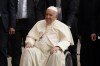
MASKWACIS – For minutes Pope Francis sat in his wheelchair, staring at hand-painted crosses marking graves.

A helicopter whirled in the grey sky in the distance. Camera shutters clicked. Otherwise, there was silence.

The 85-year-old pontiff had travelled halfway around the world, on a plane full of officials and international media, to get to Maskwacis, Alta., on Monday.
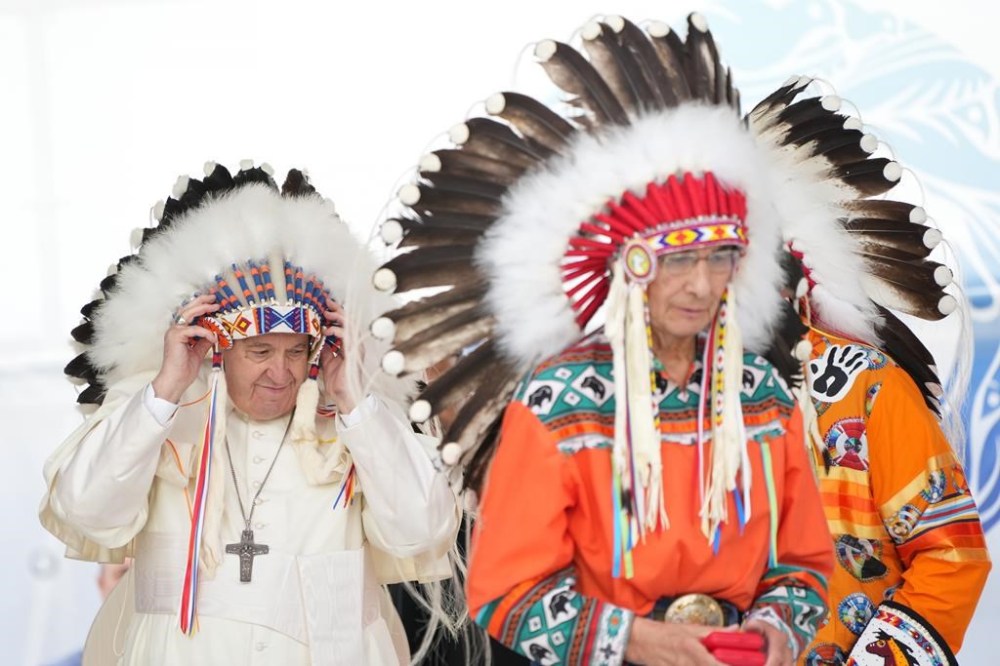
Pope Francis adjusts a traditional headdress he was given after his apology to Indigenous people during a ceremony in Maskwacis, Alta., as part of his papal visit across Canada on Monday, July 25, 2022. THE CANADIAN PRESS/Nathan Denette

Near the cemetery, thousands, including the prime minister, the Governor General, chiefs and residential school survivors from across the country, waited to hear his long-anticipated apology on Canadian soil.

Security was tight. Some officers wearing camouflage could be seen on nearby rooftops holding binoculars.

Children chased each other across the grass. Women sat wearing coloured ribbon skirts. Some elders shuffled around with canes, others sat in wheelchairs with blankets tucked around their laps.

Mental health workers passed out bottles of water, bagged lunches and information cards. Some walked around with burning sage.

A 40-metre-long red banner also weaved through the crowd. Listed on it the names of 4,120 children who died in residential schools.

But for those few moments at the cemetery, Francis sat alone, his head down, his hands clutched in prayer. He made the sign of the cross. Then he was ready.

He did not get into his specially designed popemobile for the trip down the road to a large, circular arbour at the community’s powwow grounds where the crowd was gathered.

Instead, he was pushed by an aide, his white cassock flapping in the breeze.

Jon Crier, a residential school survivor, said that before the arbour was built, a wagon trail stretched through the field. He said some parents regularly camped overnight on the bumpy ground so they could wave at their children who were attending the nearby residential school.

Drumming and Indigenous song echoed through Maskwa Park as the Pope got on a stage.

Before the crowd, Francis said, in Spanish, “I’m sorry.”

His cadence was slow.

“I humbly beg forgiveness for the evil committed by so many Christians against the Indigenous Peoples.”

Several times during his address, there was applause. Some cheered. Others held their heads and wiped tears from their eyes. Some listened to the Pope as they embraced the person next to them.

After it concluded, one woman, crying, sung out an impassioned “O Canada” in Cree. In her language, she thanked the Pope for coming and said it was an opportunity for Francis to understand Indigenous Peoples are knowledge keepers of the land.

Another person yelled for the Pope to renounce the Doctrine of Discovery, a legal principle connected to colonization and something many have asked Francis to do.

Gladys Charles and her husband travelled from Prince Albert, Sask., to hear the apology. They were overwhelmed.

“The apology was so touching and we know he said it from his heart,” she said, as Mathew, a survivor, held back a stream of tears with a tissue.

Marie-Anne Day Walker-Pelletier, a retired chief of Okanese First Nation in Saskatchewan, walked up the stage to see Francis, and he gave her a box. Inside, a pair of children’s moccasins — the same slippers she had given him in Rome in March with a plea that he return them on his pilgrimage in Canada.

The Pope said the moccasins kept alive his “sorrow, indignation and shame” over the last few months and symbolize the path forward for healing and reconciliation.

Many crowded the stage, hoping for a brief moment with the pontiff.

Chief Wilton Littlechild walked up a set of stairs holding an elaborate traditional headdress.

He placed it gently on the Pope’s head, its feathers cascading down the sides of the pontiff’s face, while a drummer pounded the steady beat of an honour song. Francis’s face briefly lit up — one of the few times he smiled during the solemn event.

Crier said the gesture honours the Pope for the work he has done.

It was a powerful image, said Sandi Harper, who travelled from Saskatoon for her mother, who went to residential school in Duck Lake.

“This is a step toward healing for many people who are suffering and who are in pain,” she said.

“I think this is one of the biggest steps toward reconciliation.”

This report by The Canadian Press was first published July 25, 2022.

— with files from Kelly Geraldine Malone in Winnipeg.

Note to readers: This is a corrected story. A previous version said the event was held Tuesday.

Report Error Submit a Tip

The Free Press acknowledges the financial support it receives from members of the city’s faith community, which makes our coverage of religion possible.
More Stories

Michael Douglas comes to terms with fears, fame, father

Hillel Italie 6 minute read Preview

Michael Douglas comes to terms with fears, fame, father

Hillel Italie 6 minute read Yesterday at 2:01 AM CDT

NEW YORK — Michael Douglas, the award-winning actor and producer, recently turned 82. He is a cancer survivor, a recovered addict, a married man, the father and son of actors.

He is also an author, who begins his memoir with a message of thanks to his family — past and present and future — for the “sense of immortality.”

“Many times my father was asked, ‘Kirk, are you jealous of your son?’” he said during a recent interview at a Manhattan hotel, referring to his late father, fellow actor and sometime combatant Kirk Douglas.

“And he said, ‘Jealous?’ This is a sense of immortality, a continuity of generations.’”

Read
Yesterday at 2:01 AM CDT

Prayers and tears: Scenes from the Pope’s apology for residential schools

Brittany Hobson and Fakiha Baig, The Canadian Press 5 minute read Preview

Prayers and tears: Scenes from the Pope’s apology for residential schools

Brittany Hobson and Fakiha Baig, The Canadian Press 5 minute read Monday, Jul. 25, 2022

MASKWACIS - For minutes Pope Francis sat in his wheelchair, staring at hand-painted crosses marking graves.

A helicopter whirled in the grey sky in the distance. Camera shutters clicked. Otherwise, there was silence.

The 85-year-old pontiff had travelled halfway around the world, on a plane full of officials and international media, to get to Maskwacis, Alta., on Monday.

Near the cemetery, thousands, including the prime minister, the Governor General, chiefs and residential school survivors from across the country, waited to hear his long-anticipated apology on Canadian soil.

Read
Monday, Jul. 25, 2022

War veteran helped build Rivercrest

Bill Redekop 6 minute read Saturday, Mar. 30, 2019

As one of the original homeowners in Rivercrest, a subdivision north of Winnipeg set aside for war veterans in 1946, and the very last of them to leave at age 101, Art Christensen embodied neighbourhood-building.

He volunteered with the construction of the Rivercrest United Church, Rivercrest Community Club, West St. Paul Curling Club, and West St. Paul Fire Hall.

He went on to serve as West St. Paul councillor for 10 years, and then as reeve for 11.

Christensen was even a bit of a social convener.

Kids deserve better

Jordan Laidlaw 4 minute read 2:00 AM CDT

As much as I cling to hope, I recognize the ominous circumstances and questionable future that our young people stand to inherit.

Youth are navigating a world plagued with the existential dangers of climate change, artificial intelligence, political polarization and rising military armament, among other disconcerting trends. While schools cannot entirely ameliorate these issues, I am inspired by the words of Amina Mohammed, the United Nations deputy secretary-general, who declared teachers to be the “guardians of our future.”

Our future integrally depends on the learning, healthy development and empowerment of young people. With the upcoming Manitoba school board elections, I invite readers, voters and prospective candidates to consider how to support the practices of these guardians so we may ensure a brighter tomorrow.

First, I believe we are in — or entering — a community mental-health crisis. There is a resounding body of peer-reviewed research outlining the declining trends in the mental health of youth, parents and teachers. In May 2026, Doctors Manitoba stated its concern that the technology consumption habits of youth rivalled the health detriments of drinking and smoking. Many parents are stressed, economically struggling and need assistance. How might schools mitigate these precarious developments?

Massive challenges in the media landscape have not altered the enduring Free Press mission

Melissa Martin  6 minute read Preview

Massive challenges in the media landscape have not altered the enduring Free Press mission

Melissa Martin  6 minute read Thursday, Oct. 4, 2018

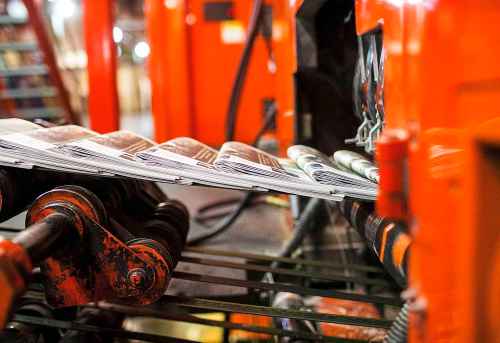
You never forget the first time you see the newspaper presses, these vast mechanical maws roaring like jet engines, gobbling up raw newsprint and transforming it into something to be held and opened and savoured. 

The sound seems to fill up your ears, your lungs, your bones. A working song, mechanical, magnificent. 

The sadness is that one day, those presses will probably fall silent. There’s no telling exactly when. Only that the march to digitize our culture is not slowing, and someday all the news there is to read will wink out from a screen.

When the presses fall silent, so too will the small pleasures of many consecutive generations. The mingling smells of ink and coffee; the sound of sparrow song, accompanied by the rustle of a morning paper; and the feel of it all. 

Read
Thursday, Oct. 4, 2018

Time for true count of COVID-related deaths

Dan Lett 5 minute read Preview

Time for true count of COVID-related deaths

Dan Lett 5 minute read Thursday, May. 5, 2022

It has often been said the first step in solving a problem is to admit you have one. If that’s true, governments around the world are moving further and further away from finding a solution to the challenge of global pandemics.

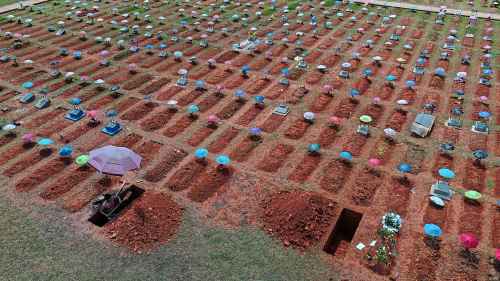
How can we both assess the response to date and plan the response to future pandemics if we cannot agree on how many people have died from COVID-19?

The death toll has been one of the stickier points of contention between medical and scientific experts, political leaders and governments — and that segment of the population that disputes the idea COVID-19 poses any significant threat.

The expert group tends to believe deaths are under-reported; governments that seek to evade accountability for their shortcomings and the COVID-19 deniers say they are overstated.

Read
Thursday, May. 5, 2022