Pope sorry for forced assimilation of Indigenous people at residential schools
Advertisement
Read this article for free:
or
Already have an account? Log in here »
To continue reading, please subscribe:
Digital Subscription
One year of digital access for only $1.44 a week*
- Enjoy unlimited reading on winnipegfreepress.com
- Read the E-Edition, our digital replica newspaper
- Access News Break, our award-winning app
- Play interactive puzzles
*Billed as $5.77 plus GST every four weeks. After 52 weeks, price increases to the regular rate of $19.95 plus GST every four weeks. Offer available to new and qualified returning subscribers only. Cancel any time.
To continue reading, please subscribe:
Add Free Press access to your Brandon Sun subscription for only an additional
$1 for the first 4 weeks*
- Enjoy unlimited reading on winnipegfreepress.com
- Read the E-Edition, our digital replica newspaper
- Access News Break, our award-winning app
- Play interactive puzzles
*Your next Brandon Sun subscription payment will increase by $1.00 and you will be charged $17.95 plus GST for four weeks. After four weeks, your payment will increase to $24.95 plus GST every four weeks.
Read unlimited articles for free today:
or
Already have an account? Log in here »
Hey there, time traveller!
This article was published 25/07/2022 (1544 days ago), so information in it may no longer be current.
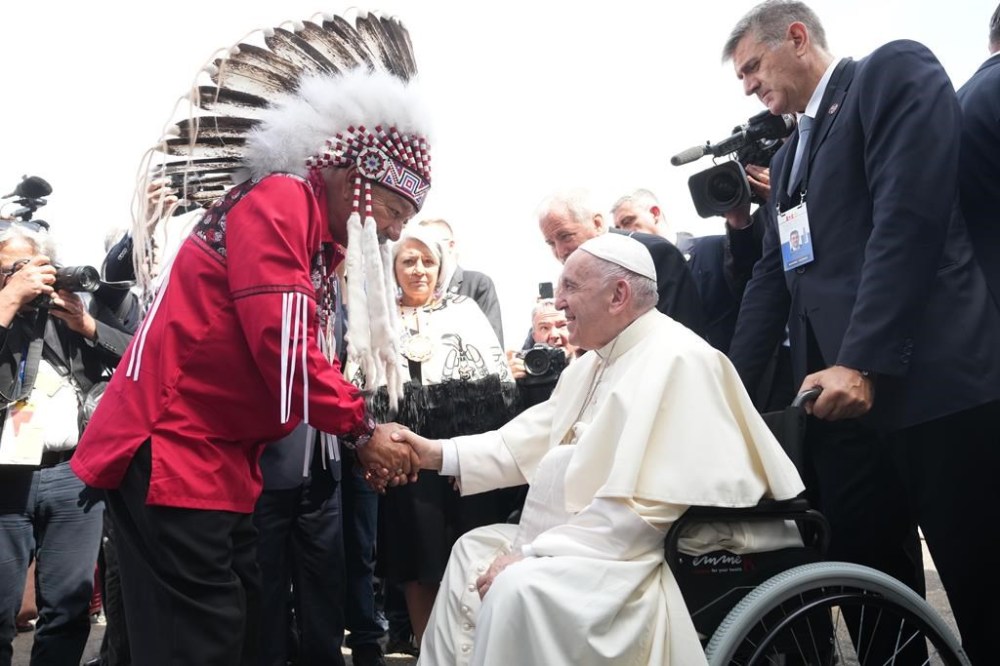
MASKWACIS – Tears streamed down the faces of Indigenous elders and survivors of residential schools as Pope Francis stood before them and begged forgiveness for the “deplorable evil” committed by members the Roman Catholic Church.
Francis, at his first public appearance in Canada in Maskwacis, Alta., said he was sorry the church took part in the cultural destruction and forced assimilation of Indigenous people.
“In the face of this deplorable evil, the church kneels before God and implores his forgiveness for the sins of her children … I humbly beg forgiveness for the evil committed by so many Christians against the Indigenous Peoples,” Francis said Monday through a translator at the community’s powwow grounds.
It was an apology that Evelyn Korkmaz, a survivor of the St. Anne’s Indian Residential School in Ontario, had waited 50 years to hear,but she was left wanting more.
“Part of me is rejoiced. Part of me sad. Part of me is numb,” she said.
“I am glad I lived long enough to have witnessed this apology.”
Francis also received applause and cheers from many in the crowd of thousands as he said he felt sorrow, indignation and shame. Others sat in contemplation with their eyes closed when the pontiff said the actions of the church were a “disastrous error incompatible with the gospel of Jesus Christ.”
Francis asked for forgiveness, in particular, for “the ways in which many members of the church and of religious communities co-operated, not least through their indifference, in projects of cultural destruction and forced assimilation promoted by the governments of that time, which culminated in the system of residential schools.”
The Pope spoke in Spanish, his first language, and it was translated into English by a priest. Translations were also available in several Indigenous languages.
He said begging forgiveness is the first step and there must be a serious investigation into what took place. He also called the overall effects of the policies linked to residential schools “catastrophic.”
Following his apology, Francis returned a pair of moccasins to Marie-Anne Day Walker-Pelletier, a retired chief of Okanese First Nation in Saskatchewan.
She had given the children’s moccasins to the Pope when an Indigenous delegation visited Rome earlier this year. They were meant to represent children who never came home from residential schools and she had told the pontiff she expected him to return them when he came to apologize on Canadian soil.
An estimated 150,000 Indigenous children were forced to attend residential schools in Canada, where neglect and physical and sexual abuse were rampant. More than 60 per cent of the schools were run by the Catholic Church.
Eileen Clearsky from Waywayseecappo First Nation in Manitoba held photos of her mother and father during the Pope’s address. She said she wanted to honour her parents, who were both survivors, and to find healing for her family.
“It’s been a long journey to find out who we are because of the legacy that residential school has left behind for us to deal with,” Clearsky said.
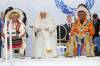
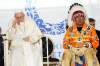
Chief Wilton Littlechild gave Francis a headdress. The former member of the Truth and Reconciliation Commission attended residential schools for 14 years as a child in Alberta.
He said he hopes the Pope’s visit furthers a pathway of justice, healing, reconciliation and hope.
Jon Crier, a residential school survivor, questioned whether the Pope’s apology is enough. He said the church must now respond by laying out a plan to repair its relationship with Indigenous people.
Treaty 6 Grand Chief George Arcand Jr. said the Pope’s apology felt genuine but action around his words is needed.
Minister of Crown-Indigenous Relations Marc Miller said the apology must be “the beginning and not the end.” He said more work must be done, including getting documents from the Catholic Church.
Earlier in the day, Francis held his own face as he was brought in a wheelchair to a graveyard in Maskwacis. Organizers said there are likely remains of residential school students among the graves.
The Ermineskin Indian Residential School was one of the largest residential schools in the country. Five teepees were set up at the location for the Pope’s visit — four representing the nations of the land and the fifth as a symbol of the entrance to the former school.
Later Monday, Francis echoed his comments of sorrow to members of the Church of Sacred Heart in Edmonton’s inner city.
“May this never happen again in the Church,” the Pope said. “May Jesus be preached as he desires, in freedom and charity.”
The century-old church blends Catholic and Indigenous rituals. The pontiff sat in a chair placed at the front of the church under wooden teepee poles.
Francis also blessed a statue of Kateri Tekakwitha, the first Indigenous person to be canonized as a saint. He held the hands of elders, touching some on the head, as he was wheeled out.
Later in the week, the Pope is scheduled to host a large outdoor mass at the city’s football stadium and take part in a pilgrimage in nearby Lac Ste. Anne, before travelling to Quebec City and Iqaluit.

The Indian Residential Schools Resolution Health Support Program has a hotline to help residential school survivors and their relatives suffering trauma invoked by the recall of past abuse. The number is 1-866-925-4419.
This report by The Canadian Press was first published July 25, 2022.
— With files from Kelly Geraldine Malone in Winnipeg
—
This story was produced with the financial assistance of the Meta and Canadian Press News Fellowship.
Related Articles
'Deplorable evil': Full text of the Pope's residential school apology
Advertisement Advertise With Us
Advertisement Advertise With Us
The Free Press acknowledges the financial support it receives from members of the city’s faith community, which makes our coverage of religion possible.